Canada News
Changes are coming to Ontario’s kindergarten program — what parents and caregivers need to know

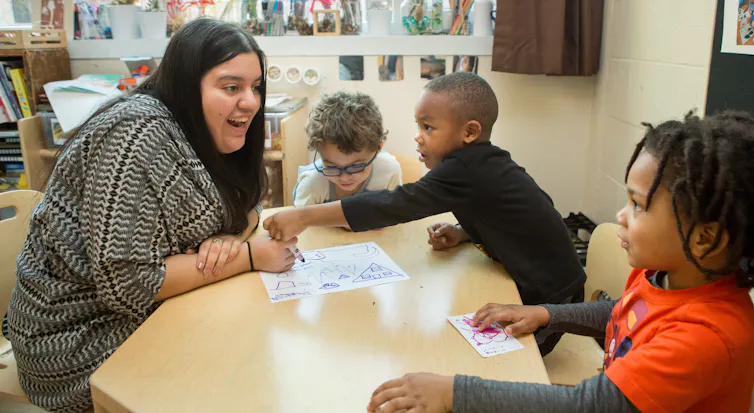
(Allison Shelley/The Verbatim Agency for EDUimages), CC BY-NC
Ontario Education Minister Stephen Lecce recently announced Ontario’s full-day kindergarten program is undergoing an “overhaul” which will help “to create more systemic approaches to reading instruction and the introduction, in a very basic way, of mathematical skills and numeracy skills.”
What do these proposed changes mean for educators, parents and children?
The proposed revisions must be considered and understood in the context of 1) the current full-day play-based kindergarten curriculum, and 2) recommendations and research that emerged from Ontario’s Right to Read report, released in February 2022, stemming from an inquiry of the Ontario Human Rights Commission (OHRC).
The Right to Read inquiry revealed Ontario’s public education system was not using evidence-based approaches to teach children with reading disabilities (and others) how to read. The education minister also said curricular updates are in keeping with the Right to Read report’s recommendations.
While the province says kindergarten updates will be combined with “hands-on and play-based learning” there are concerns that play-based aspects of the curriculum — also grounded in evidence-based approaches to child development — could be impacted by curricular revisions.
Teaching reading isn’t basic
The “back to basics” language used in the province’s kindergarten announcement is intentionally and strategically tied to Premier Doug Ford’s promise in his election campaign and is a slogan that Ford (and his team) have continued to use since becoming premier.
It is not surprising that this political strategy is being used to market updates to the kindergarten program.
However, this language distracts from the importance of continuously updating and revising curriculum across the kindergarten to Grade 12 education sector.
It’s also important to note that the phrase “basics” is contradictory to what we know about the science of reading: teaching reading is anything but basic and involves understanding reading psychology and development, understanding language structure, applying evidence-based practices and using validated and reliable assessments to inform teaching.
Ontario’s full-day play-based kindergarten
The current kindergarten curriculum has been in effect following a 2010 public policy shift. Based on recommendations from Ontario’s special advisor on early learning, in 2010 Ontario began phasing in full-day play-based kindergarten for all four- and five-year old children.
This shift was also informed by interviews, focus groups and published scientific research on early learning.
Essential to the revised kindergarten program was the play-based structure of the full-day program. So was the delivery of the model by a teaching team of an Ontario certified teacher and a registered early childhood educator.
Decisions to revise the earlier half-day kindergarten program acknowledged and leveraged research on the value of play and its role in supporting academic, social and emotional development.
It is important to note that misconceptions exist about play-based learning, including the belief that play-based learning means letting children do whatever they want. Evidence-based play-based learning “…involves educators being deliberate and purposeful in creating play-based learning environments.”
Furthermore, play is a basic human right of all children as recognized in the United Nations Convention on the Rights of the Child. The revised play-based model in Ontario had (and continues to have) both empirical and philosophical grounds.
The OHRC Right to Read report
Changes to the above model are now being made in response to recommendations from the Right to Read inquiry.
The inquiry’s report includes 157 recommendations directly tied to addressing systemic issues affecting children’s right to read. These involve changes to curriculum, instruction and interventions and screening and assessments related to reading. The recommendations for curriculum and instruction focus on the need for evidence-based direct and explicit instruction.
These recommendations were made based on the most up-to-date research on reading, lived experiences of students, families and educators and informed by expertise in the area of human rights.
The Right to Read report states: “Implementing the OHRC’s recommendations will ensure more equitable opportunities and outcomes for students in Ontario’s public education system.”
In keeping with prior revisions to the Ontario Kindergarten program, current plans to update kindergarten curriculum are being made based on empirical and philosophical grounds.
Not an either/or conversation
As revisions to Ontario’s kindergarten curriculum unfold, stakeholders need to ensure the best scientific research in both play-based learning and early reading are leveraged to ensure the success of all young children.
The beauty is that play-based learning is not an all-or-nothing approach. Drawing on the benefits of playful learning and using these strategies in combination with evidence-based direct instructional practices in kindergarten will be essential to successfully integrating proposed revisions.
There are many educators in Ontario who already offer meaningful play-based learning opportunities and direct and systematic instruction in their classrooms.
This is evidenced in research published in 2016 by early childhood researchers Angela Pyle and Erica Danniels and also in follow-up research by Pyle and colleagues in 2018 which focused on how play and literacy interface in full-day kindergarten classrooms.
My current research in kindergarten classrooms, to be published later this year, examines how educators use a range of approaches (including teacher-directed play) to support children’s literacy and self-regulation outcomes. This research has, to date, also documented kindergarten educators using systematic instruction in combination with play-based learning.
Educators need development, resources
What’s needed is to ensure kindergarten educators are being provided with training and professional development to effectively lead classrooms utilizing both play-based learning and systematic instruction in reading, writing and math. This task is anything from basic — but is 100 per cent possible and necessary.
As curricular revisions are made, we must ask:
- Who are the stakeholders that are being invited to make the revisions to the curriculum?
- Who is missing from the conversations?
- What research is being used?
- What type of training will be provided to educators?
- Will this training include a focus on what it means to teach in evidence-based ways — and how to do so?
- Will policymakers consider class size and sufficient resourcing for teachers so all students have the classroom supports required to ensure these changes will have real impact?
In updating a curriculum, we cannot merely add additional content for educators to cover each day.
Instead, we need to consider what these changes mean and how we can best support educators in successfully supporting children’s learning — through both play-based learning and direct instruction.
Kristy Timmons, Associate Professor, Early Childhood Education, Queen’s University, Ontario
This article is republished from The Conversation under a Creative Commons license. Read the original article.