
News
Two charts that reveal a key weakness in Trump’s reelection bid

All US presidential elections are different, but a renewed contest between Joe Biden and Trump is rather unusual. (File Photo: Gage Skidmore/Flickr, CC BY-SA 2.0 DEED)
Donald Trump’s win in New Hampshire’s Republican primary on January 23, a week after his decisive victory in the Iowa caucuses, means that he is almost certain to be the Republican nominee for the US presidential election in November 2024. All US presidential elections are different, but a renewed contest between Joe Biden and Trump is rather unusual.
It is rare for the same candidates to be nominated by their parties to run on two separate occasions. The last time it happened was in 1956, when the Republican president, Dwight Eisenhower, defeated Democrat Adlai Stevenson for the second time in a row.
American politics is currently very polarised in a way that was not true in the past. One source of this division is political ideology, which research shows plays a central role in defining people’s political identities.
A large proportion of Americans identify themselves as liberals or conservatives. People look favourably on those who share their ideological views, regarding them as “insiders”, while at the same time looking unfavourably on “outsiders” in the opposite camp.
The 2020 and 2024 elections have a lot in common, so we can use data from the 2020 American National Election Study to explore the likely role ideology will play in the contest in November.
Ideological appeal
The 2020 study surveyed more than 8,000 Americans both before and after the election. Respondents were asked a variety of questions about their participation in politics, their attitudes to issues and candidates, and their voting behaviour.
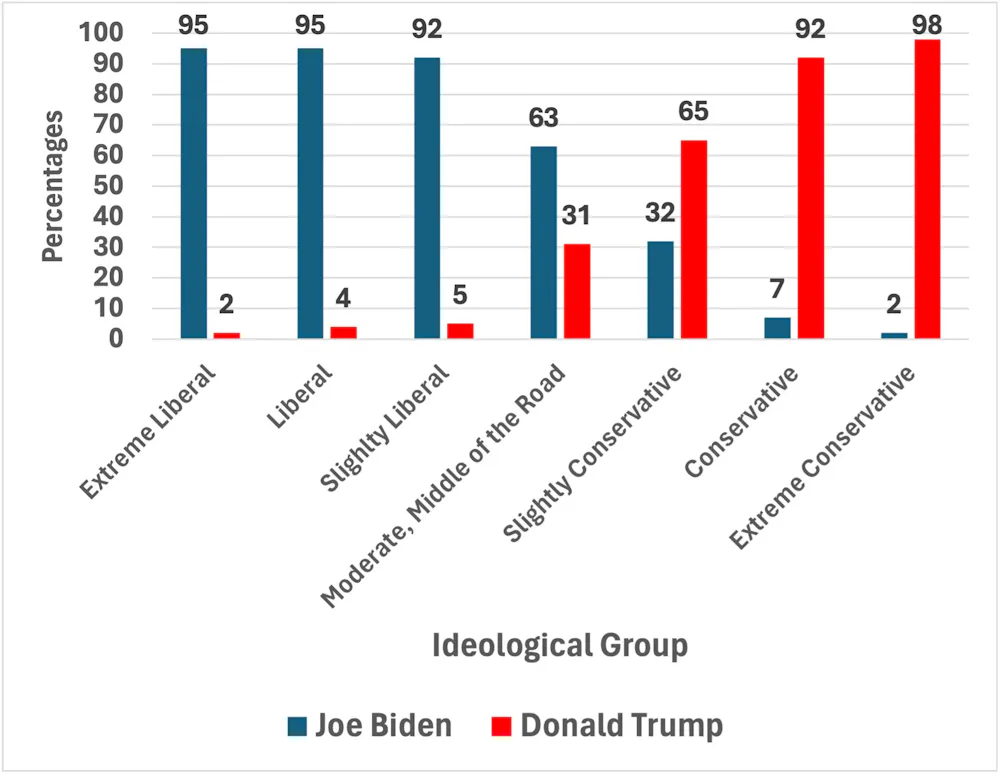
One question asked respondents to identify the ideological group they thought they belonged to using a seven-point scale. The scale, shown in the chart below, varies from “extreme liberal” to “extreme conservative” with a midpoint category of “moderate, middle-of-the-road” voters.
Voting and political ideology in the 2020 US presidential election
American National Election Study (2020), CC BY-NC-SA
The chart identifies the relationship between ideology and voting for the two candidates. The relationship was very strong, with 95% of extreme liberals voting for Biden, and 98% of extreme conservatives voting for Trump.
If we combine the three categories of liberal, this consisted of 33% of all respondents. If we do the same for conservatives, it made up 40%. The middle-of-the-roaders comprised 27%.
At first sight, it looks like Trump had a clear advantage over his rival because there were more conservatives than liberals. Why, then, did Biden win the contest? Because he was supported by 94% of all liberals, whereas Trump was supported by 84% of conservatives.
What let Trump down was the fact that only 31% of moderates and 65% of the “slightly conservative” group supported him. In contrast, Biden took 92% of the “slightly liberal” respondents and 63% of the middle-of-the-roaders.
Clearly, Biden’s ideological appeal was significantly broader than Trump’s in the contest. This suggests that, while Trump’s abusive “take no prisoners” style of campaigning – employed against both Democrat and Republican rivals – is very popular among strong conservatives, it tends to alienate moderates, liberals, and about a third of the slightly conservative voters.
There was evidence of this in the New Hampshire primary results. Trump dominated among registered Republicans, but underperformed among voters who weren’t loyal supporters. In other words, his support base is very loyal but limited in size.
Partisanship
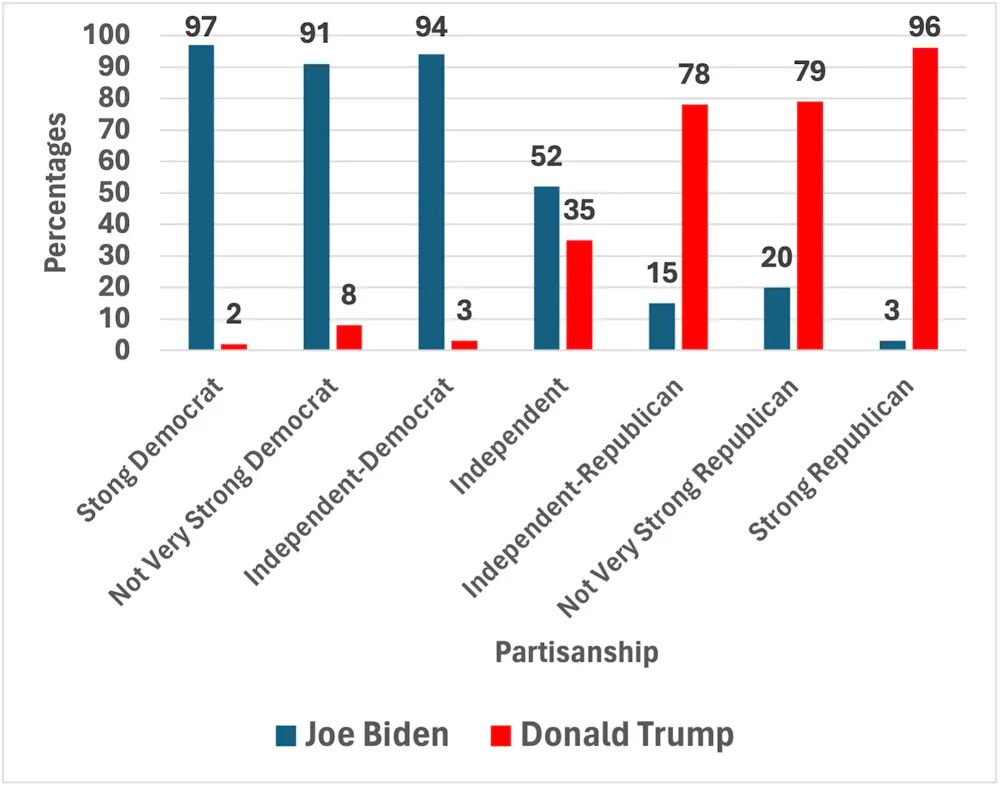
Another important source of political identity in American politics, which also has a very strong influence on voting, is partisanship – the extent to which people think of themselves as Republicans, Democrats or independents. In the 2020 study, 46% of respondents identified with the Democrats, 42% with the Republicans, and 12% with the independents. The second chart shows how this related to voting behaviour in the 2020 election.
Voting and partisanship in the 2020 US presidential election
American National Election Study (2020), CC BY-NC-SA
Partisanship was measured using another seven-point scale. If we group together all three categories of Democrat, Biden was supported by 95% of them in the 2020 election. In contrast, Trump was supported by only 87% of those who identified as Republican.
In the case of “independent-Democrats”, 94% of them voted for Biden, whereas only 78% of “independent-Republicans” voted for Trump. As regards the pure independents, 52% opted for Biden and only 31% for Trump. Once again, Biden’s appeal was much broader than Trump’s.
What could this mean?
These two political identities (ideology and partisanship) tell a similar story because they are strongly related to each other. Attacks on opponents within his own party, as well as on Democrats, mobilises Trump’s ideological and partisan base, but at the cost of alienating moderates and independents.
This will probably happen again in November 2024, and we can be fairly sure about its effects. Questions in the survey asked respondents to give a “likeability” score to each candidate, rated on a 100-point scale where zero meant they “intensely disliked” a candidate and 100 meant they “intensely liked” them.
In the case of Biden, 21% gave him a score of zero and 10% a score of 100, with an average of 48. For Trump, 39% gave him zero and 15% rated him 100, with an average of 41. It turns out that likeability is strongly associated with voting for a candidate.
Trump appears to have a vociferous group of loyal supporters who intend to vote for him regardless of his legal problems or bad publicity. But there is a relatively silent group more than twice as large that will never vote for him under any circumstances.
Paul Whiteley, Professor, Department of Government, University of Essex
This article is republished from The Conversation under a Creative Commons license. Read the original article.




















