Headline
Ukraine war increasingly seen as ‘fought by the poor’, as Zelensky raises taxes and proposes strict mobilisation laws

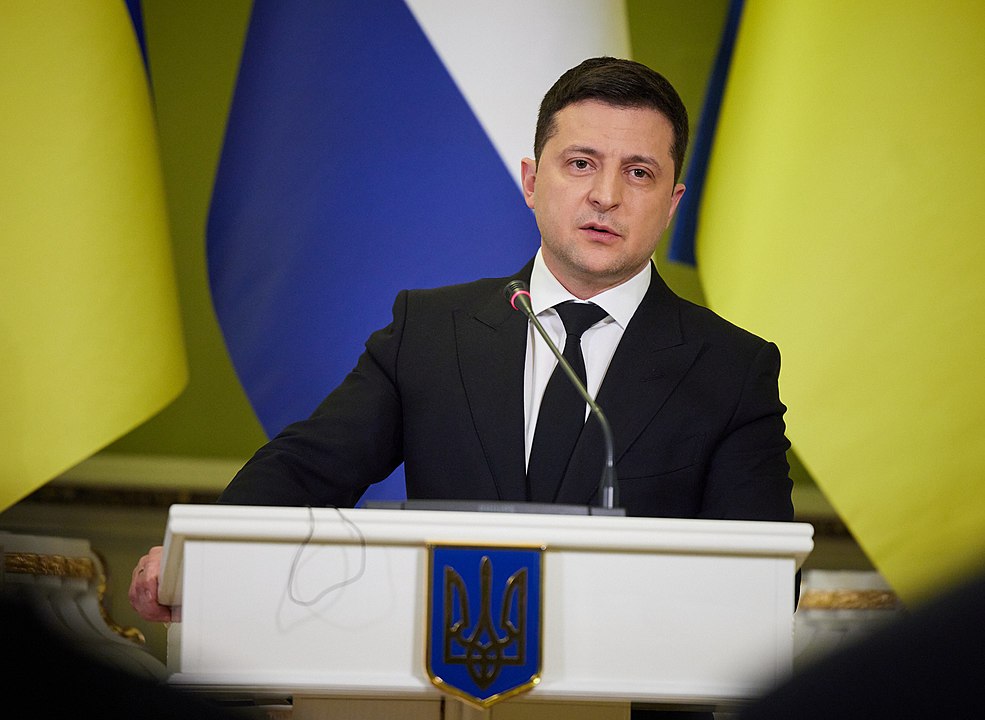
FILE: President Volodymyr Zelenskyy met with the Prime Minister of the Netherlands Mark Rutte, in the Mariinskyi Palace, Kyiv on February 2, 2022. (Photo By President.gov.ua, CC BY 4.0)
After the failure of Ukraine’s 2023 counteroffensive, Kyiv finds itself at a major crossroads and with no easy options.
The demand late last year by the Ukrainian president, Volodymyr Zelensky, for the mobilisation of an additional 500,000 troops over the next few months signals both resolve and desperation. It will likely make Ukrainian domestic politics more fractious but it could also buy Zelensky time to reconsider his own endgame and how to get there.
Since the beginning of Russia’s full-scale invasion in February 2022, Ukraine’s armed forces have had a strength of around a million soldiers, with continuous regular mobilisation compensating for losses on the battlefield. Against this background, the target of an additional half a million troops constitutes a significant increase of 50% above the current baseline. There are several possible reasons for this.
First, it could be an indication of the real scale of losses at the front over the past year. Ukraine suffered high rates of attrition as a result of relentless Russian counterattacks, including along the long stretch of frontline in Donbas.
There is also increasing concern over the sustainability of western support. Kyiv may be anticipating a need to compensate for an expected decrease in western supplies of arms and ammunition by increasing human resources on the ground.
Russia’s recent mobilisation of 170,000 new troops brings the total strength of its armed forces to around 1.3 million. So Zelensky’s announcement may simply be an attempt to level the playing field in terms of troop numbers.
Taken together, all three of these possible explanations also indicate a concern about the likelihood of a new Russian offensive in 2024. Whatever the ultimate Russian war aims might be, Moscow’s territorial claim to the whole of the Ukrainian regions of Luhansk, Donetsk, Kherson and Zaporizhzhia is one of the more concrete – and hitherto unachieved – objectives.
With the Kremlin’s relative military strength growing, denying Putin this success – which he is likely to want to achieve before his all-but-certain re-election in March and likely inauguration in May – will require a serious Ukrainian defence effort.
In turn, this implies that the Ukrainian leadership is currently less concerned about strategic prospects, but is motivated by the need to mobilise all available resources for this effort.
The two complementary bills regarding on mobilisation which were submitted by the government to parliament on December 30 2023, indicate that Zelensky and his inner circle are serious about this. At the same time, if adopted and implemented, the new approach to mobilisation will also add significant strain for already stretched the Ukrainian state institutions and society.
Running out of men to mobilise?
As publicly confirmed by senior Ukrainian officials, large numbers of volunteers for frontline service simply no longer exist. So the government proposes coercive measures to ensure continuing enlistment. These range from high fines for draft dodging, to seizure of real estate and the freezing of private bank accounts, to the cancellation of passports of Ukrainian refugees abroad.
The latter group in particular, including an estimated 600,000 fighting-age men living in the EU, will become a key target of Kyiv’s mobilisation efforts. Addressing them directly in his new year’s speech, Zelensky didn’t mince his words: “You need to decide whether you are a refugee or a citizen.”
In parallel, there will be further efforts to put Ukraine’s economy on a war footing, as announced by Ukraine’s prime minister, Denys Shmyhal. The planned mobilisation will be accompanied by a new economic strategy to increase the tax burden on individual citizens and small and medium-sized businesses, while social spending will be radically reduced.
Deepening social divisions
These measures are undoubtedly necessary from a strategic perspective – especially if Ukraine wants to regain the initiative on the battlefield. But taken together, these actions by the government have revived potentially divisive discussions in Ukrainian society about social justice, corruption and the social contract between elites and society. The level of public trust in elites is already low, and decreasing further, and the war is increasingly seen as a “war fought by the poor”.
What is more, the demographic trends in Ukraine’s society further exacerbate the unfavourable long-term prospects of the ever-increasing number of people living in poverty. Life expectancy of men has reduced from an already low 65 years in 2021 to 57 years in 2023.
Birth rates remain very low, with some demographers estimating a fall to 0.55 babies per family in 2023. Meanwhile, emigration of the most skilled and economically active population has accelerated since the war began. This leaves predominantly the poor to do the fighting while seeing their living standards further decline.
Forced mobilisation, the reduction of the rights and freedoms of the population, further economic disruption and social hardship contrast sharply with what is widely perceived as the corruption-fuelled lifestyle of an entrenched and unaccountable elite. Zelensky himself may not (yet) be directly associated with this – and his relative lack of success in rooting out corruption has yet to significantly harm his own popularity.
But several people in his inner circle have been associated with corrupt practices. If nothing else, more fractious domestic politics, including between military and political elites, will undermine Ukraine’s resilience and combat effectiveness from the inside, further playing into Russian hands.
Thus, Ukraine needs a new social contract between elites and society as much as it needs a re-assessment of its military strategy. Yet, neither are likely. Zelensky and his foreign minister, Dmytro Kuleba, insist that there is a path to victory and that they “do not have a plan B”. This uncompromising position is reflected in the current mobilisation plans.
More men, however, do not constitute a strategy. At best, they can be part of a strategy. To justify the undoubted sacrifice that Zelensky is asking of Ukrainian society, he needs to articulate a clearer purpose and direction. Simply reiterating the desirable – Ukraine’s complete liberation – will sooner or later come to be seen in Ukraine and in western partner capitals as a fantasy dangerously detached from realities on the ground.
Stefan Wolff, Professor of International Security, University of Birmingham and Tetyana Malyarenko, Professor of International Relations, Jean Monnet Professor of European Security, National University Odesa Law Academy
This article is republished from The Conversation under a Creative Commons license. Read the original article.