Headline
Biden’s burden: four percentage points, a struggling economy and a fragile democracy

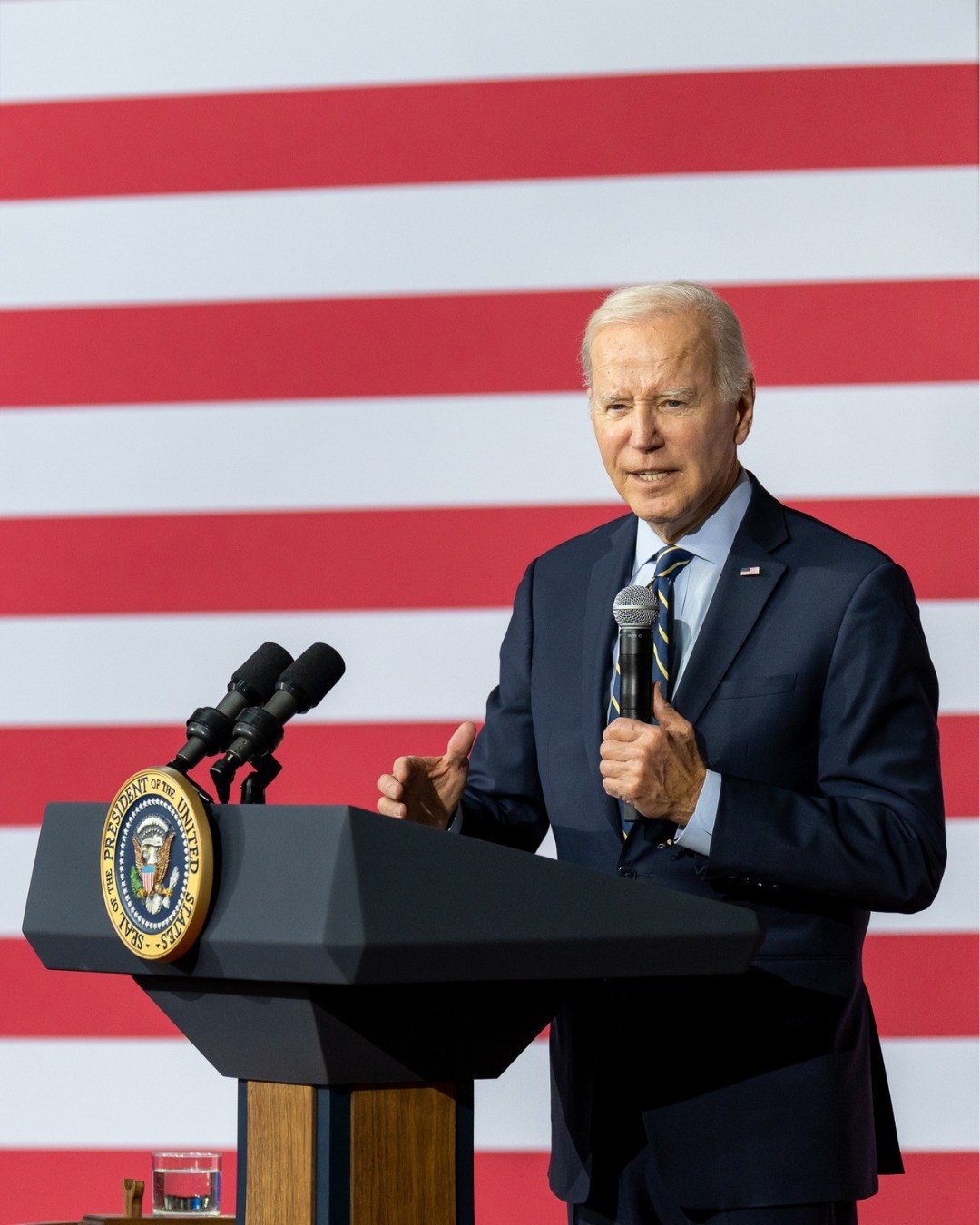
Why is Biden so unpopular? (File Photo: President Joe Biden/Facebook)
In the United States, one of the men vying for the presidency faces 91 criminal charges in four concurrent criminal cases. He uses openly fascist language, and has mused about “terminating” the Constitution. Just last week, he said that should he win the election, he would be a “dictator” for day one of his presidency (but not after that).
He currently sits four percentage points ahead of the incumbent president.
Last week, a Wall Street Journal poll of 1,500 US voters found that, in a hypothetical head-to-head, Democratic President Joe Biden would attract 43% of votes compared to presumptive Republican nominee Donald Trump’s 47%. When five independent candidates were added to the mix, Biden’s projected vote dropped to 31%, compared to Trump’s 37%. The same poll measured Biden’s current approval rating at 37%.
In a country that prides itself on being the “oldest democracy in the world,” how is it possible that an explicit anti-democrat is outpolling the democratically elected president? Why is Biden so unpopular?
There are some obvious, immediate answers to this question. While not many of the truisms of the 1990s retain their relevance, Bill Clinton’s 1992 campaign dictum that “it’s the economy, stupid” retains a lot of explanatory power.
While the big indicators of economic recovery and success are tracking reasonably well in the United States – gross domestic product is up, inflation is down, and unemployment is at its lowest level since 1969 – these numbers just don’t line up with Americans’ material experiences.
That’s why the Biden administration is scrambling to sell the positive message of “Bidenomics”. They are struggling to sell that message at least in part because while those policies, such as Biden’s signature Inflation Reduction Act, are having an impact, they haven’t been enough to reduce rampant inequality.
These perceptions – real and imagined – of an economy that doesn’t work for the majority of Americans are colliding with other crises in the United States that, sometimes fairly and sometimes not, are being laid at the feet of the president.
There is the ongoing trauma of a pandemic that killed over one million Americans; of gun violence; and of deaths of despair. And for young people especially, there is the sense of betrayal that a president who promised to be a generational bridge has not lifted young people up, has not done enough on climate, and proudly proclaims his Zionism in the face of unspeakable horror being perpetrated in Gaza by the right-wing Israeli government.
In what we might unsatisfactorily call a “normal” election cycle, this polycrisis would be enough of an explanation for recent polling.
But the possibility that an openly authoritarian candidate might win the highest office in the world’s most powerful democracy, even if it is an imperfect one, is not “normal”. Given the stakes of this election, there has to be more at play.
Polling consistently shows that Americans are deeply worried about the state of their democracy. At the end of 2022, for example, an NPR/PBS Newshour/Marist poll found that a vast majority of Americans – eight in ten people – see American democracy as under threat.
Experts agree that they are right to understand the 2024 presidential election in these terms. American democracy has always been fragile, and it is now at as dangerous a point as at any other moment in its history.
It is these long threads of American history that connect to the present. For many, if not all, of his supporters, Trump’s seemingly untouchable popularity comes because, not in spite of, his particularly American brand of anti-democratic white supremacy.
Understanding Trump’s popularity with these voters means confronting what Fintan O’Toole has described as the “unresolved contradictions of American history”. By that he means the legacy of slavery, the Civil War, the undoing of Reconstruction, and the unfinished business of the Civil Rights movement.
Trump is popular precisely because he sits at the intersection of American history – the mutually reinforcing trends of white supremacy, exceptionalism and conspiracy.
At his strongest, Biden understands and acknowledges this. Biden speaks clearly and consistently of the threat Trumpism poses to American democracy. Twice in recent history, in the 2020 presidential elections and the 2022 midterms, voters have agreed with him.
When it comes down to it, those voters may well agree with him once more. We can say with reasonable certainty that Biden’s “disaffected Democrats” won’t turn out for Trump. And we know from experience that polls are incomplete snapshots of intention and sometimes fail to capture other motivating factors.
The real risk is that this time around, Biden’s message of threat mitigation will not be enough. As the United States’ immediate polycrisis collides with its old one, Biden’s tendency to fall back into old tropes of American exceptionalism has started to ring hollow, and only reinforces existing perceptions that, at 81, he is too old to run again.
As he seeks out a second term, the president’s apparent inability to articulate a coherent alternate vision for the future of his country may well be critical.
While those four percentage points might not seem like much, and will likely keep moving until November, they’re representative of a very big problem for the future of American democracy.
Emma Shortis, Adjunct Senior Fellow, School of Global, Urban and Social Studies, RMIT University
This article is republished from The Conversation under a Creative Commons license. Read the original article.