News
Santos, now booted from the House, got elected as a master of duplicity – here’s how it worked


Santos lied about his religion, marital status, business background, grandparents, college, high school, sports-playing, income and campaign donation expenditures. (File Photo: Representative George Santos/Facebook)
U.S. Rep. George Santos, a Republican from New York, was expelled on Dec. 1, 2023 from Congress for doing what most people think all politicians do all the time: lying.
Santos lied about his religion, marital status, business background, grandparents, college, high school, sports-playing, income and campaign donation expenditures.
Santos’ fellow members of Congress – a professional class stereotypically considered by the public to be littered with serial liars – apparently consider Santos peerless and are kicking him out of their midst on a 311-114 vote, with two members voting present.
How could a politician engage in such large-scale deception and get elected? What could stop it from happening again, as politicians seem to be growing more unapologetically deceptive while evading voters’ scrutiny?
Santos’ success demonstrates a mastery of something more than just pathological lying. He managed to campaign in a district close to the media microscope of New York City, in one of the richest districts in the state, and get elected and stay in office for a year, despite making a mockery of any semblance of honesty.
I am a scholar of political deception. Experiments I conducted have revealed how the trustworthiness of politicians is judged almost entirely from perceptions of their demeanor, not the words they utter.
Misleading with a smile
I have found that voters are drawn in by politicians’ demeanor cues, which are forms of body language and nonverbal communication that signal honesty or dishonesty and yet have no relationship to actual honesty. For example, looking nervous and fidgety or appearing confident and composed are demeanor cues, which give impressions of a politician’s sincerity and believability. Someone’s demeanor cues might signal that they are trustworthy when they’re actually lying, or could signal lying in someone who is actually telling the truth.
The most authoritative index of demeanor cues that affect people’s perceptions of honesty and deception was developed by Tim Levine, a professor of communication at the University of Alabama, Birmingham. Demeanor cues that convey sincerity and honesty include appearing confident and composed; having a pleasant, friendly, engaged and involved interaction style; and giving plausible explanations.
The insincere/dishonest demeanor cues include avoiding eye contact, appearing hesitant and slow in providing answers, vocal uncertainty in tone of voice, excessive fidgeting with hands or foot movements, and appearing tense, nervous or anxious.
Empirical research has long revealed that voters are overwhelmingly influenced by politicians’ nonverbal communication. In one experiment, participants were shown 10-second clips of unfamiliar gubernatorial debates. The participants were asked to predict who won the election.
Participants who saw muted 10-second clips – making their judgments solely on nonverbal cues – were able to predict which candidate would go on to win. But those who watched the video with the sound were no better at picking the winner than if they picked randomly without ever watching or listening to anything. Voters make their judgments of a politician’s competence, it turns out, based on a 1-second glance at the politician’s face.
Another study also found that politicians’ facial expressions have the power to move us, literally: People watching clips of Ronald Reagan looking friendly adjusted their facial muscles accordingly and mimicked his smile, and people watching clips of Reagan looking angry tended to furrow their brow, too.
How Santos does it
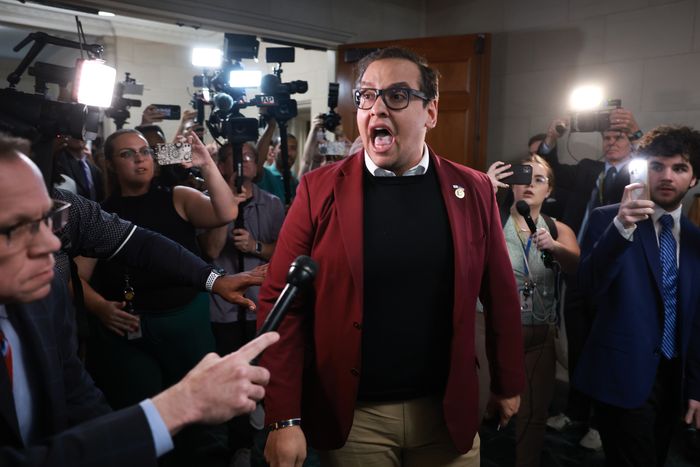
Santos speaks with certitude. He has a charming, friendly and interactive manner – all sincere demeanor cues. He makes intense eye contact without fidgeting. He dresses well and is pleasant looking.
He was able to make up lies out of whole cloth and have them believed – a feat rarely accomplished by liars. He exudes confidence.
Santos dresses with sartorial elegance. He wears chic eyeglasses and sunglasses, accessorized with bright but not tacky jewelry. All this is complemented by one of his signature fleeces or sweaters, typically worn over a collared dress shirt and under a smart jacket. Santos even bought his campaign staff Brooks Brothers shirts to wear.
In my experiments, which have shown that voters base their judgment of politicians’ trustworthiness almost entirely from perceptions of demeanor, I found that Republicans are especially susceptible to demeanor cues. Republican voters will disbelieve their own honest politician if they perceive that the politician’s demeanor is insincere. But they will believe their own politician if they perceive sincerity.
Santos’ believable demeanor follows in the lineage of other con artists who could deceive absurdly yet adroitly. Disgraced financier Bernie Madoff dressed well, looked dignified, acted friendly and cordial, and his resting face was a smiling expression. The Fyre Festival fraudster Billy McFarland also had a resting face that was a smiling, aw-shucks expression, and acted harmless and friendly.
And Elizabeth Holmes of Theranos – who became the youngest female billionaire in history – faked a deep voice, walked upright with perfect posture, smiled and conveyed unrelenting confident poise, and maintained an unblinking gaze. All this enabled her to tell lies to some of the richest, most accomplished, intelligent titans of industry.
Madoff, McFarland and Holmes could look people in the eye and steal their money – swindling largely through the same sorts of demeanor cues that Santos exhibits.
McFarland, Holmes and Santos have the ability to smile with their upper teeth showing while they are answering tough questions in interviews, which research shows exudes trustworthiness.
Fool me once …
Just because someone speaks confidently, dresses well and acts friendly does not mean the person is honest. Pay attention to what people say – the content of their verbal messaging.
Don’t fall prey to body language or seemingly sincere behavioral impressions, which actually have no correlation to actual truthfulness. As my research has shown, the appearance of sincerity is misleading. It is a myth that eye contact means someone is telling you the truth and that a roving gaze or elevated blinking means they are lying.
Some people just look honest but they are pulling the proverbial wool over your eyes. Some people look sketchy and appear unbelievable, but what they say is truthful.
Santos’ disgrace is a teachable moment for citizens. As the proverb goes: Fool me once, shame on you; fool me twice, shame on me.
David E. Clementson, Assistant Professor, Grady College of Journalism and Mass Communication, University of Georgia
This article is republished from The Conversation under a Creative Commons license. Read the original article.