
News
Understanding the history of the Israeli-Palestinian conflict in 5 charts

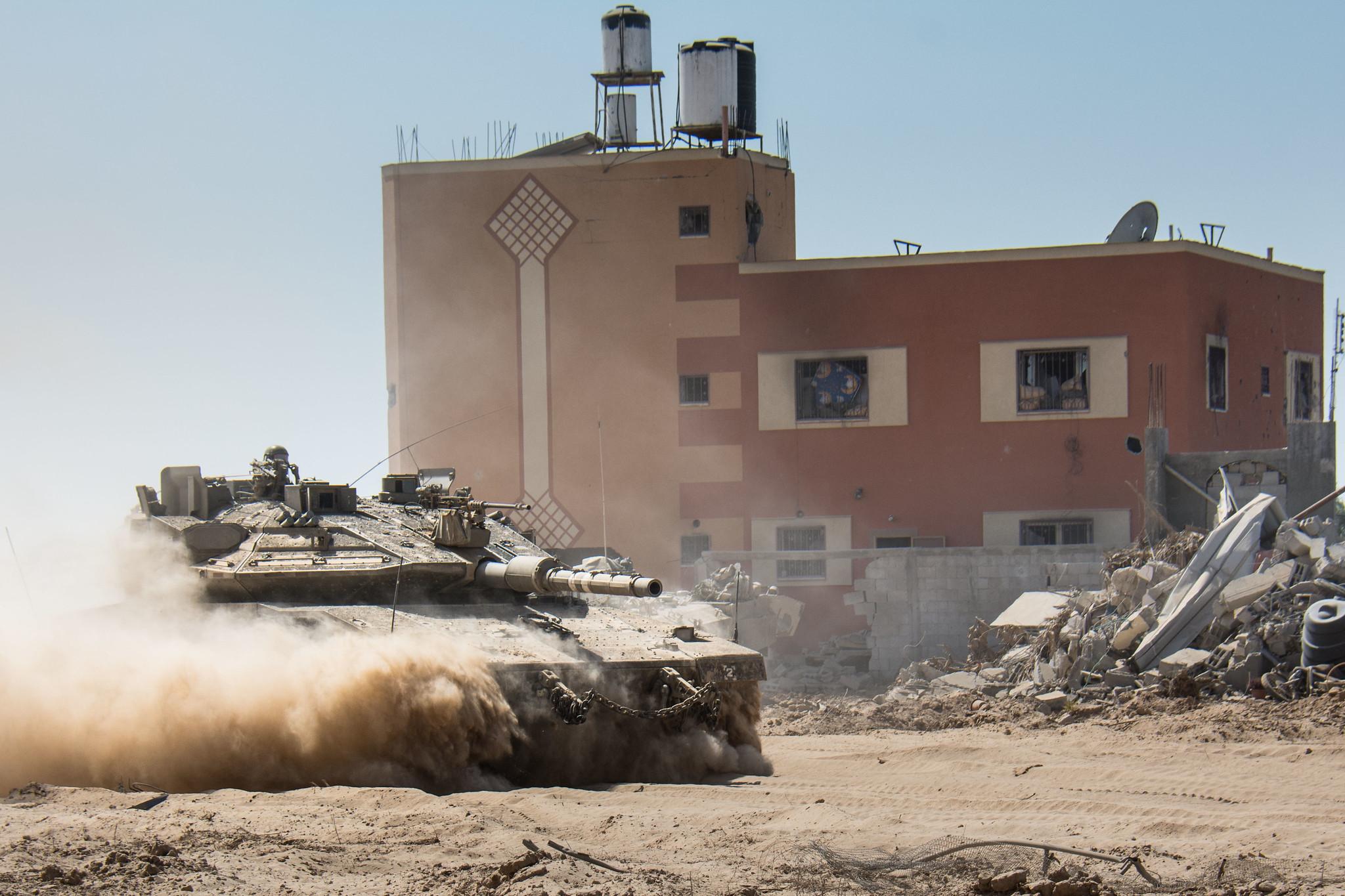
FILE: Armored corps operating in the Gaza Strip. (Photo: Israel Defense Forces/Flickr, CC BY-NC 2.0)
Understanding the current war between Israel and Hamas in Gaza requires context and history. These charts aim to show changes in the region that have occurred over time to put some of the events in perspective.
This first chart shows the history of Israeli settlements in the West Bank. The map shows when and where those settlements were built – the darker red colour indicates a more recent settlement, while pink is older. The grey dots indicate settlements that didn’t have verified establishment dates.
Settlement started to become a policy of the Israeli government in earnest after the 1967 Six Day War, which resulted in the Israeli seizure of the West Bank and Gaza from Jordanian and Egyptian control, respectively. Some settlements are small, with less than 100 people, while others have grown into large towns of thousands with their own industrial areas.
The data was collected from a number of sources, including the UN Office for the Coordination of Humanitarian Affairs (OCHA); Peace Now, an Israel based non-governmental organisation that tracks settlements; and B’Tselem, another Israeli-based organisation that tracks human rights violations allegedly committed by Israel in the Palestinian territories.
The legality of these settlements is a source of much debate, though under international law — specifically Article 49 of the Fourth Geneva Convention — they are considered illegal.
To get a deeper picture of how the settlements have encroached on Palestinian land, we need to rewind to the 1990s and the Oslo Accords. These were a series of agreements between the Israeli government and the Palestinian Liberation Organisation (PLO) that sought to establish the boundaries of control in the West Bank and Gaza.
The Oslo II Accords divided the West Bank into parcels that were controlled by Israel, the Palestinian Authority or a joint operation. Initially, Oslo II was designed to provide a framework to hand over territory in the West Bank and Gaza to the government of an eventual Palestinian state. Settlement has made this eventuality near impossible.
The borders on the map above are complex and are close to overlapping, leaving some Palestinian-controlled areas completely cut off from one another.
The West Bank is split into three main areas, called Area A, Area B and Area C.
In Area A, which is red on the map, the Palestinian Authority has civil and security control.
Area B, in blue, is a joint control zone, with Israel maintaining security and the Palestinian Authority looking after civil affairs such as schools, health and the economy.
Area C, in green, is the Israeli-controlled sector. Israeli settlements are mostly built in these areas.
The major West Bank city of Hebron was also split internally into H1 and H2, pink and yellow respectively on the map. H2 is controlled by Israel and H1 by the Palestinian Authority.
Displaced people and conflicts
Conflicts over the years in the Gaza strip have forced many people to evacuate their homes. Many of these internally displaced people find their way to refugee camps and shelters run by various organisations.
Israel’s 2004 disengagement policy was a plan to remove Israeli troops and settlements from Gaza. Prior to the policy, there were 21 civilian settlements in Gaza, with around 8,500 Israelis. Also, the expansion of the buffer zone at the Rafah crossing (at the border with Egypt) from 2000 resulted in the destruction of a third of the refugee camp there and 16,000 Palestinians being internally displaced.
The chart below shows the recent build-up of internally displaced people in UN Relief and Works Agency-run shelters in Gaza during October. The sudden increase in the Deir al Balah, Rafah and Khan Younis areas, all in the southern end of Gaza, since October 12 came after Israel ordered residents in northern Gaza to evacuate to the south. Many expected Egypt might also open its borders at Rafah.
Since Hamas’ attack on October 7, which started the recent hostilities, there has been a sharp increase in conflict events within Gaza and the West Bank. The map below shows where and when those events have occurred. The data is from the Armed Conflict Location & Event Data Project, a US-based organisation that collects information on crisis events, including violence and protests.
The volume and swiftness of the events means that data tracking is a few days behind the most recent action.
And the blast at al-Ahli Arab Hospital on October 18, which killed hundreds of Palestinians, is the latest in a upward trend of incidents involving health care workers in Israel and the Palestinian territories. The chart below tracks those incidents since 2018. The data is from the OCHA and was filtered down to show the four main perpetrators.

Matt Garrow, Editorial Web Developer, The Conversation
This article is republished from The Conversation under a Creative Commons license. Read the original article.




















