World News
Most pink diamonds were birthed by a disintegrating supercontinent. Where can we find more?

For many they are the ultimate “I love you” gift, and jewellers will tell you the ultra-hard stones have unmatched “fire” and “brilliance”. (Pexels Photo)
There is nothing quite like a diamond. For many they are the ultimate “I love you” gift, and jewellers will tell you the ultra-hard stones have unmatched “fire” and “brilliance”. The sentimental and aesthetic value of the gems is matched by their price, which can run to tens of thousand dollars per carat – and even more for coloured diamonds, especially if they are blue, green, violet, orange, red or pink.
But why are diamonds so expensive? How do they form? Do we really find diamonds in volcanoes? What is the link to supercontinents and ancient lifeforms?
In new research published in Nature Communications, we answer some of these questions by studying the world’s largest diamond deposit, Argyle in Western Australia, the source of more than 90% of pink diamonds.
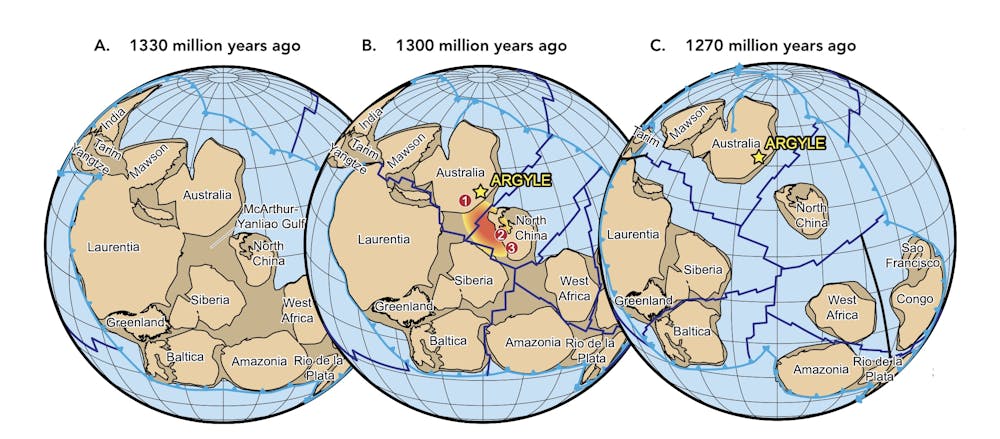
We found that at Argyle, diamonds crystallised deep in Earth’s interior were brought to the surface when a supercontinent, Nuna, began to break apart. As continents break up, their edges stretch, allowing small pockets of diamond-rich magma to rise to the surface.
Why are pink diamonds so special?
Only about 20% of mined diamonds are of gemstone quality. If you think of diamonds as cars, 80 of every 100 on the road would be old, beat-up rides and 20 would be luxury cars.
One in every 10,000 would be the equivalent of a supercar: a rare and precious coloured diamond.
However, some places in the world are special. Just as you might see a greater proportion of supercars in Monaco or Hollywood, so too do some places produce more coloured diamonds.
When it comes to pink diamonds, one place stands alone. More than 90% of all the pink diamonds ever found come from a single mine in the Kimberley region of Western Australia: Argyle.
The Argyle mine closed in 2020, and the price of pink diamonds has skyrocketed while the supply dwindles.
While pink diamonds are highly prized, they are also in a sense “damaged goods”.
Diamonds are made of carbon atoms arranged in a compact, regular lattice. Clear, perfect diamonds sparkle because light reflects off their internal surfaces.
However, when diamonds are subject to intense pressure deep inside Earth, the lattice of atoms can twist and bend. This causes small imperfections that diffract light and bring colour to the gem.
Why is Argyle so well-endowed in pink diamonds?
All diamonds are found in pipelike volcanoes, or in their eroded remnants. These volcanoes have deep roots under continents, which is where diamonds reside.
The roots need to be deep. If they’re shallow, the carbon that might become diamonds will instead be in the form of graphite, which is not nearly as appealing on an engagement ring.
The story of the Argyle volcano begins some 1,800 million years ago, when the continental plate beneath the Kimberley smashed into the rest of WA to form the first supercontinent, Nuna. Five hundred million years later, Nuna ripped apart again while Australia hung together.
Olierook et al. / Nature Communications, CC BY
Yet old wounds never fully heal. The suture between the Kimberley and the rest of the continent was stretched open as Nuna split up, and the Argyle volcano shot to the surface, bringing pink diamonds with it. The death of a supercontinent gave birth to Argyle.
So what made Argyle’s diamonds pink? The force that damaged the deep diamonds, resulting in their beautiful hue, probably came from the continental collision that formed the supercontinent in the first place. But the diamonds remained deep below this old wound for a long time before being brought to the surface.
Will we find another trove of pink diamonds? With Argyle now closed, the search is on to meet the demand for these illustrious gems.
The ingredients appear to be continental breakup, the edges of ancient continents and volcanic pipes.
Is carbon recycled in Earth’s interior?
Finding diamonds is no mere quest for glitz and glamour. It’s an exploration of Earth’s deepest history.
Diamonds are ancient time capsules from the depths of our planet. They are relics of a past so remote it challenges comprehension.
We know they are made of pure carbon – but where did this carbon come from?
Most of the carbon is remnants of carbon-rich asteroids that clumped together to form Earth 4.5 billion years ago.
However, some diamonds contain carbon that was once part of living organisms. Organic carbon, from organisms that once thrived on Earth’s surface, got buried deep down by geological processes.
The Argyle diamonds, for instance, hold such organic imprints, like echoes from an ancient world long vanished. In these glimmers of the distant past, we find more than beauty; we find keys to unlock the most profound secrets of our planet’s history.
Denis Fougerouse, Research Fellow, School of Earth and Planetary Sciences, Curtin University; Hugo Olierook, Research Fellow in Geology, Curtin University, and Luc Doucet, ARC Future Fellow at the Earth Dynamics Research Group, Curtin University
This article is republished from The Conversation under a Creative Commons license. Read the original article.