
Business and Economy
Will the Bank of England’s reliance on quantitative easing work for the UK economy?

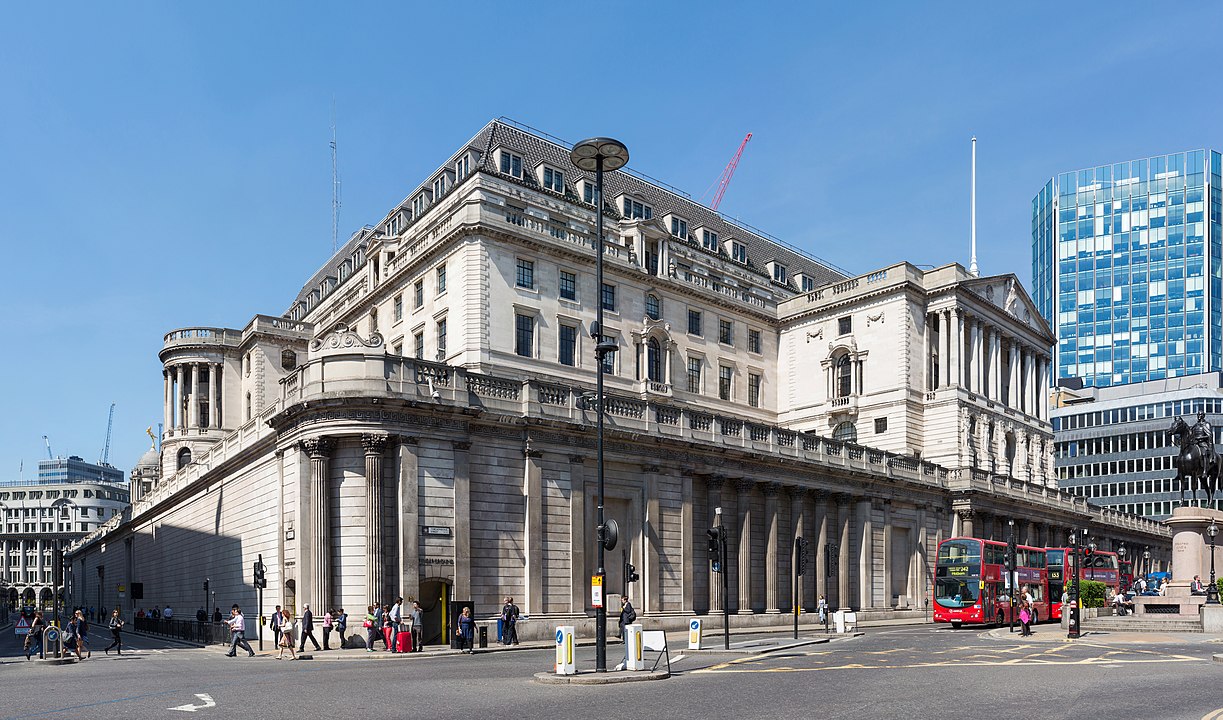
FILE: The main Bank of England façade (Photo by Diliff/Wikimedia Commons, CC BY-SA 3.0)
It was the Bank of Japan which first embarked on the experiment known as quantitative easing, or QE, in order to try and stimulate the Japanese economy out of its period of very low growth known as the “lost decade” between 1991 and 2001. Since the global financial crisis and recession of 2007-2009, quantitative easing has been a mainstay of western governments’ monetary policies aimed at stabilising the economy.
However, central banks have spent trillions on QE since in the years since – £895 billion in the UK alone – and as the Bank of England launches a new £150 billion stimulus package there are questions as to whether QE can provide the economic stability governments and markets are hoping for in the face of economic paralysis caused by the pandemic.
QE in a nutshell
With quantitative easing, central banks create money to buy government-issued bonds from banks and other investors, which provides them with cash to lend or invest in the economy. This prompts increased demand for government bonds, which in turn raises their price and causes the returns on the bonds to fall.
Governments issue bonds of different duration, the length of time before the government repays the value of the bond back to the purchaser, which range from a few years to many decades. Each bond of different duration is worth a different amount of money in repayments to the purchaser, known as a yield. Plotting yields against the duration of the bond generates what is called a yield curve.
Under normal economic conditions we expect yield curves to increase as duration increases – a rising yield curve. Quantitative easing has two effects on yield curves: it lowers the curve, so that yields are lower for bonds of all durations, and it forces the yield on longer duration bonds to fall into line with those of shorter duration, flattening the yield curve. Faced with these lowered returns from investing in bonds, banks and investors are more inclined to invest in the real economy where better returns can be found, providing an economic boost.
Has QE been effective, and can it be effective now?
Looking at the 12 years of quantitative easing in western economies since the financial crisis, and 20 years in the case of Japan, the impact of QE has been mixed. For Japan specifically there is some evidence that QE reduced the long-term interest rate, causing the Japanese Yen to depreciate. For other advanced economies, one of the main motivations was to avoid a surge in unemployment, and in this regard QE succeeded in both the UK and the US – at least, until the pandemic.
When QE began it was seen as a temporary, emergency measure. Yet more than a decade later it continues, and grows. One side effect of QE is that it has made the rich richer: borrowers with large mortgages benefit from lower interest rates. The excess cash now washing around the economy has caused stock market bubbles in financial markets.
Coordinated action from the Treasury and the Bank of England indicates that they believe the economy to be in serious trouble. The furlough scheme has been extended to end of March 2021, which may indicate that the government is not convinced the UK will emerge from lockdown in December, and, as comments have hinted, lockdown may extend into the new year. This will lead to a double-digit decline in the UK economy for 2020.
A new round of QE in Britain must be seen in this context, perhaps motivated by additional factors such as the very low inflation rate of 0.7% (as measured by the consumer price index). Given such a low rate it’s possible that the coming period of depressed economic activity may lead to negative inflation rates – otherwise known as deflation, as briefly occurred during 2015-2016. The bank may see QE as a precautionary measure to avoid deflation, which causes problems including a decline in consumer spending and an effective rise in interest rates.
The next 12 months
But what of next spring, in March 2021 when the furlough scheme ends? The Bank of England and the Treasury will be busy: the bank may inject more money into the economy yet more rounds of QE, coupled with lowering the bank interest rate further – from its current all-time low of 0.1% perhaps even into negative territory. This will force commercial banks to invest their money in the real economy, as the only means to generate a return. Looked at in this context, the current QE can be interpreted as preparing the ground for negative interest rates, with the expectation that inflation will remain low for the foreseeable future.
All these factors will make it even cheaper for the Treasury to borrow by issuing bonds with very low yields. Heading towards a post-pandemic world, we should expect more government borrowing in order to support the economy.
We cannot know for sure whether this arrangement of the Treasury issuing bonds to investors and the Bank of England buying them back will be successful until counting the costs, well after the pandemic has ended. That said, if the UK can avoid a substantial rise in unemployment after the furlough scheme ends, or if a short spike quickly recovers by the end of 2021 alongside wider economic growth, then we will be through the worst and may judge the current strategy to have been a success.
Ghulam Sorwar, Professor of Finance, Keele University
This article is republished from The Conversation under a Creative Commons license. Read the original article.




















