
Canada News
Feds went with simple rules for benefits to speed up COVID-19 aid, Morneau says

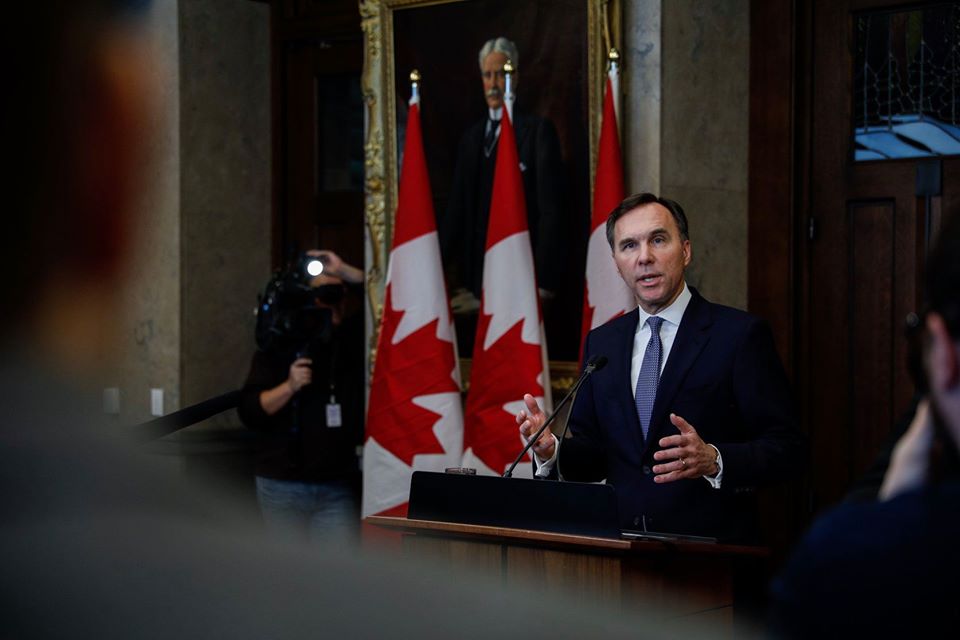
Speaking to the House of Commons finance committee, Morneau said the government stuck with three criteria for the $2,000-a-month emergency benefit for individuals to speed up payments. (File photo: Bill Morneau/Facebook)
OTTAWA — Finance Minister Bill Morneau says imposing hard and fast rules about who can receive federal aid to weather the economic shock from COVID-19 was the only way to get the money out the door fast — even if some people fall through the cracks as a result.
Speaking to the House of Commons finance committee, Morneau said the government stuck with three criteria for the $2,000-a-month emergency benefit for individuals to speed up payments.
Those criteria were that a worker had to have earned at least $5,000 in the last year, had to see their income drop to zero as a result of COVID-19, and either hadn’t worked — or don’t expect to work — for 14 days in the initial four-week period.
With days to go before the benefit becomes available, some analyses suggest hundreds of thousands of workers won’t be helped by the $24-billion benefit or a $71-billion wage subsidy program to help keep employees on company payrolls.
Morneau said trying to tailor help to individual situations would have delayed desperately needed financial support.
“We’re trying to make sure that we get systems up and running that can be put out to get people income as rapidly as possible,” he said by teleconference.
“I acknowledge that presents some situations that are challenging for people if they are still earning some revenue, but we just don’t have the capability of administering multiple kinds of plans and also getting the money out to people rapidly.”
Among the workers who may find themselves in a tight spot are contract or gig economy workers who want to keep small jobs, or can’t afford to not work for two weeks to qualify for the emergency benefit.
Other cases that Morneau conceded were things the government was looking at were volunteer firefighters or municipal politicians who receive an honorarium for their work, even if they have lost their day jobs due to COVID-19.
Morneau hinted at more details and help to come to address gaps in the economic package, now valued at more than $250 billion with just under half of that — over $105 billion — being direct financial aid for workers and businesses.
The remainder is made up of $85 billion in tax deferrals and $65 billion in loans.
The taxable benefit to workers, called the Canada Emergency Response Benefit, will begin to take applications on April 6.
Demand is expected to be high as more than 2.1 million people have filed claims for employment insurance benefits in the last two weeks, a dramatically higher number than the program would normally see.
An analysis published Thursday by the Canadian Centre for Policy Alternatives estimated one-third of unemployed Canadians, about 862,000, won’t get help from EI or the CERB. A further 390,000 will get some help, but below the $500 per week under the CERB.
“Critical changes can and should still be made to the CERB which would allow all unemployed people to receive the benefit, no matter when they lost their jobs or how much they made in the past year,” wrote David Macdonald, the centre’s senior economist and author of the new analysis.
It will take three to six weeks to set up the application platform for the government’s promised 75-per-cent wage subsidy to businesses, non-profits and charities of all sizes. Qualifying businesses should receive payments within three business days through direct deposit, officials told the committee.
But first, Parliament has to approve the program that wasn’t part of the last week’s bailout bill. Conservative finance critic Pierre Poilievre chided Morneau during the meeting for announcing the program after the fact.
Earlier Thursday, the parliamentary budget officer put his cost estimates to some of the federal aid. The reports by Yves Giroux said a special GST credit payments to 13.2 million people will cost $5.67 billion.
A top-up to the Canada Child Benefit in May to 3.4 million recipients will cost $1.9 billion, Giroux says, with the average payment estimated at $556. And reducing by 25 per cent the amount seniors have to withdraw this year from registered retirement income funds will cost $506.5 million.




















