
Canada News
Green with rage: Women climate change leaders face online attacks

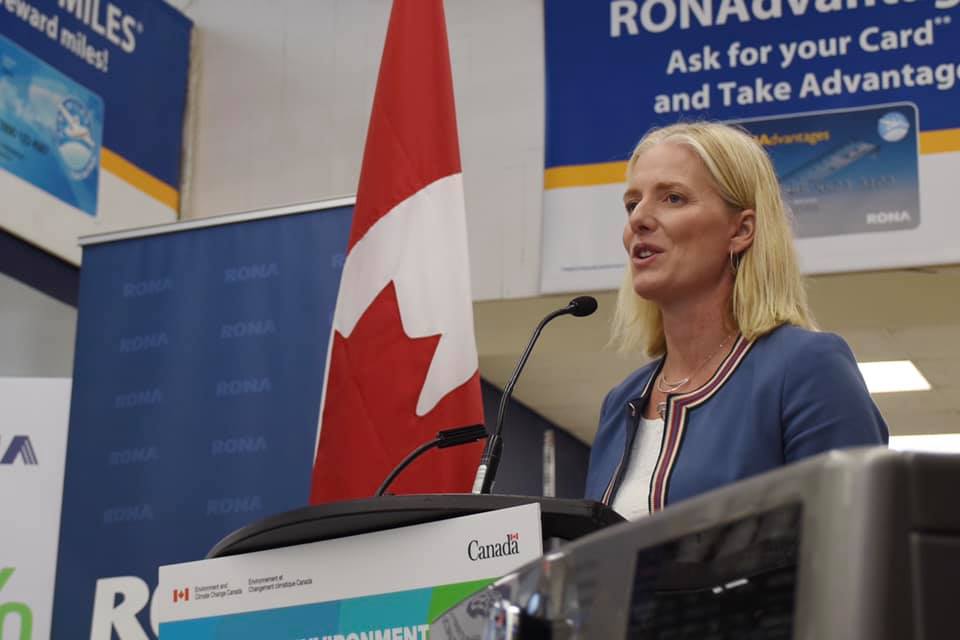
Catherine McKenna, Canada’s environment and climate change minister, recently announced that she’s had to hire security to protect herself and her family while in public. With an election now on, it’s likely she’ll face further abuse in the weeks to come. (File Photo: Catherine McKenna/Facebook)
Women leaders who support climate action are being attacked online with increasing regularity. These attacks should be viewed as a problem not only for the planet, but also to the goals of achieving gender equality and more inclusive, democratic politics.
Catherine McKenna, Canada’s environment and climate change minister, recently announced that she’s had to hire security to protect herself and her family while in public. With an election now on, it’s likely she’ll face further abuse in the weeks to come.
McKenna hired security after she was out with her children and a driver rolled down his window and shouted: “F-k you, Climate Barbie.” This sexist taunt was popularized by Conservative MP Gerry Ritz, who once used the slur in reference to McKenna on Twitter.
It resulted in a tsunami of #Climatebarbie hashtags and variations of the slur ever since. Ritz has since apologized and deleted the original tweet.
A worldwide problem
Unfortunately, vitriol directed at women leaders who support climate action is becoming more frequent in Canada and beyond.
Maxime Bernier, leader of the Peoples’ Party of Canada, recently tweeted at 16-year-old activist Greta Thunberg, calling her:
“…clearly mentally unstable. Not only autistic, but obsessive-compulsive, eating disorder, depression and lethargy, and she lives in a constant state of fear.”
Other “green” women leaders have spoken out about the sexism they have experienced, including Green Party Leader Elizabeth May, Tzeporah Berman from Stand.Earth and Catherine Abreu from the Climate Action Network.
Following the proposal of the New Green Deal by U.S. congresswoman Alexandria Ocasio-Cortez, critics attacked her intelligence and her personal and professional background. National Review writer Charles Cooke referred to her as an “unmarried, childless bartender” who “somehow has the temerity to fancy herself a congressional representative.” He claimed the New Green Deal she supports is:
“ …an untrammeled Dear Santa letter without form, purpose, borders, or basis in reality.”
When New Zealand Prime Minister Jacinda Ardern spoke about climate change, an Australian “shock jock” broadcaster said someone should “shove a sock down 1/8her 3/8 throat.”
Nothing new
Violence and threats of violence against women leaders are certainly not new. According to research by Rutgers University professor Mona Lena Krook and University of Florida professor Juliana Restrepo San?n, women in politics experience violence, sexism and sexual harassment because of the threat they pose working in a male-dominated field.
Sexist attacks and threats of violence therefore serve to discredit women’s ideas and delegitimize their power, with the ultimate goal of excluding them from the public sphere.
Other research shows that the higher their position of power, the more threatening women become.
Although male politicians are also attacked online, recent research in the United Kingdom reveals that the effects of online attacks are particularly difficult for women politicians to deal with. That’s because women MPs are more likely to fear for their safety compared to their male colleagues.
Attacks against women climate leaders specifically can be further explained by the relationship between misogyny and climate denialism.
Misogyny at work
Unlike sexism, an ideology that promotes patriarchal social relations, misogyny is an enforcement mechanism that seeks to punish women who challenge the traditional patriarchal order, according to Cornell University professor Kate Manne.
Climate denialism has also been linked to traditional assumptions of masculinity. Research shows that climate deniers are more likely to adhere to older forms of industrial modern masculinity that helped to push society towards “industrialization, mechanism and capitalism.”
Accordingly, some climate deniers prefer this older form of masculinity over a newer “eco-modern masculinity” of care and compassion for the environment.
A 2019 study found that some men will avoid certain environmental actions, such as recycling or using reusable shopping bags, in order to maintain “an outward-facing heterosexual identity.”
These versions of heterosexual masculinity appear to be predicated upon the domination and exploitation, rather than the preservation, of the environment.
A double threat
Women leaders who promote climate policies are therefore doubly threatening to those who hold misogynistic attitudes. First, simply by being women in a powerful position and, second, by espousing policies that directly challenge traditional norms of masculinity.
“Green rage” directed at women climate leaders thus serves the function of safeguarding male dominance by punishing women who challenge the patriarchal social order. The result is a toxic brew of masculinity directed at women climate leaders by way of sexist attacks and threats of violence.
Social media reactions to McKenna’s announcement that she now requires security for her and her family reveal how deeply embedded misogynistic attitudes are about women today.
After she tweeted about how difficult it is for women working on climate issues, some tweeters expressed support and sympathy. But many others denied that gender played a role in the attacks against her. Others continued to degrade her with sexist language, using hashtags #hypocriteBarbie and, once again, #climateBarbie.
Canadians go to the polls soon and the climate crisis is bound to be a heated campaign issue in the weeks to come.
Understanding the complex and challenging terrain women leaders must navigate is an important requirement of an informed electorate.
While some women politicians like McKenna have attempted to tackle head on the problem of online attacks against them, it should not be left to women alone to combat this issue. Dismantling patriarchal assumptions about gender is not just good for women, it is also good for men — and for the planet.
———
This article is republished from The Conversation under a Creative Commons license. Disclosure information is available on the original site. Read the original article:
https://theconversation.com/green-with-rage-women-climate-change-lea




















