
News
Guatemalans worry about graft after Giammattei wins election

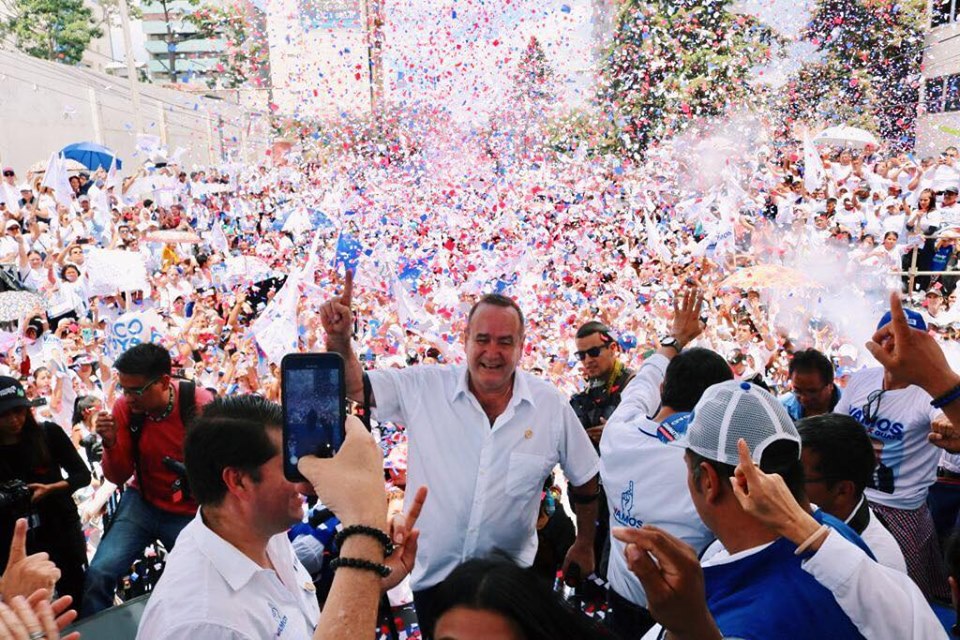
Giammattei, who takes office Jan. 14 for a four-year term, received nearly 58% of the votes compared with 42% for former first lady Sandra Torres in Sunday’s runoff. But more than half of the 8 million registered voters abstained, suggesting a fed-up electorate disenchanted by both candidates. (File Photo: Alejandro Giammattei/Facebook)
GUATEMALA CITY — Few took to Guatemala’s streets to celebrate Monday after Alejandro Giammattei overwhelmingly won election as the country’s next president, with some questioning how he would tackle the corruption, violence and insufficient economic opportunity that has driven tens of thousands to flee the Central American nation.
Giammattei, who takes office Jan. 14 for a four-year term, received nearly 58% of the votes compared with 42% for former first lady Sandra Torres in Sunday’s runoff. But more than half of the 8 million registered voters abstained, suggesting a fed-up electorate disenchanted by both candidates.
“I think it is going to be the same as this government,” said Guillermo Cacao, a businessman, referring to the outgoing administration of Jimmy Morales, who has been the subject of suspected graft allegations though he denies guilt and has been shielded from prosecution as sitting president.
But with homicide rates among the worst in the world at about 35 per 100,000 inhabitants, enough voters in the runoff were still swayed by the president-elect’s promises to crack down on crime, in addition to his staunchly conservative stances against abortion and same-sex marriage.
“If he fights corruption, many of the country’s problems will be solved because there will be money for investment, health, security and education,” university student Christopher Alvarado said.
Giammattei, a 63-year-old doctor, succeeded on his fourth run for the presidency after several more popular candidates were barred from the race, including a former prosecutor who was instrumental in the anti-corruption drive of recent years.
Even so, analysts see in his victory a likely continuation of the political status quo.
“During his 20 years of running for the presidency, Giammattei has been surrounded by people linked to corruption and organized crime,” said Mike Allison, a political scientist specializing in Central America at the University of Scranton. “Like Morales, Giammattei will be more interested in protecting his friends and allies from criminal judgment than in strengthening the rule of law.”
Morales last year ended the mandate of a U.N. commission that helped jail dozens of powerful politicians, officials and businesspeople. The commission known as CICIG is set to wrap up operations and decamp from the country next month.
Giammattei “will not support the continuation of CICIG, which has achieved important advances in that fight in recent years,” said Michael Shifter, president of the Inter-American Dialogue.
Nonetheless, he expressed hope that the new government may surprise by committing to serious reforms on other matters of public importance.
One of Giammattei’s most crucial and difficult tasks will be trying to stem the large flow of migrants heading toward the United States, with at least 1% of Guatemala’s population of some 16 million having left this year alone.
He will also have to figure out whether to abide by or scrap an agreement Morales signed last month with Washington that would require Hondurans and Salvadorans crossing through his country to apply for asylum there instead of on U.S. soil.
The agreement, which came amid pressure from the Trump administration, has been criticized at home by opponents who note that Guatemala suffers the same violence, poverty and lack of opportunity that other Central Americans and the country’s own citizens are fleeing. The deal has been challenged in the courts.
Neither Giammattei nor Torres talked much about the agreement in their final pitches to voters in recent weeks, beyond saying the issue should have been left to the winner of the election rather than negotiated under Morales. The president-elect has not said whether he will implement the deal, though he has allowed that Guatemala has scant resources to apply to the issue.
Allison said it appears that Giammattei “would seem to be aligning with those who believe the consequences of rejecting a ‘safe third country’ agreement with the United States would be worse than accepting it.”
U.S. Secretary of State Mike Pompeo congratulated the president-elect in a brief statement, saying Washington looks forward to continuing partnership in areas including addressing irregular migration. He did not mention the July agreement.
Giammattei spent several months behind bars in 2008 when he was director of the country’s prison system, after some prisoners were killed in a raid on his watch. He was eventually acquitted of wrongdoing.
Leaning on the crutches he uses because of his multiple sclerosis, Giammattei acknowledged in an emotional speech late Sunday that it had been a long road to victory.
“We won. We are very excited, it is logical, it has been 12 years of struggle,” Giammattei said. “Twelve years waiting to serve my country.”
The leader of Torres’ party congratulated Giammattei, but the candidate herself lashed out on Twitter, calling the president-elect, Morales and others “people without scruples, sold to dark powers and who have harmed Guatemala for years favouring the few and neglecting the people.”
Human Rights Prosecutor Jordan Rodas said Sunday he hopes the new government will respect liberties and that he was prepared to hold talks on protecting rights, amid fears from the LGBTQ community that rights could be rolled back.
“The future president has sided with the vision of conservative groups that maintain a caveman mentality, and for them nothing exists other than a man and a woman as such,” said activist Leonel Hernandez.
But Geovany Vasquez, a businessman, said he had voted in favour of Giammattei and was happy the candidate won.
“I didn’t want Sandra Torres in the presidency because she’s been handing out solidarity bags,” he said. “People need work, not presents.”




















