
Canada News
Bills now take almost three times as long to get through the Senate

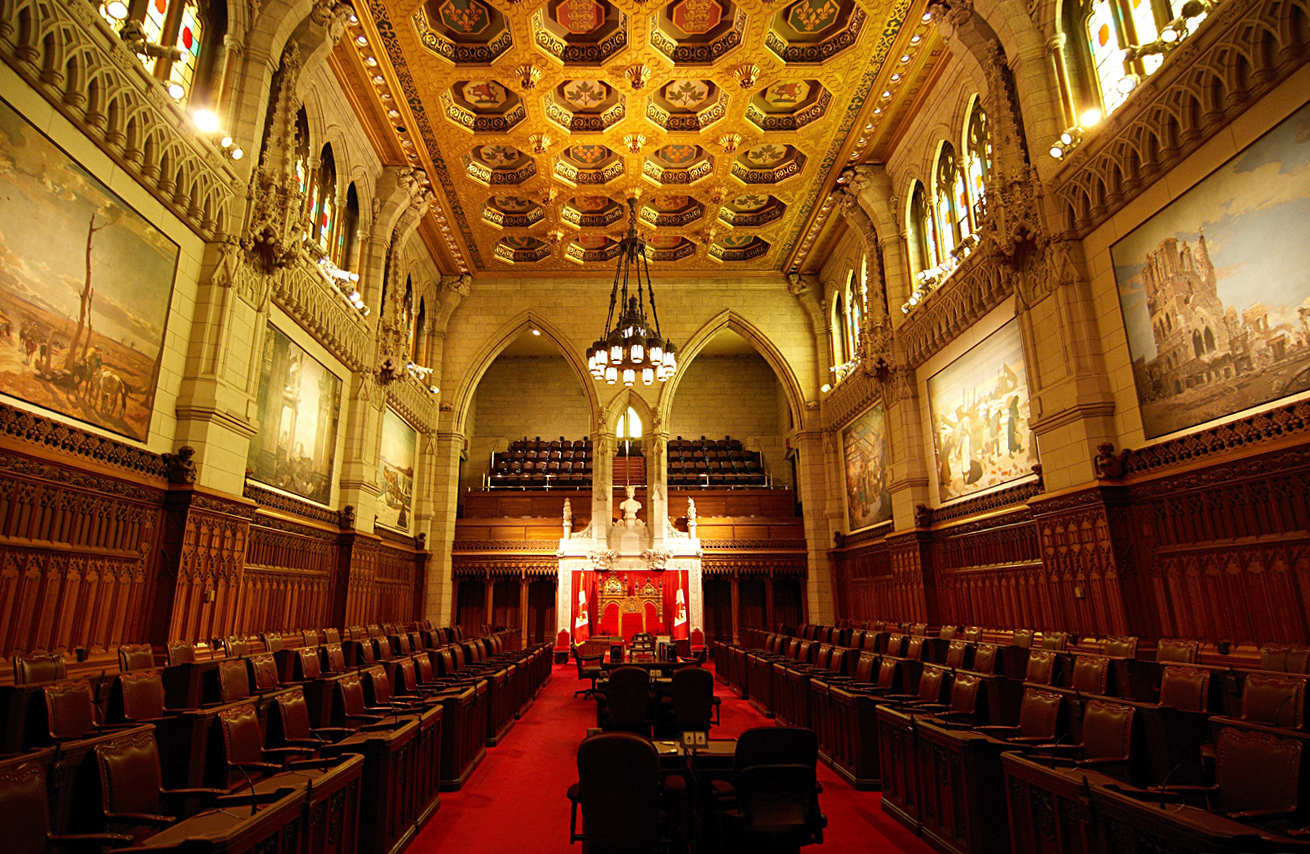
FILE: Senate Chamber, Centre Block of the Parliament of Canada (Photo By Mightydrake – Own work, CC BY 3.0)
OTTAWA — Bills are spending more than twice as long in the Senate since Prime Minister Justin Trudeau’s reforms to the upper house of Parliament, raising the question of who should get the credit for the chamber’s more thorough approach — or the blame for its plodding pace.
From 2011 to 2015, when the Senate was controlled by Conservatives, government bills from the House of Commons spent an average of just 12 sitting days in the upper chamber, according to an analysis by The Canadian Press.
In the past four years, however, the length of time a bill will spend in the Senate has skyrocketed to 31 days, on average. That number is even higher depending on how one divides up the time the two chambers spend dealing with amendments proposed by the Senate.
The calculations were made using the number of sitting days between the time a bill was introduced in the Senate and when it passed third reading there. The averages also exclude appropriations bills, which are rarely debated at length and pass swiftly.
According to the leader of the largest group in the upper chamber, that increase in time is, in part, a “reflection of the Senate doing its job.”
Yuen Pau Woo, the senator who serves as the “facilitator” for the Independent Senators Group, said more scrutiny, debate and deliberation meant longer timelines. The group is a loose affiliation of senators without formal party links, formed under Senate rules to distribute things like budgets and committee assignments.
Woo also pointed out the Senate amended a high proportion of bills — 29 out of 65 government bills originating in the House (again, excluding appropriations bills). Traditionally, a party that controls majorities in the Commons and the Senate has been able to count on senators not to get in the way of its legislation.
Woo noted that in no cases did the Senate insist on its amendments, meaning senators did not “overreach,” in his view.
“I think we very much met the test of an independent Senate,” he said.
But Woo also argued a portion of the delay was because of Conservative senators, “who have used the rules of the Senate to hold up bills and to delay their passage.”
Procedural shenanigans were usually aimed at making sure private members’ bills didn’t come to the floor of the Senate, but they had an effect on government legislation as well, Woo said.
“That’s just a complete fabrication,” said Stephen Kelly, chief of staff to Larry Smith, the Conservative leader in the Senate.
“The government determines the legislative agenda of the Senate” through negotiations with the Conservatives, he said.
However, Kelly did say the Conservatives were fulfilling their role as Official Opposition in giving voice to Canadians who were against the policies of the government.
“If that takes more time as opposed to less time, if that takes a little longer than what some people had hoped, then so be it. But those are the tools of opposition — it’s not unique to the current circumstances,” Kelly said.
At the end of the day, he said, the delays were a normal result of “the basic relationship in the chamber” and negotiations to set out the agenda between the government and the Official Opposition.
Add to that the fact the government needed to make so many amendments on its own bills, he said, and that during debates on sensitive bills like C-45 (the cannabis legalization bill), the government did not aggressively push other bills forward.
“The legislative lethargy of this government is not something that’s fabricated by the Opposition,” he argued.
On the Senate specifically, Kelly did note there is a “certain degree of incoherence” to the current structure of the chamber, with its independent elements. The inability of the government representative in the Senate, Sen. Peter Harder, to limit debate by invoking time allocation was one change that had an impact, he said.
For Woo, also, the current rules and procedures of the Senate could be improved.
Noting the crush of bills that were debated and passed in the last week of sitting time — major bills on the environment, solitary confinement, even the federal budget — he said many ISG senators were “dissatisfied” with the pacing of their work and the time afforded for real debate.
He specifically raised the example of Bill C-58, on the access-to-information law, which spent 116 sitting days in the Senate, by far the most of any bill.
“To me there is really no reason it should have taken that long,” Woo said, “and a more rational and orderly process of managing our agenda surely can be worked out and put into practice.”
Both sides acknowledged the election will lead to a turning point in the way the Senate functions — whether it will continue on its current path of reform or revert closer to its expressly partisan past. Conservative Leader Andrew Scheer has talked about returning to partisan appointments if he becomes prime minister; if Trudeau wins re-election, he’ll likely get to entrench his system of naming senators who don’t answer to a whip.
“This should be an issue which is front and centre in the election, because the Senate is a foundational institution in our democracy, and Canadians need to pay attention,” Woo said.
“There will be unfinished business, regardless of who wins the election.”




















