Canada News
Why a group of First Nations wants to own the Trans Mountain pipeline

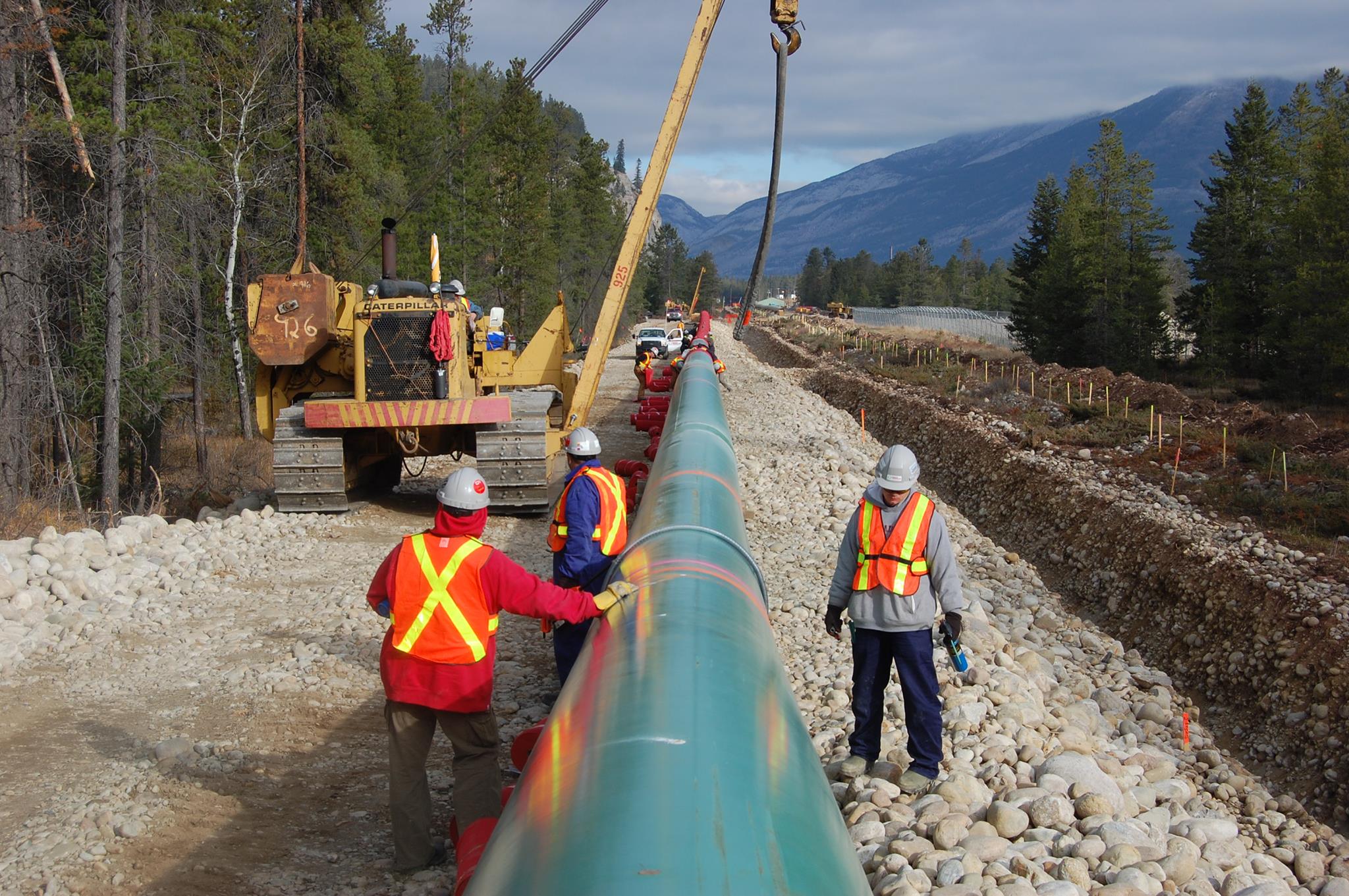
An Indigenous-led initiative to acquire majority ownership of the Trans Mountain pipeline and expansion could help foster economic independence for First Nations. (File Photo: Trans Mountain/Facebook)
The standoff between Indigenous communities — backed by environmentalists — and the oil industry has led to regional alienation that is threatening the fabric of Canada in ways not seen since the height ofthe Quebec separatist movement.
We, a business school professor and a former chief of the Thunderchild First Nation, believe the future of Canada — a major energy exporter — must include national economic prosperity, environmental stewardship and social and economic justice for Indigenous peoples.
An Indigenous-led initiative to acquire majority ownership of the Trans Mountain pipeline and expansion could help foster economic independence for First Nations. It could give Indigenous people a place at the table making decisions affecting the rivers, streams and oceans on their traditional territories and break the standoff over infrastructure development.
Different journeys
We met two years ago after the Thunderchild First Nation acquired a 16 per cent stake in Prairie Thunder Resources, an oil company. The chief asked the professor, who had board experience, to represent Thunderchild on the board.
Delbert Wapass was born on the Thunderchild First Nation on the Great Plains of North America. Family oral history has it that he is a descendent of Sitting Bull, the 19th century Indigenous leader.
He was the first in his family to attend university, earning a masters of education. After teaching for several years, he was elected chief of Thunderchild in 1998 and served until 2002. He was elected vice chief of the Federation of Sovereign Indigenous Nations for two terms between 2003 and 2010. He was elected chief of Thunderchild again in 2010, a post he then held for eight years.
Delbert looks to the ancestral teachings learned from his grandparents and practises traditional ceremonies to guide his vision for his people. He speaks his native Cree and English.
Harrie Vredenburg was born in the Netherlands and immigrated to Canada with his parents. He too was the first in his family to attend university, earning an MBA and PhD, eventually becoming a professor. He speaks his native Dutch and English.
For Delbert, the vision of First Nation economic sovereignty comes from being a chief, where the challenge is to provide for his people’s needs — housing, health care, food, education — with limited means. And those challenges must be met in a society straddling its traditional lifestyle of hunting, gathering and agriculture and the dark side of living in contemporary Canada: unemployment, poverty, addictions and suicide.
Harrie’s interest in Indigenous economic development and environmental and cultural stewardship dates back to the 1970s. He was a guide in the Arctic when Justice Thomas Berger was holding hearings for the Mackenzie Valley Pipeline Inquiry. This was the first time Canada recognized and consulted with Indigenous peoples.
Harrie went on to research oil company collaboration with Indigenous communities in the Amazon and their use of collaboration with intermediary organizations to bridge the divide between industry and communities. He co-authored a paper developing a model for resource industries to engage ethically with Indigenous peoples that eventually led to a UN Development Program project in Latin America where the oil industry stimulated sustainable economic development for Indigenous communities.
A pipeline to reconciliation
Since late 2018, we have both been involved in Project Reconciliation. We are building an inclusive coalition of Western Canada’s Indigenous communities to purchase a 51 per cent stake of the Trans Mountain pipeline and its expansion.
Because the initiative is based on mutual respect and places Indigenous people at the centre, the initiative has been well-received by Indigenous and business commentators. All Indigenous communities in British Columbia, Alberta and Saskatchewan have been invited to join.
The $7.6 billion needed to acquire the stake would come from a syndicated bond, essentially a loan. It would not involve taxpayer money or place up-front costs on First Nations communities, nor is there any liability risk to them should a mishap occur as Trans Mountain, like all pipeline companies regardless of ownership, carries insurance to cover incidents.
The pipeline and expansion already have long-term contracts in place to ship oil from Alberta to the marine terminal in Burnaby, B.C. It would generate profits to meet the communities’ high environmental standards — environmental monitoring, assessment and spill response — and provide income to build an Indigenous sovereign wealth fund.
Most of the income from the pipeline would be channelled into this fund that would be invested, like the oil export sovereign wealth funds of Norway, Abu Dhabi and Kuwait, in a professionally managed diversified portfolio of international financial and real assets for long-term returns to Indigenous communities.
These returns would support investments in Indigenous community sustainable infrastructure, from adequate housing, health care and Indigenous businesses to low-carbon energy.
Oil remains important to Canada
With a 51 per cent stake in the pipeline, Indigenous communities will have a say in the construction and operation of the expansion. They can ensure the highest standards for climate, safety, marine environment and spill response.
The B.C. coastline is home to more than 135 First Nations communities, and it is critical that Indigenous leaders and communities play a significant role in ensuring that this work is carried out responsibly and in a sustainable way.
Project Reconciliation will engage the First Nations Fisheries Council’s Marine and Environmental Response Program to train and certify marine and environmental response workers in coastal First Nations’ communities, and to connect them to employment opportunities across the marine sector.
While all Indigenous communities have been invited to join the coalition, some will not, on principle, and that will be respected.
Despite the global transition to lower carbon energy, the production and export of oil and oil technologies will remain part of Canada’s energy portfolio for many decades. Canada has the third-largest proven oil reserves in the world and is the world’s fourth-largest exporter of oil.
The oil industry represents more than 20 per cent of Canada’s exports and it employs thousands across the country in good jobs. The industry’s royalties and taxes fund government services across Canada.
Oil demand is growing globally, and the United States, once Canada’s only oil customer, has become a competitor. Canada has made technological leaps to meet the growing oil demand, but it needs pipelines to its coasts to reach markets.
A leader in emissions reduction
Canada’s oilsands industry is developing technologies to reduce emissions by increasing energy efficiency. The industry is achieving measurable results of increased energy efficiency and reduced emissions intensity, and is approaching the average energy efficiency and emissions per barrel of all global oils.
This means that the label “dirty oil,” sometimes used by opponents to describe the oilsands, is no longer applicable as Canadian oilsands-derived heavy oil, much in demand, is no dirtier (or cleaner) than average oil.
Waste gas flaring from conventional oil production worldwide has increased since 2010. It has not in Canada. A recent study concluded that if Canada’s minimal flaring practices were adopted worldwide, greenhouse gas emissions per barrel would fall by 23 per cent.
Despite these environmental advances, activists have blocked pipeline approvals. Without new pipelines, companies have halted major new investments and jobs have not materialized.
The median incomes on more than 80 per cent of Indigenous reserves lie below the poverty line, according to data from the 2016 census.
The federal government has said it is committed to implementing the Truth and Reconciliation Commission’s calls to action, which includes a call on the business sector to ensure Indigenous Peoples “gain long-term sustainable benefits from economic development projects.”
The government also supports the UN Declaration on the Rights of Indigenous Peoples, which articulates Indigenous Peoples’ right to economic development.
Change, however, has been slow.
Finance Minister Bill Morneau said discussions of possible Indigenous ownership could proceed “if the communities had `meaningful economic participation,’ if the deal can proceed in the spirit ofreconciliation and if the resulting entity works to the benefit of all Canadians and on a commercial basis.”
Project Reconciliation is the concrete execution of these principles.
Canada, it is time.
———
Delbert Wapass, executive chairman of the Project Reconciliation group and former chief of Thunderchild First Nation, co-authored this article.
———
This article is republished from The Conversation under a Creative Commons license. Disclosure information is available on the original site. Read the original article:
https://theconversation.com/why-a-group-of-first-nations-wants-to-ow