
News
Maduro’s foes fill embassies in Venezuela as crisis deepens

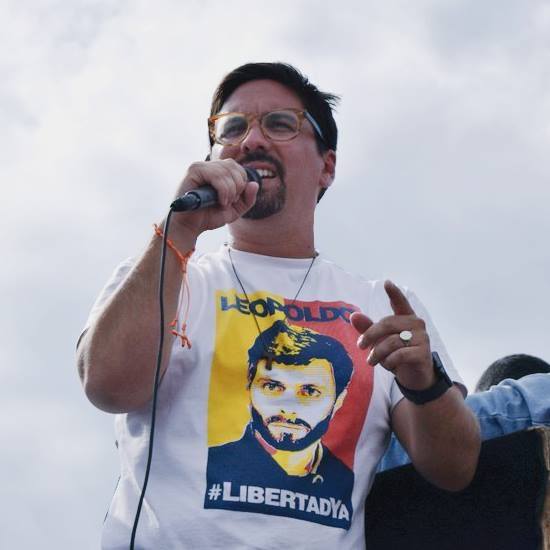
“Gracias, Gracias ambassador. In the name of all of us,” said Guevara speaking into his cellphone as he sits down for a rare interview inside the diplomatic compound that has been his uneasy and isolating home the past 18 months. (File Photo:
Freddy Guevara Cortez/Facebook)
CARACAS, Venezuela — From the lush tropical garden of the Chilean ambassador’s residence, Venezuelan opposition leader Freddy Guevara takes a much-anticipated call from a foreign diplomat and asks him to protect a fellow lawmaker fleeing President Nicolas Maduro’s latest crackdown.
“Gracias, Gracias ambassador. In the name of all of us,” said Guevara speaking into his cellphone as he sits down for a rare interview inside the diplomatic compound that has been his uneasy and isolating home the past 18 months.
“You probably think this was all staged for you, right?” he chuckles while tapping out a text message sharing the good news to someone in his party. “But the last few days have all been like this.”
As Venezuela’s crisis deepens, more and more government opponents are on the run, facing arrest for their role in a failed military uprising last week when opposition leader Juan Guaido briefly took control of a highway with a small cadre of troops seeking to topple Maduro.
But instead of going into exile, or to jail as another silenced martyr of the movement to oust Maduro, many dissidents are pounding on the doors of foreign embassies in a throwback to the dark days of the 1970s, when far bloodier military dictatorships in South America hunted down their opponents.
In the past 10 days, as Maduro has mopped up from the uprising, three lawmakers have taken refuge in the ambassadorial residences of Italy and Argentina, while opposition leader Leopoldo Lopez, who defied house arrest to partake in the putsch, is now living with his family in the Spanish ambassador’s residence. Others are hiding out in undisclosed missions while 18 national guardsmen who answered Guaido’s call to rebel are holed up in Panama’s embassy.
None have requested asylum, even though countries in Latin America have a tradition of granting such status to political outcasts showing up at their diplomatic missions, allowing them to enter instead as “guests” in a sort of limbo waiting for Maduro to fall.
For Guevara, that’s allowed him to remain politically active, holding frequent strategy sessions with Guaido and other members of their Popular Will party.
“I’m like the ghost in a haunted house: I can’t leave but if you want to come over you can talk to me,” he says.
Guevara’s decision to seek refuge inside the ambassador’s residence was part necessity, part political strategy.
The 33-year-old cut his political teeth during student protests against Hugo Chavez a decade ago and quickly rose through the opposition’s ranks after several of its stalwarts were jailed or exiled. As vice-president of the opposition-controlled congress, he was one of the leaders of anti-Maduro protests in 2017 that led to more than 130 deaths. When the government finally quelled the unrest, Guevara was high on the list of organizers they went after.
Guevara said he was tipped off about his impending arrest on charges of instigating violence by a Supreme Court magistrate and narrowly sneaked out the back door of his apartment building as feared SEBIN political police were arriving.
He appealed for protection from Chile in the hope that it would drive home to Venezuela’s neighbours, many of whom were reluctant to confront Maduro but now recognize Guaido as the country’s rightful leader, the spillover risks from a spiraling political and economic crisis.
“Every lawmaker living inside an embassy is a permanent reminder for that country, its media and its people that Nicolas Maduro isn’t just a problem for Venezuelans,” said Guevara. “Imagine if Nancy Pelosi had to run to an embassy because President Trump wanted to send her to prison, or the head of congress in France had to hide inside the Spanish embassy because of Macron.”
He was welcomed with open arms by Chile’s then-ambassador, Pedro Ramirez, who had already taken in Roberto Enriquez, president of the conservative COPEI party. Two years later, Enriquez is still living in the compound.
At one point, Ramirez was also sheltering five judges whose appointment to the high court by congress was disallowed by Maduro. The jurists, who did request asylum, later abandoned the residence and slipped across the border after Maduro’s government denied them safe passage into exile.
For Ramirez, who had served as a Cabinet minister in the socialist government of Salvador Allende, it was an opportunity to return a favour: When Allende was overthrown in 1973, Ramirez was arrested and spent three years in jail before being exiled to Venezuela, which took in tens of thousands of Chileans following the coup. Ramirez considered himself an admirer of Chavez but quickly came to view his successor Maduro as a dictator after returning to Venezuela as ambassador in 2014.
“Venezuela for me is like a second home,” said Ramirez from Chile’s capital. “It pains me to watch what’s happening. It’s almost indescribable.”
Clearly Guevara is better off than the 857 Venezuelans, including two fellow lawmakers, considered political prisoners by local human rights groups. Giant tortoises and loud-squawking “guacharaca” birds roam a tropical garden complete with a pool where he works from every day. Embassy employees cook his meals, power up a generator during frequent blackouts and resolve daily chores that are a time-consuming burden for even better-off Venezuelans in a collapsed economy marked by hyperinflation and widespread shortages.
But for all the comforts, the deprivations are real too: He can’t travel to visit family living abroad and he’s already missed two friends’ weddings where he was supposed to serve as best man. He’s also not allowed overt political activity, although Chile’s foreign ministry made him available to The Associated Press for a rare interview.
His own plans are also on hold. Recently he asked his fellow activist girlfriend to get married, convinced that he could no longer allow Maduro to dictate the course of his life. He’s confident they’ll be able to get married in a post-Maduro Venezuela — freed from what he calls his “golden cage” — by the end of the year.
“Part of resisting a dictatorship is just living your life,” he said.
Meanwhile, he draws strength from jumping rope and a book of daily prayers that was a favourite of Abraham Lincoln and that he bought at the U.S. National Archives in Washington.
“Freedom is something intrinsic to our common humanity — it’s not enough to just have a roof over year head, a bed and food,” he says. “That’s helped me understand why communism goes against human nature. … As the Bible says, ‘Man doesn’t live on bread alone.”’




















