
Lifestyle
Seeing is believing: 4 lessons of the new black hole image

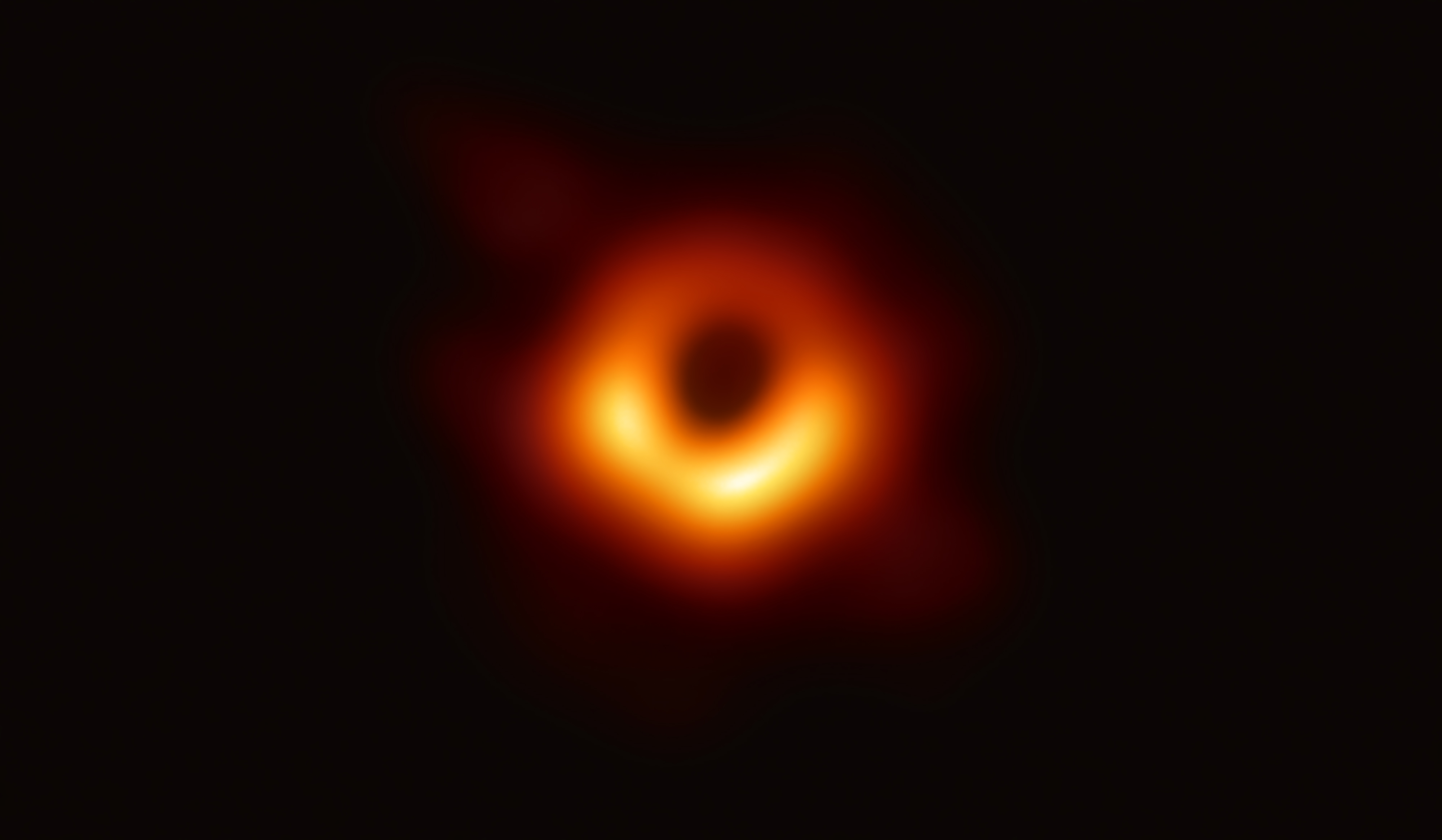
Using the Event Horizon Telescope, scientists obtained an image of the black hole at the center of galaxy M87, outlined by emission from hot gas swirling around it under the influence of strong gravity near its event horizon. (Photo: Event Horizon Telescope collaboration et al. via National Science Foundation/Website)
WASHINGTON — Black holes are cosmic prisons, where nothing escapes, not light or even data. But lots did come out of Wednesday’s first image of the shadowy edge of a supermassive black hole. Here are four things we learned:
SEEING IS BELIEVING
Scientists have known for decades that black holes exist, but only indirectly. Three years ago, they essentially heard the sound of two smaller black holes crashing together to form a gravitational wave. The image revealed Wednesday showed the edges of the black hole — called the “event horizon” — for the first time.
There actually were a few academic holdouts who denied black holes existed, but now they can’t, said Boston University astronomer Alan Marscher, who was on one of four imaging teams.
The new image shows a glowing ring that was obviously a black hole and its surroundings, said Harvard’s Sheperd Doeleman, director of the Event Horizon Telescope team.
“We saw something so true,” Doeleman said. “We saw something that really had a ring to it if you can use that phrase.”
He said the team “uncovered part of the universe that was off-limits to us.”
EINSTEIN IS RIGHT AGAIN
Each major astrophysics discovery of the last few decades tends to confirm Albert Einstein’s general theory of relativity. It’s a comprehensive explanation of gravity that the former patent clerk thought of in 1915 before computers and with much weaker telescopes.
On Wednesday, Einstein’s predictions about the shape and glow of a big black hole proved right, and astronomer after astronomer paid homage to the master.
“Today general relativity passed another crucial test,” said University of Waterloo astronomer Avery Broderick, a co-discoverer. “The Einstein equations are beautiful. So often in my experience, nature wants to be beautiful”.”
It sounds strange to keep saying Einstein is right, but every time his general relativity theory is confirmed, “we kill a cloud of alternative theories” and gain better understanding how to create an even more comprehensive theory of physics, said Ethan Vishniac of Johns Hopkins University. He wasn’t part of the discovery team.
GRAVITY IS POWERFUL
The black hole that scientists took a picture of is in the centre of a galaxy called M87 and it is far bigger than anything in the Milky Way. Its mass — the chief measurement of a black hole — is 6.5 billion times as much as our sun’s. The event horizon stretches about the breadth of our solar system.
“M87’s huge black hole mass makes it really a monster even by supermassive black hole standards,” said Sera Markoff, a discovery team member at the University of Amsterdam.
Some black holes are inactive, but not this one, she said. And that means it converts nearby gas and matter into energy with 100 times more efficiency than the nuclear fusion that powers the stars.
Black holes like these “temporarily become the most powerful engines in the universe,” Markoff said.
WORKING TOGETHER WORKS
The project succeeded because of international co-operation among 20 countries and about 200 scientists at a cost of $50 million to $60 million, according to the National Science Foundation.
To get an image of a faraway black hole, scientists had to get eight radio telescopes on several continents, including Antarctica, to look at the same place at the same time. In getting the instruments connected, they essentially created one Earth-size connected telescope.
The amount of data generated was so massive that it could not be transmitted over the internet, so it was flown to data centres by jet.
The data collected was equivalent to a lifetime collection of selfies from 40,000 people, said discovery team member Daniel Marrone of the University of Arizona.
And just to start to take pictures the weather had to be good at all eight telescopes on the same days in April 2017. The scientists had only 10 days to look and got four perfect weather days, three of them at the start.
It then took more than a year for that data to be processed into the first glimpse of images that scientists saw in the summer of 2018.
Those images were so good that scientists at first worried that it was just too good to be true, Boston University’s Marscher said.
——
The Associated Press Health and Science Department receives support from the Howard Hughes Medical Institute’s Department of Science Education. The AP is solely responsible for all content.




















