
News
Critics: Bangladesh vote opens door for an aggressive Hasina

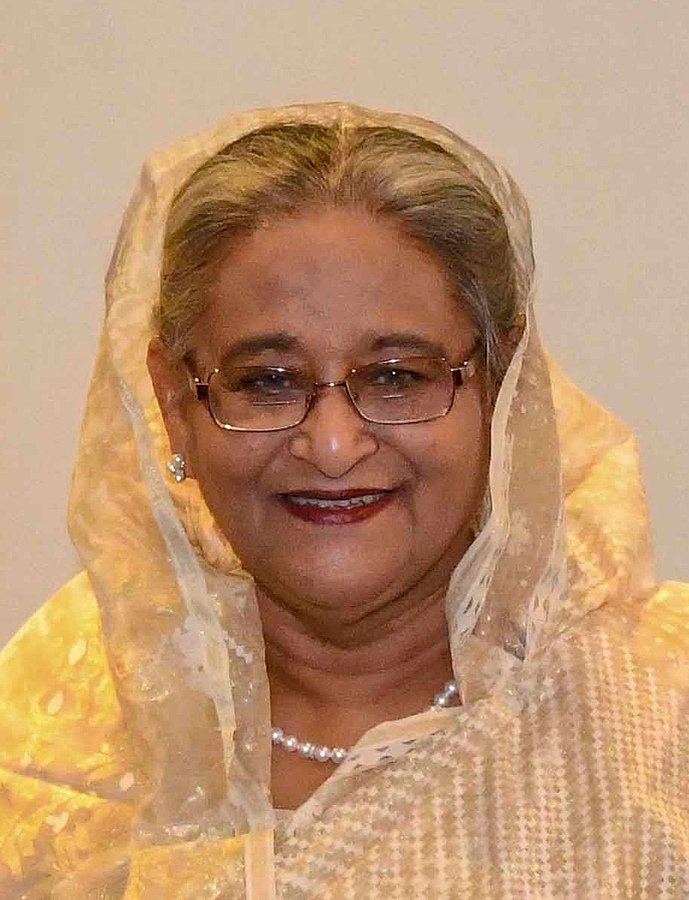
FILE: Secretary of State Michael R. Pompeo meets with Bangladeshi Prime Minister Sheikh Hasina, on the margins of the United Nations General Assembly, in New York City. (Photo
By U.S. Department of State from United States/Wikimedia commons, Public Domain)
DHAKA, Bangladesh — While Sheikh Hasina is set to begin her third consecutive term as Bangladesh’s prime minister following a landslide election victory, critics say having such an overwhelming majority in parliament could create space for her to become even more authoritarian.
The Hasina-led coalition won 288 seats in the 300-seat parliament in Sunday’s election, amid allegations by the opposition that the voting was rigged. Hasina rejected the accusations at a briefing with foreign journalists a day after the vote.
The new Cabinet is expected to be sworn in by Jan. 10, but members of the opposition alliance, which won only seven seats, said they would not take the oath. In response, the ruling party’s general secretary said byelections would be held for those seats. This would result in a parliament with virtually no opposition.
Over her last 10 years as prime minister, Hasina took up many development projects, from power generation to the building of a seaport, but her record of maintaining human rights was widely criticized by activists and international rights groups. Some of those critics now say her new government could be even more iron-handed and aggressive.
More than a dozen people were killed in election-related violence Sunday, and the election campaign was dogged by allegations of the arrests and jailing of thousands of Hasina’s opponents.
Dozens of activists took to the streets of Dhaka on Tuesday to protest the alleged gang rape by Hasina supporters of a mother of four who had voted for the opposition.
The opposition had blamed Hasina’s government for arbitrary arrests and enforced disappearances of dissenters, while the jailing of a renowned photographer on charges of spreading propaganda against the government sparked criticism at home and abroad. The enactment of a digital security law ahead of the election was criticized by journalists and rights groups who said it would choke free speech and media freedom.
The opposition accused the security agencies and the police of intimidation and threats to prevent them from campaigning ahead of the elections, and there were allegations that the Election Commission and other departments overlooked the complaints.
“Sheikh Hasina’s government during its previous term displayed an increasingly authoritarian streak, deeming all legitimate criticism to be anti-state,” said Meenakshi Ganguly, South Asia director for Human Rights Watch. “The ruling Awami League’s student and youth groups had free rein to bully and intimidate, while civil society faced pressure to self-censor.”
“It was particularly unfortunate that senior officials refused to address concerns of victims, including families of disappeared persons,” Ganguly said.
She doubted that the next government would be more tolerant.
“We remain concerned that a government that has allowed impunity for serious violations like extrajudicial killings and enforced disappearances will persist with little tolerance for dissent and constructive criticism,” Ganguly said.
Hasina trumpeted her development agenda to woo voters and said people voted her to power again for the development bonanza. She took up some big projects, including a bridge more than 5 kilometres (3 miles) long, a nuclear power plant and metro rail system for Dhaka, the capital.
But an analyst said it was not a legitimate argument.
“When you say that we’ll give you development but you have to sacrifice your rights, you have to sacrifice your voice,” said Asif Nazrul, a law professor at Dhaka University and a government critic. “Because if you look at the constitution of India, Bangladesh, Sri Lanka, Nepal, nowhere is it written that we are going to give you development but forget your political and civil rights.”
Still, Hasina enjoys a lot of support, especially from religious minorities in the Muslim-majority nation who say she has safeguarded their rights.
At the Dhakeshwari Temple in Dhaka, Hindus poured in on Tuesday to pray and get a glimpse of the Goddess Durga, something they say was not possible under previous governments.
“She has definitely unleashed and freed us minorities,” Jayanti Sharma, a Hindu devotee who was visiting from a nearby town, said of Hasina.
While parliament could be without a practical opposition, no major opposition leaders even exist in the country to pose a serious threat to Hasina.
Her archrival, former Prime Minister Khaleda Zia, the leader of the opposition Bangladesh Nationalist Party, is in jail. A court deemed Zia ineligible to run for office because she was sentenced to more than two years in prison after being convicted of corruption. Her supporters say the charges were politically motivated.
In Zia’s absence, opposition parties formed a coalition led by Kamal Hossain, an 82-year-old former member of Hasina’s Awami League who served as foreign minister under Hasina’s father, Sheikh Mujibur Rahman, Bangladesh’s founding leader.
Hossain is a leader of his small party, Gono Forum, which does not have much popular support. Hasina and Zia, on the other hand, have much larger support bases and attract hundreds of thousands of supporters to their rallies.
On Monday, during a briefing with foreign journalists and election observers, Hasina came down heavily on the opposition. In a wide-ranging discussion, she refused a suggestion that she offer her political foes an olive branch.
“The opposition you see, who are they? The main party, BNP, it was established by a military dictator (Zia’s husband, Ziaur Rahman) who introduced martial law in this country. There were no constitutional rights for the people,” Hasina said.
She dismissed questions about the fairness of the election.
“I feel that it was a very peaceful election,” Hasina said. “Some incidents took place, some of our Awami League party workers were killed by the opposition. I’m very sorry for that, but I always appreciate our law enforcement agencies, also our people who were working hard to have this election in a peaceful manner.”
But there have been allegations of widespread irregularities with the election.
On Sunday, The Associated Press received more than 50 calls from people across the country who identified themselves as opposition supporters complaining of intimidation and threats, and of being forced to vote in front of ruling party men inside polling booths.
Those complaints could not be verified independently.




















