
News
Trump and China loom over a tumultuous year in Asia

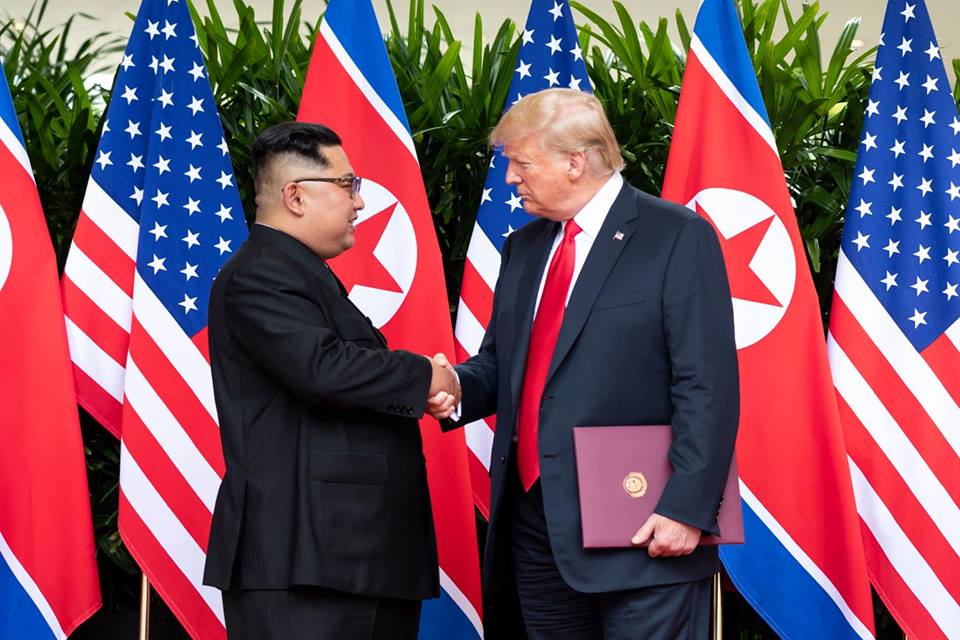
Just months after a barrage of threats of missile strikes and personal insults had many fearing the worst, President Donald Trump and North Korean leader Kim Jong Un strode toward each other on a sultry June day in Singapore and grasped hands, vowing to upend decades of animosity and pursue a nuclear settlement. (File Photo: Donald J. Trump/Facebook)
SEOUL, Korea, Republic Of — To judge by the stream of extraordinary images on the Korean Peninsula, you might think 2018 marked the beginning of an elusive peace in one of the world’s last vestiges of the Cold War.
Just months after a barrage of threats of missile strikes and personal insults had many fearing the worst, President Donald Trump and North Korean leader Kim Jong Un strode toward each other on a sultry June day in Singapore and grasped hands, vowing to upend decades of animosity and pursue a nuclear settlement. About a month earlier, Kim walked across the cracked concrete block that marks the Korean border, the world’s most heavily armed, and then, with a grin, guided a delighted South Korean President Moon Jae-in back into northern territory for a quick photo-op. Moon later flew into Pyongyang for a triumphant tour that saw him address a stadium of 150,000 North Koreans.
And yet, despite all the jaw-dropping images, any one of which would have stood out in sharp relief in an ordinary year, a sense of unease has taken hold in South Korea. There has been no substantial disarmament by the North, no grand peace deals, and many have the same old fears that North Korea will never give up its nuclear arsenal.
As 2018 draws to a close, the Korean Peninsula is not the only place in Asia looking ahead with apprehension.
Across the region, there are pockets of optimism but also a pervasive feeling of disquiet, a lot of which is linked to the twin political behemoths whose presence has been felt this year in every corner of Asia: China and Trump. That’s especially true of a Trump-China trade war that has caused fears of a global economic slowdown.
Much of the news in Asia has been the typical scattershot fare of tragedy and triumph: there were catastrophic tsunamis, quakes and floods in the Pacific “Ring of Fire,’ the return to office in Malaysia of a 93-year-old former strongman, and a fall from grace for the Nobel Peace laureate who now leads Myanmar over what many call a campaign of ethnic cleansing against hundreds of thousands of Muslim Rohingya.
But if you want to mark a through-line in a region that contains more than half the world’s population and boasts a stunning range of diversity, look to China and Trump.
China’s increasing power has been impossible to ignore on the Korean Peninsula, where Beijing props up its ally in Pyongyang even as it serves as Seoul’s largest trading partner. Beijing fires up feelings of both nationalist rage and avarice in Southeast and South Asia as it pushes its territorial claims, using huge sums of money, investment and diplomatic energy to promote its interests.
For his part, Trump has made himself felt in a way both modern and unorthodox, using his Twitter feed to repeatedly wade into Asia’s biggest hot spots in a manner that for many here can seem intent on upsetting years of previous U.S. policy and precedent in the region.
His fraught diplomacy with North Korea and his high-stakes trade dispute with Beijing have drawn the most attention.
After testing the effectiveness of belligerent rhetoric, Trump has turned to action with China, hiking tariffs on Chinese goods over U.S. complaints that Beijing steals or pressures companies to hand over technology.
Trump’s moves against Beijing, which denies any trade misbehaviour, reflect broad American anxiety about Chinese competition and fears that Beijing’s plans for the state-led creation of global tech champions might erode U.S. industrial leadership.
Trump and his Chinese counterpart, Xi Jinping, agreed Dec. 1 to postpone more tariff hikes for 90 days while they negotiate, and U.S. and Chinese envoys are preparing for talks in January. But penalties that have hammered Chinese manufacturers, American soybean farmers and other exporters remained in place.
Forecasters warn that with no resolution, the conflict could knock up to 0.5 percentage points off global growth through 2020. They say the loss to China’s growth could be as much as 1.3 percentage points next year.
As Trump and Kim angle for another summit, there are growing doubts that Kim will ever voluntarily deal away the weapons that he likely sees as his strongest guarantee of survival. Several reports from private analysts in recent weeks have accused the North of continuing nuclear and missile development, citing details from commercial satellite imagery.
And analysts say that China, North Korea’s main economic lifeline, has been loosening its enforcement of sanctions against the North following Kim’s outreach to Beijing and amid the trade dispute with the United States.
China and Trump were also on the minds of officials in South and Southeast Asia this year.
India managed to avoid the worst of the Sino-U.S. trade spat, but even New Delhi, which Washington sees as a valuable ally and a bulwark against growing Chinese power, comes in for occasional criticism, such as when Trump blasted India’s tariffs amid Harley-Davidson’s decision to move production overseas.
The government of Prime Minister Narendra Modi is often more focused on Beijing than on Washington, watching warily as China’s influence grows in countries like the Maldives and Sri Lanka, both of which India has long seen as within its sphere of influence. New Delhi was quietly relieved by the 2018 electoral defeat of former Maldives strongman Yameen Abdul Gayoom, who had forged increasingly close ties to China.
In Southeast Asia, China, whose historical influence over the region used to be checked by projections of American force, has stepped up efforts to take advantage of a perceived U.S. vacuum and has, with little challenge, asserted its maritime claims in the South China Sea by building island bases in waters also claimed by four other governments, most notably Vietnam and the Philippines.
China’s soft power, in the form of infrastructure investment, especially related to its ambitious Belt and Road Initiative, began to meet some pushback, as financial terms and prospective debt began to be seen as potentially onerous.
The region’s most stunning political development came in Malaysia, where Prime Minister Mahathir Mohamad united with former foes to oust his old long-ruling party. After taking over, Mahathir cancelled plans for some major Chinese projects.
In Myanmar, democracy activists’ high hopes that the coming to power of Aung San Suu Kyi in 2016 would usher in enlightened civilian rule have died as the Nobel Peace laureate has failed to restrain, or even denounce, the Buddhist-majority country’s violent military campaign against the Muslim Rohingya minority. More than 700,000 Rohingya still languish in miserable refugee camps in neighbouring Bangladesh after being driven out of their homeland beginning in 2017.
But Southeast Asia also had what might have been Asia’s most inspiring story of the year when Thai navy SEALs and cave divers from around the world staged a daring underwater rescue of 12 members of a boys’ soccer team and their coach who’d been trapped in a flooded cave in northern Thailand for almost three weeks.
Maybe it’s fitting that this rare feel-good story, unlike much of the rest of Asia, had little to do with either Trump or China.
———
Associated Press writers Kim Tong-hyung in Seoul, South Korea, Grant Peck in Bangkok, Tim Sullivan in New Delhi and Joe McDonald in Beijing contributed to this report. Foster Klug is AP’s bureau chief for South Korea and has covered Asia since 2005.




















