
Canada News
Canada to send hundreds of observers to Ukraine presidential election

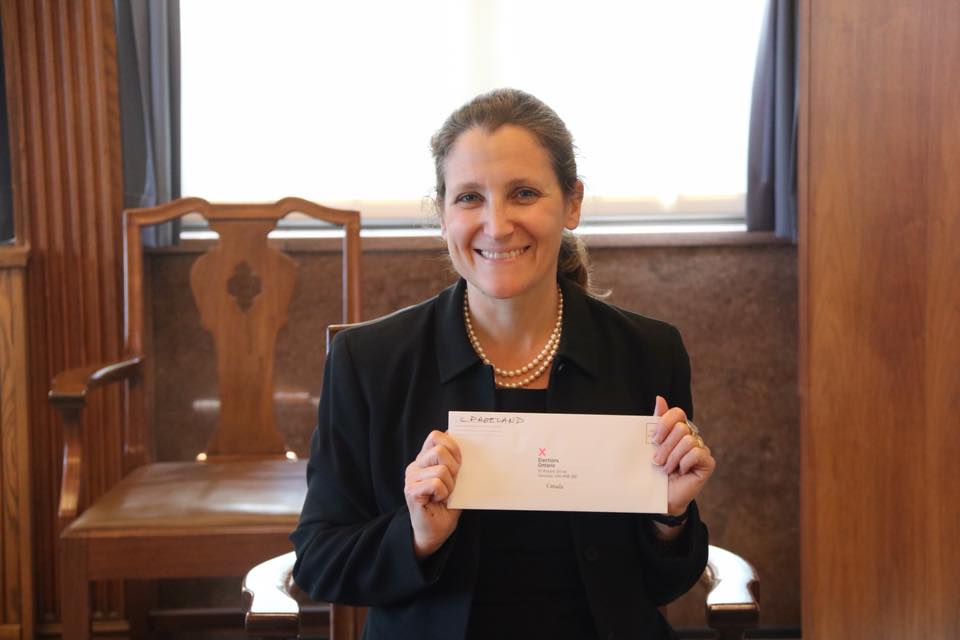
Freeland, who is at OSCE meetings in Milan, said that Canada is a steadfast partner of Ukraine, and that election missions are key to strengthening democratic institutions. (File Photo: Chrystia Freeland/Facebook)
OTTAWA — Canada is planning to send hundreds of election observers to Ukraine to prevent Russian meddling in its March 2019 presidential elections, The Canadian Press has learned.
Government officials, speaking on the condition of anonymity, say as many as 500 monitors could be sent in missions run by the Organization for Security and Co-operation in Europe as well as a separate mission organized between Ukraine and Canada.
Foreign Affairs Minister Chrystia Freeland and International Development Minister Marie-Claude Bibeau announced a $24-million contribution on Thursday to support electoral reforms, gender equality and inclusive governance in Ukraine.
Ukraine’s ambassador to Canada told The Canadian Press recently that his country is convinced it will face Russian interference in the upcoming presidential ballot.
Andriy Shevchenko also says the recent Russian seizure of three Ukrainian ships and their two dozen sailors in the Kerch Strait last month is another attempt to destabilize Ukraine ahead of the election.
Freeland, who is at OSCE meetings in Milan, said that Canada is a steadfast partner of Ukraine, and that election missions are key to strengthening democratic institutions.
“Canada’s commitment to democracy and the sovereignty of Ukraine is unwavering,” Freeland said in a statement.
The commander of the Canadian Army, Lt.-Gen. Jean-Marc Lanthier, also just returned from a visit to Ukraine, which included time with Canadian troops and meetings with multiple Ukrainian military leaders. Canada wants to help Ukraine “maintain its sovereignty, security and stability,” the Department of National Defence said of the trip.
A senior official said the number of election observers sent for the March election will depend on what the OSCE asks for.
The OSCE monitoring missions are widely considered the gold standard in international election monitoring. They include contributions from multiple countries.
Canada’s decision to send separate observer missions is unique and has generated controversy over the years, including numerous internal government assessments that found the missions to be either problematic or too expensive.
The practice has sparked concerns that successive Liberal and Conservative governments were simply playing politics to win the support of the estimated 1.3 million Canadians of Ukrainian descent.
A Liberal government sent the first group of observers in 2004 under the leadership of former prime minister John Turner. The former Conservative government of Stephen Harper contributed Canadians to several more of these “bilateral” missions.
“It is considered a best practice for international election monitoring to be organized through multilateral observation missions,” Margaret Biggs, the former head of the now defunct Canadian International Development Agency, wrote in an April 2012 memo obtained by The Canadian Press.
“Multilateral organizations, such as OSCE/ODIHR in the case of Ukraine, are viewed as the most impartial and trustworthy, and their findings are taken seriously by the host country and the international community.”
In 2014, the Conservative government sidelined the independent agency Canadem, which had picked the participants for bilateral mission from a roster of qualified recipients, and created a new entity to vet the participants.
Now, the government has decided to return to using Canadem to select the observers.
“Canada will support Ukraine by committing a significant number of Canadian observers to support both a Canadian bilateral observation mission and, if called upon next year, an Organization for Security and Co-operation in Europe (OSCE) election observation mission,” the government said in a statement on Thursday.