
Canada News
Feds’ social finance pledge turns Canada from ‘laggard’ to leader, experts say

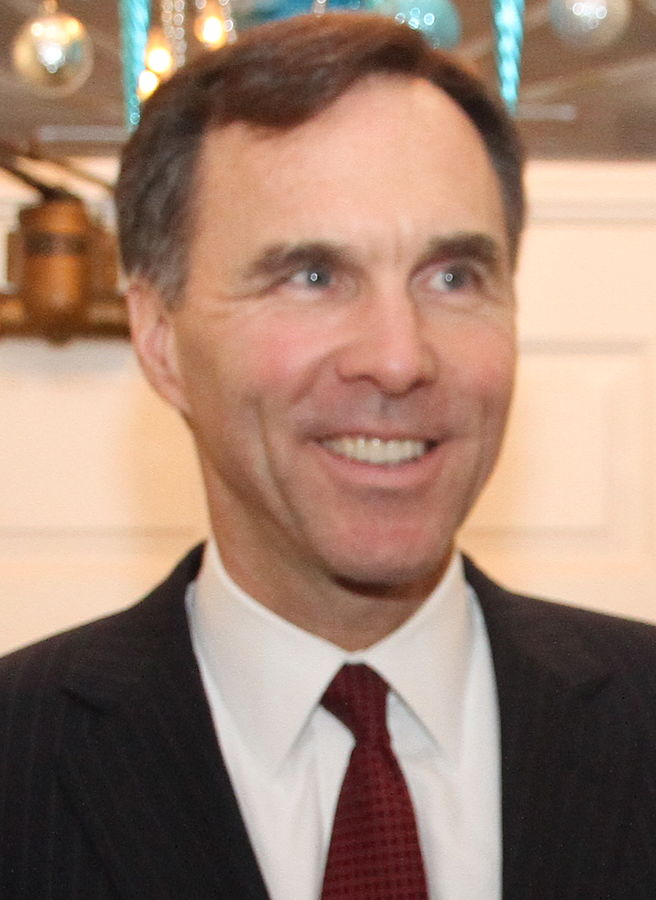
Finance Minister Bill Morneau is promising almost twice as much, spread over 10 years. (File Photo By US Embassy Canada/Wikimedia commons, CC BY 2.0)
OTTAWA — The Canadian government is sinking $755 million into an experimental way to pay for charitable work, charging into “social financing” with more seed money, proportionately, than similar efforts around the world.
A government-struck panel over the summer recommended the Liberals provide up to $500 million in financing for groups that provide services such as housing the homeless or training hard-to-employ people with new skills.
The government’s economic update this week went way beyond that. Internal government documents from this fall note that similar funds overseas, scaled toCanada’s population and economy, would have about $400 million in seed money. Finance Minister Bill Morneau is promising almost twice as much, spread over 10 years.
“It takes us from being a complete laggard in this area to being a world leader just with that level of commitment,” said James Tansey of the University of British Columbia’s Sauder Centre for Social Innovation and Impact Investing.
The goal of social financing is to bring private money into social services governments are used to either providing themselves or paying for directly, and sometimes ineffectively.
Instead of paying to teach people basic bike-repair skills, for instance, one type of social-finance program might offer a $100,000 payment to anyone who could train a certain number of people well enough to pass a certification standard. If the trainers could do it for $90,000, someone willing to advance them the money could make a $10,000 profit and apply some private-sector discipline to the effort.
Another type, like one run by Quebec non-profit
MicroEntreprendre, provides microloans to new Canadians to help
build businesses — amounts so small that they might not be worth it
to a traditional bank.
The federal seed money is meant to start local and regional funds that will encourage these kinds of deals, including by lending some of the advance money themselves. The idea is that as loans seeded with federal money are repaid, local intermediaries could hand out more loans and entice traditional lenders to open their wallets. And some of the money will come back to federal coffers.
“This would be investing in investments that are not already being supported or are viable within the commercial market,” said Ajmal Sataar, who co-chaired the expert panel and runs a group helping build social-finance know-how among grassroots groups. “Hopefully this creates a self-sustaining social finance market over time that would not require ongoing government support.”
What makes the approach attractive to governments is that it shifts financial risk from taxpayers to investors and can turn up more efficient ways of providing social services.
“This is putting capital in the hands of people who have solutions, who can propose lots of ideas, but need that support to go the next step,” said Stephen Huddart, CEO of the McConnell Foundation, which has a social-investment program.
Many small charities, however, don’t know how to set up a partnership with a private investor, or don’t have the know-how to apply for federal cash — an issue flagged in the expert panel’s summer report.
The government’s response is an additional $50 million to help groups learn how to land the upcoming federal money.
Documents obtained by The Canadian Press under the access-to-information law show that when senior civil servants met a delegation from two international funds in early September — Big Society Capital in the U.K., and Portugal’s Social Innovation Fund — key questions were how much money a Canadian version required and what pitfalls it needed to avoid.
The U.K. fund, for example, had a hard time handing out capital because groups either weren’t ready for the system or were turned off by demands for high returns. The Portuguese fund found there weren’t enough middlemen to hand out funding to local groups.
Adam Jagelewski, lead executive at the MaRS Centre for Impact Investing, said international experience underlines the importance of getting the operating details right. The Liberals say those details will come out early next year.
“If we can learn from our global colleagues on how to do this right, I think everyone will remain happy,” Jagelewski said.
The Liberals hope all the seed spending blossoms into $2 billion in economic activity and creates or maintains up to 100,000 jobs over the next decade. Social Development Minister Jean-Yves Duclos, who has overseen work on a social-finance strategy, said the actual outcomes will rest on how well the government and social-services sector work together.
Part of that work, he said, will be seeing “how able they will be to generate significant social and economic outcomes.”




















