
News
When Moon meets Kim: Can roads pave way to denuclearization?

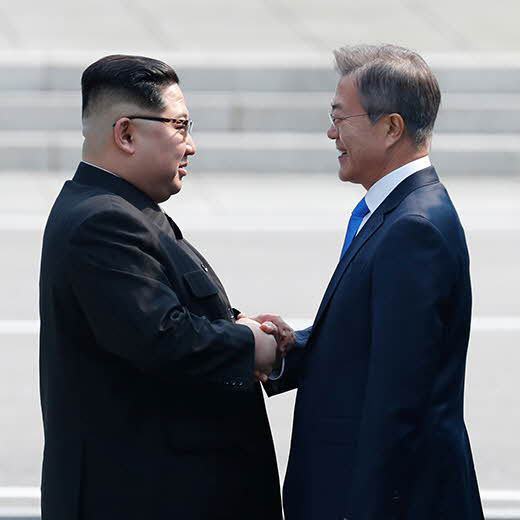
Could fixing it help pave the way to denuclearization? (File Photo By Cheongwadae / Blue House, KOGL)
PYONGYANG, Korea, Democratic People’s Republic Of — Reunification Highway runs all the way from the North Korean capital of Pyongyang to the Demilitarized Zone that divides the North from South Korea, 170 kilometres (100 miles) away. It starts under a giant concrete arch depicting two women in traditional gowns reaching out to each other and holding up a map of a unified Korea. Road signs along the way show the distance to Seoul, though it’s impossible to actually drive there.
The highway is one of the best in North Korea. It’s paved — a rarity in the North. It’s broad and visibility is generally good. But it’s also riddled with cracks and potholes. Lanes aren’t marked well, if at all. At night it’s pitch black, unless there are oncoming headlights. If it were on the South side, it wouldn’t be one of the best, it would be among the very worst.
Could fixing it help pave the way to denuclearization?
When South Korean President Moon Jae-in travels to Pyongyang this week for his third summit with North Korean leader Kim Jong Un, he will have two major tasks: He needs to keep Pyongyang’s talks with Washington on denuclearization from breaking down so that his own efforts at rapprochement can continue, and he needs to speed up a series of inter-Korean co-operation and engagement projects to keep frictions with the North low and his domestic critics at bay.
With each summit, the stakes get higher. It’s still unclear what Kim, riding a wave of successes in his debut on the world stage and fresh off a major celebration marking North Korea’s 70th anniversary, intends to do with his nuclear weapons. And pressure is mounting in the administration of President Donald Trump for quick and concrete progress.
Moon’s gamble has consistently been to pursue increased engagement on such things as joint projects to improve roads, railways and the North’s decrepit electricity grid with the big-ticket items that generally get all the headlines — denuclearization and a formal peace agreement for the Korean War, which ended in 1953 with what was intended to be a temporary armistice.
Moon’s approach hinges on the belief that better inter-Korean relations will naturally lower tensions and that joint projects to improve the North’s infrastructure are an investment in Korea’s future that has the potential to benefit both sides significantly in the long term.
Kim has been all ears.
His push this year to pursue better relations with the North’s neighbours, resulting in a flurry of summits with Moon and Chinese leader Xi Jinping and his meeting with Trump in June, was based on his claim that he had sufficiently built up his arsenal of long-range missiles and nuclear weapons and could shift his primary focus to improving the domestic economy.
Fixing the country’s infrastructure is a big part of that, and the reason why is telling.
Since assuming power after the death of his father in late 2011, Kim has allowed a market-based economy to grow significantly. The North remains decidedly socialist, and the role of the central government in economic planning and policies continues to be key.
But the role of markets and capitalist-style entrepreneurialism has also become an established fact of daily life and an important income source for the regime.
Better roads and railways, and the ability to move goods and people quickly and reliably, would help such economic activity grow.
Kim has been surprisingly open about the sad state of his country’s transportation system. In his first summit with Moon, he expressed his “embarrassment” about the “poor transit infrastructure.” That same month, he conveyed his “uncontrollable grief” over the death of dozens of Chinese tourists whose bus plunged off a bridge near the city of Kaesong, which is close to the South Korean border.
Proposals to boost the North’s infrastructure go way back. They were an important part of the South’s “Sunshine” policies of the late 1990s to 2009, when the North conducted a nuclear test that sent relations into a rapid downward spiral. Seoul declared the policies a failure the following year, but Moon has wasted no time in trying to revive them.
In their first meeting, Moon laid out his plans for North Korean development on a USB memory stick.
Ultimately, South Korea wants to see a high-speed train linking its capital of Seoul to Pyongyang and farther north to Sinuiju, an important trade hub on the Chinese border. The price tag is a reported $35 billion. By the time the summit was over, both sides had agreed to work together to improve the roads and railways in what is called the eastern transportation corridor, and from Pyongyang to Sinuiju.
How far they will get remains to be seen. Similar plans have been kicking around for years, if not decades. Connecting the rail systems was on the agenda of a North-South summit in 2000 as well.
Moon’s vision goes well beyond Korea’s borders.
At an event last month, he said he wants to see the establishment of road and rail links with the North to deepen regional economic integration with China, the Russian Far East and even Mongolia. He said he wants this to get underway before the end of the year.
The biggest obstacle, however, might be the United States.
The U.S.-led United Nations Command, which monitors activity around the DMZ, blocked plans for the North and South to conduct a field study of the North’s railroads last month. The plan was to run a train along a railway linking Seoul to Sinuiju.
The command reportedly refused to approve the plan because Seoul did not supply enough details.
Officials in Washington have also expressed concern that Seoul may be moving too fast and undermining support for trade sanctions that the U.S. sees as one of its best means of keeping the pressure on Pyongyang high. The Trump administration says it will keep its “maximum pressure” policy and sanctions in place until the North demonstrates it is serious about denuclearization.




















