
Canada News
A decade later, Alberta project aims to both capture CO2 and boost oil output

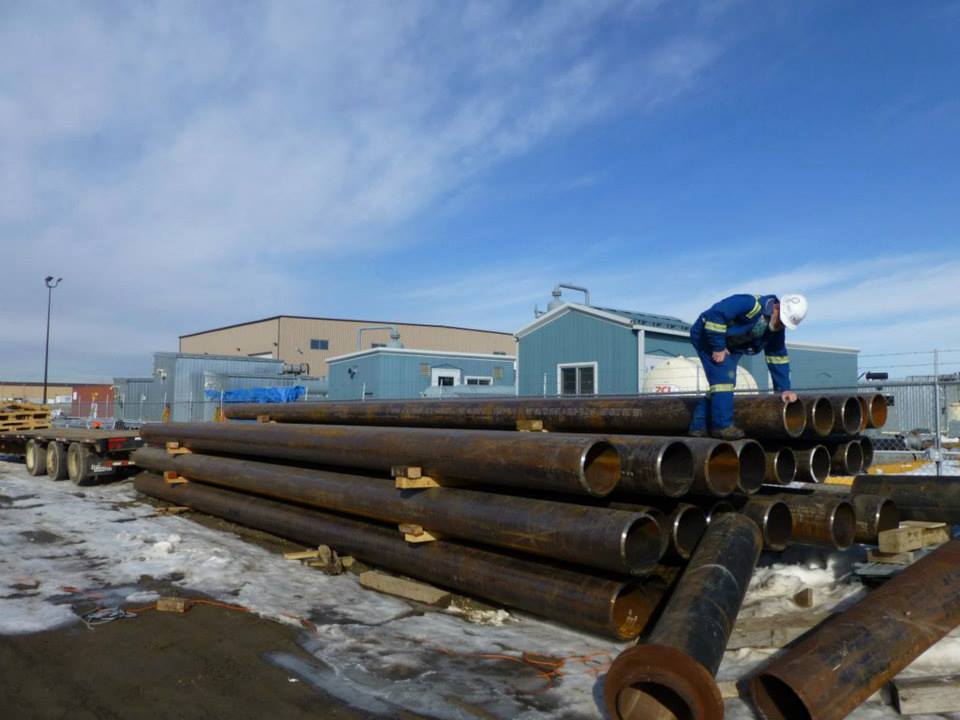
FILE: ACTL Pipe (Photo: Alberta Carbon Trunk Line)
CALGARY — Nearly a decade after winning millions of government dollars in support, a project with the seemingly contradictory goals of trapping greenhouse gas and boosting oil output is poised to bring a new dimension to the Alberta oilpatch.
In August, Enhance Energy announced it has enlisted Wolf Midstream as a partner on its long-awaited Alberta Carbon Trunk Line project to capture CO2 from two Edmonton-area industrial sites and ship it 240 kilometres south to a legacy oilfield near Clive, Alta.
The wells are to be drilled and the line commissioned by late 2019.
But that’s just the starting point, according to the two private Calgary companies, who say rising carbon taxes in Canada and producer demand for CO2 to coax oil from some of Alberta’s less productive oilfields could fuel a rapid expansion of the scheme.
It was a different world in 2009 when the project was promised $63 million from Ottawa under then-prime minister Stephen Harper and $495 million from Alberta under former Conservative premier Ed Stelmach.
The money was to be spent on upgrading the proposed Sturgeon Refinery to provide a pure CO2 stream for the project, as well as building the pipeline and drilling the wells, with some set aside for operating costs.
Startup was expected in 2012, but delays in building the refinery and difficulty in raising capital after the oil price crunch of 2014 resulted in the project being put on hold.
“Government funding was important for this project because it was built to have a lot of excess capacity … a 40,000-tonne (per day) pipeline that is only going to initially carry 5,000 tonnes per day,” said Enhance CEO Kevin Jabusch in an interview.
“I don’t believe it’s as critical for the next incremental addition to the system.”
Compressed CO2 mixes with oil trapped in spaces in the rock and increasing pressure so that crude flows more easily toward the recovery wells, said Jabusch. At the surface, the CO2 is separated, recompressed and sent back down an injection well.
In the oilfield Enhance initially intends to tap, about half of the original oil in place has been recovered.
“We think we can get another 15 to 20 per cent,” said Jabusch, adding the CO2 will be locked underground when all the recoverable oil has been produced and the well is capped and abandoned.
He said it won’t escape.
“We’re putting it in reservoirs that have held oil and gas for hundreds of millions of years, so we’ve got closed containers.”
The ACTL line is expected to attract customers building several more 2,000- to 5,000-tonne-per-day enhanced oil recovery (EOR) projects over the next five to 10 years, Wolf CEO Gordon Salahor said.
EOR, the process of injecting substances including hot and cold water, propane, natural gas and chemicals into underground reservoirs to produce more oil, is nothing new.
About 20 per cent of non-oilsands crude in Western Canada is produced using EOR and that production is rising, up 83,000 barrels per day over the past decade, while non-EOR volumes have declined by about 116,000 bpd, according to a June report by Capital Markets analysts.
The same report dubs carbon dioxide for EOR a “magic bullet” for the sector given Canada’s greenhouse gas reduction pledge and Ottawa’s carbon price that rises to $50 per tonne by 2022.
Using CO2 for EOR results in a half-tonne increase in downstream emissions for every tonne of CO2 brought to the EOR site, because of downstream consumption of the increased oil production, according to a 2013 study produced by the Pembina Institute environmental think-tank.
But there is a net reduction in overall CO2 emissions if one assumes that the oil produced displaces conventional crude, with an even bigger net reduction if it displaces oil from the oilsands, the study says.
The political climate provincially and federally has shifted away from carbon capture and storage but the study’s conclusion that CO2 for EOR is a valid part of the climate change solution is still relevant, said Duncan Kenyon, Pembina’s program director of responsible fossil fuels.
Industries that are among the biggest generators of jobs and wealth in the Canadian economy — think energy, fertilizer, chemicals, cement and steel — also produce the biggest emissions, he said. Capturing the CO2 and storing it underground doesn’t provide the revenue needed to make such programs financially sustainable.
That’s why the ACTL is a “foundational project,” he said, noting it runs through the middle of Alberta’s Industrial Heartland region and leads to mature oilfields that are ripe for CO2-powered enhanced oil recovery.
“It starts to glue together different projects that start to create a bit of an industrial ecosystem around the use of CO2 for economic purposes,” said Kenyon.
He believes the ACTL project will be more effective than Canada’s largest CO2 for EOR project, Saskatchewan’s Boundary Dam 3, which he calls a “boondoggle” for its $1.5-billion cost and poor operational track record since opening in 2014, as well as its sourcing of carbon dioxide from a coal-fired power plant.
Enhance and Wolf are counting on more than oil to make a profit. The trapped carbon dioxide qualifies for emission credits in Alberta that can be purchased by large emitters to offset the provincial carbon tax — now set at $30 per tonne — they must pay.
The Alberta government reports that over 49 million tonnes of emission offsets have been generated and sold since its program began in 2007. It says offset producers report getting prices of between $20 and $26 per tonne.