
Canada News
Radio telescope near Penticton, B.C., opening new doors in astrophysics

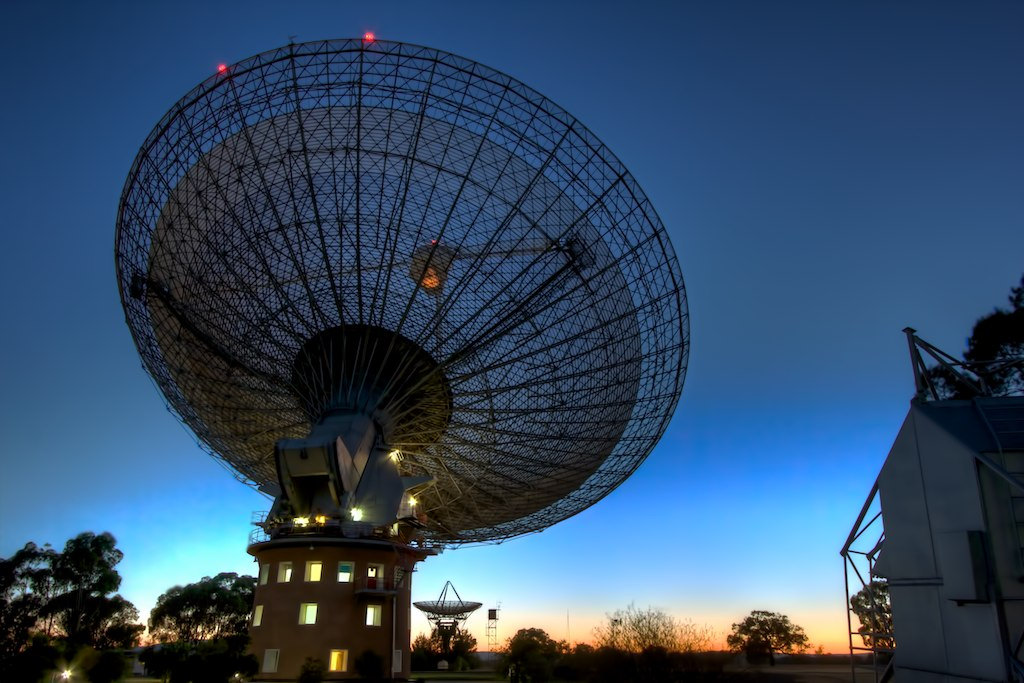
File Photo: “If you look in the right place, you’ll find it. It’s just hard to figure out where that place is,” she said. (Photo by Steve Dorman/Flickr, CC BY-NC 2.0)
VANCOUVER — A new radio telescope has allowed space watchers to see bursts of light travelling from a far-away galaxy in a discovery they say could open new doors in understanding the universe and the study of star systems.
The revolutionary radio telescope housed in an observatory south of Penticton, B.C., is at the centre of the Canadian Hydrogen Intensity Mapping Experiment, or CHIME.
It is a collaboration by several North American universities, including the University of British Columbia, the University of Toronto, McGill University, Yale and the National Research Council of Canada.
Deborah Good, a UBC PhD student working on the project, said unlike a normal radio dish, this radio telescope is made up of four cylinders containing 1,024 antennae that can measure fast, short-lived bursts of light found on the radio wave spectrum called fast radio bursts.
Fast radio bursts are made up of photons, which are particles of light that can be dispersed by gas and dust found it space. The further away they are, the more dispersed they will be.
The telescope was originally designed to chart hydrogen and measure the historical expansion of the universe.
Good said the majority of the bursts they previously detected were measured around 1,400 megahertz, making the bursts detected on July 25 at 580 megahertz an illuminating find.
While the telescope is extremely sensitive, Good said it’s a bit like looking for a needle in a haystack using a large magnifying glass.
“If you look in the right place, you’ll find it. It’s just hard to figure out where that place is,” she said.
Radio waves occur naturally from cosmic objects and lightning strikes, and are longer waves of light than the human eye can normally see, like the infrared and ultraviolet spectrums.
On a typical day, the telescope detects between two and 50 fast radio bursts. After a previous burst measuring 700 megahertz was spotted, Good said they were worried that might be the lowest frequency they could see with the telescope, or that perhaps they weren’t searching for the right frequencies.
“We’re kind of relieved to see that, indeed, we get to see things in the lower half of the band,” she said during a telephone interview.
Good likened the telescope to studying a group of college students: observing 20 college students would not necessarily give you enough data to analyze, but if you studied several thousand, the data becomes significantly deeper and allows researchers to find trends.
“If I know there’s one guy with glasses, that doesn’t tell me if glasses are just a feature that college students can have, or if this guy is some other type of thing because he’s a college student with glasses,” Good said while explaining the importance of measuring more fast radio bursts so researchers can better understand what they’ve found so far.
Researchers have detected several more such bursts recently, she said, but they are still measuring the information and she couldn’t go into further detail. The recent discoveries are very exciting and a bit of luck after weeks of hard work, she said.
“With astronomy we’re trying to detect something that’s out there and we don’t get to control when it shows up,” said Good, referring to the difficulty of the experiment versus more typical scientific experiments with human control.
For those hoping the radio bursts might be a sign of alien life, Good dispels that notion.
“There’s a bunch of theories right now, but one thing we’re really confident about is that it’s not aliens,” she said laughing.




















