
Canada News
Bitumen spill would harm swimming performance of migrating B.C. salmon: study

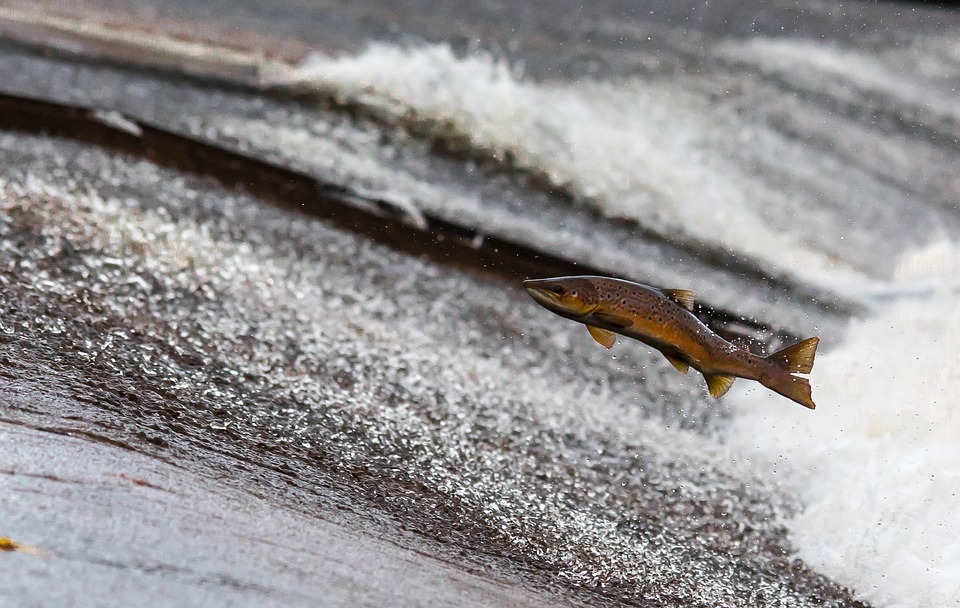
Bitumen has the consistency of crumbling asphalt and doesn’t flow freely like oil. It needs to be diluted with another petroleum product for it to flow through pipelines. (Pixabay photo)
VICTORIA— Salmon migrating through rivers and streams in British Columbia use all their strength, but new research says even tiny amounts of diluted bitumen weakens their chances of making it back to spawn.
Exposure to diluted bitumen hinders the swimming performance of salmon, causes their heart muscle to stiffen and damages their kidneys, Sarah Alderman, a post-doctorate researcher at the University of Guelph, said in an interview.
“We’re seeing changes from molecules up to what the organ actually looks like. All of this is affecting how they can actually swim.”
Bitumen has the consistency of crumbling asphalt and doesn’t flow freely like oil. It needs to be diluted with another petroleum product for it to flow through pipelines.
It is the main crude product flowing through Kinder Morgan’s Trans Mountain pipeline from Alberta to B.C. The capacity of the pipeline is slated to triple to 900,000 barrels a day.
No one was available from Trans Mountain for an interview. The company said in a statement that it is not familiar with the University of Guelph research, but it is committed to ensuring pipeline safety.
“Trans Mountain shares the value Canadians place on our waterways and our important salmon populations,” said the statement.
“Pipeline safety is our number one priority and, through the experience gained in 65 years of operations, Trans Mountain has developed a mature suite of programs to prevent pipeline failures and maximize the safety of the pipeline system.”
Alderman said their research and work from Simon Fraser University, based in Burnaby, B.C., and the University of British Columbia are the first studies on the impact of bitumen on salmon migration.
“It really is an area that hasn’t had much attention,” she said. “Our knowledge of bitumen toxicity is really limited.”
Alderman said a bitumen spill is more difficult to control than an oil spill because bitumen sinks, while oil can be corralled with booms and skimmed from the surface.
The research involved exposing year-old salmon, the typical age of migration from freshwater to the sea, to low levels of bitumen. The salmon exposed to diluted bitumen were found to be less fit, with a 15-per-cent reduction in swimming capacity and signs of cardiac fibrosis. she said.
Blood tests indicated muscle and kidney damage, raising concerns about the ability of the salmon to recover from their migration, Alderman said.
“All of our (bitumen) exposures are at really low concentrations, parts per billion,” she said. “It doesn’t take much to have a big effect. The highest one we used was about 70 parts per billion of these dissolved compounds, and that’s 20 times less than was measured in the Gulf of Mexico after the BP oil spill.”
An explosion on the Deep Water Horizon oil rig in 2010 caused massive environmental damage along the coastline of the United States. It is considered the largest marine oil spill in the industry’s history.
The researchers plan to test how salmon perform in a simulated migration from fresh to salt water after being exposed to diluted bitumen, Alderman said.
She said the Trans Mountain expansion project and a potential spill is on the minds of the researchers.
The pipeline crosses the Fraser River watershed, Canada’s largest freshwater salmon-bearing area, Alderman said. B.C.’s commercial salmon and sport fishing industries are worth hundreds of millions of dollars and the species has significant cultural and spiritual importance to Indigenous people.
Alderman said they want to know how to be prepared for a possible spill and initial research indicates a quick responses limits the harm to salmon populations.
“That’s the big take home message from our first study,” Alderman said. “If this happens it really matters what life stages are present in the stream and how quickly you can clean it up and how much gets spilled.”




















