
Canada News
UN says 1.25 million South Sudanese are 1 step from famine

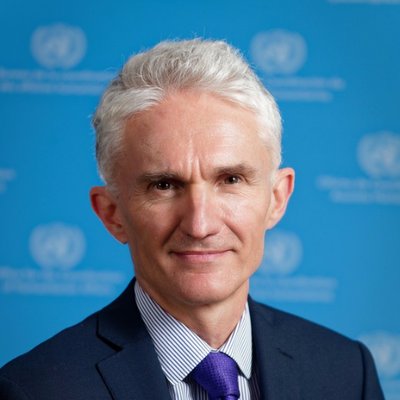
Mark Lowcock told the U.N. Security Council that even though 2 million people have fled the country over the past four years, 7 million people inside the country — “almost two-thirds of the remaining population” — still need humanitarian aid. (Photo: Mark LowcockVerified account/Twitter)
Over 1.2 million people in war-torn South Sudan are one step away from famine — twice as many as at the same time last year — and in early 2018 half the country’s population will be reliant on emergency food aid, the U.N. humanitarian chief said Thursday.
Mark Lowcock told the U.N. Security Council that even though 2 million people have fled the country over the past four years, 7 million people inside the country — “almost two-thirds of the remaining population” — still need humanitarian aid.
“The next lean season beginning in March is likely to see famine conditions in several locations across the country,” Lowcock said. “We were able to reverse famine conditions this year — with significant resources and risks — and we must avoid a repeat of this.”
U.N. peacekeeping chief Jean-Pierre Lacroix called the security situation in South Sudan “precarious” and warned of escalating military conflict and intercommunal fighting as the dry season sets in. He cited a resurgence of fighting in southern Unity states in the last two weeks between opposition forces allied to former vice-president Riek Machar and current First Vice-President Taban Deng.
In addition, he said, conflict-related human rights violations continue including looting, house burnings, killing of civilians, arbitrary arrests and sexual violence, “with organized forces being implicated as perpetrators in most instances.”
Lacroix urged the Security Council “to remain vigilant and exert more effort to condemn and stop the violence, protect civilians and urgently facilitate a political settlement of the conflict.”
There were high hopes that South Sudan would have peace and stability after its independence from neighbouring Sudan in 2011. But the world’s newest nation plunged into ethnic violence in December 2013 when forces loyal to President Salva Kiir, a Dinka, started battling those loyal to Machar, a Nuer who now lives in South Africa.
An August 2015 peace agreement has not stopped the fighting, and clashes in July 2016 between supporters of Kiir and Machar set off further violence. The conflict has killed tens of thousands of people.
Lacroix strongly backed the revitalization process put forward by the eight-nation East African regional group known as IGAD which aims to achieve a cease-fire, implement the 2015 peace agreement and develop “a revised and realistic timeline for its implementation.”
He said the U.N. hopes the IGAD-led High-Level Revitalization Forum, which is scheduled to start in mid-December, will not be a one-off event but “a sustained process” that holds the government and opposition accountable to end hostilities and ensure a successful transition.
Lacroix said the forum and a national dialogue under way at the local level in South Sudan “can address the spiraling crisis, if well-co-ordinated.”
“But fighting cannot continue in tandem with efforts to craft a durable peace,” he warned. “The two are simply incompatible.”
U.S. Ambasador Nikki Haley warned South Sudan’s government and rival forces last week that the United States is ready to pursue additional measures if they don’t take action to end violence, start negotiations, and ease the humanitarian crisis.