Health
Interview: Increasing screen time causes short-sightedness in children

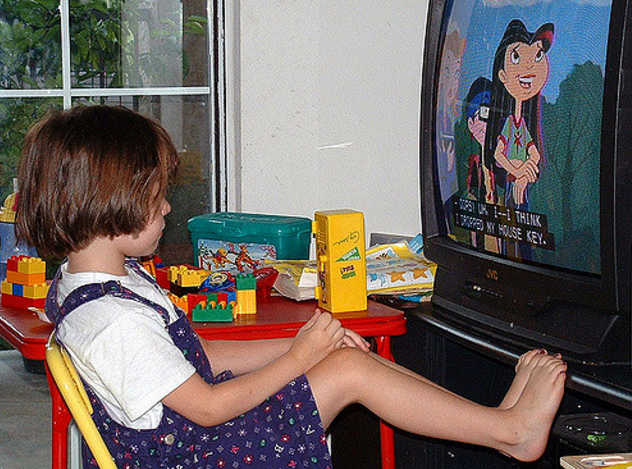
(Photo: Flickr/oddharmonic)
MELBOURNE – The increasing amount of time children spend looking at screens – TV, computer and mobile phone – could be responsible for the rising incidence of degenerative eye problems, an Australian expert has warned.
Christine Nearchou, a paediatric and binocular vision expert from the University of Melbourne, said that the prevalence of myopia, or short-sightedness, has risen to as high as 90 percent in some populations and it is only going to get worse.
Short-sightedness is an inability to properly see objects that are far away, with objects often appearing blurry, that gets worse as time progresses.
“Its prevalence is enormous. In the Asian population, prevalence among adults can be up to 90 percent.
It’s been increasing exponentially in the last 30 years,” Nearchou told Xinhua on Thursday.
“Once one becomes myopic, short-sightedness will progress as they get older. The earlier we become short-sighted the more short-sightedness we have by the time we are in our adult years and that can have lots of far-reaching effects such as increasing the risk of eye disease.
”
Myopia affects up to 2.3 billion people in the world, with Singapore having the worst rate of myopia in the world at 90 percent, prompting the World Health Organization (WHO) to label the condition an epidemic.
Nearchou said that changes in society, such as spending more time indoors and more time looking at screens at a close proximity, were the likely reasons for the rise in myopia, particularly among children.
Short-sightedness occurs as a result of the eye growing too long. As the eye stretches, light taken in from a long distance lands in front of the retina rather than on the retina, causing the image to be blurry.
While the mechanism in the eye that links increasing close proximity screen-time to myopia is not yet known, Nearchou said a number of studies have proven the link exists.
“There’s a lot of evidence from as far back as 100 years ago linking Myopia with the amount of ‘near-work’ (close to screens) that we do,” she told Xinhua.
“The two most significant factors are indoor/outdoor time, so the more time we spend indoors increases our risk, and the amount of time we spend doing ‘near-work,’ such as reading books or looking at screens also increases our risk.”
“Myopia in children who spend more time outdoors, up to 40 minutes outdoors per day, progressed much more slowly than children who had a normal unchanged routine.”
“There’s certainly evidence that we have to get our kids outdoors more.”
More time spent doing “near-work” increased the chances that the ciliary muscle, the muscle responsible for adjusting the lens of the eye, could become distressed and have a spasm, Nearchou said.
“As soon as we have to do that task for a prolonged period of time evidence shows it creates distress for the muscle which could cause headaches and the muscle to go into a spasm which accelerates myopia,” she said.
“The fact that it’s happening earlier in children is certainly a modern world problem purely because of the accessibility to near activities.”