Headline
Demonstrators raise voices in song to protest police killings of unarmed black men

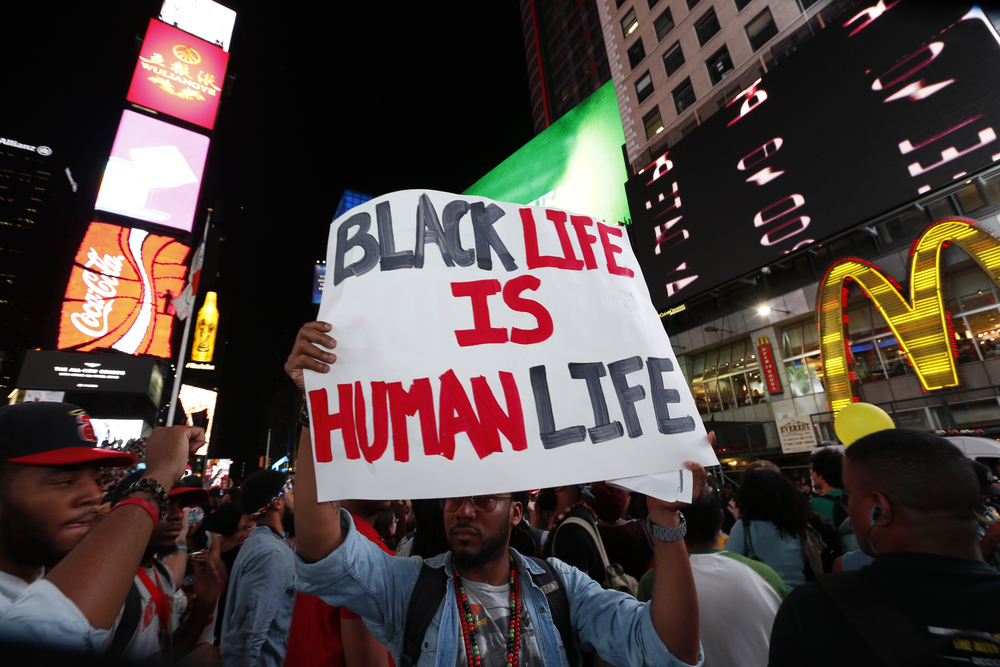
Thousands of New Yorkers responded to Anonymous’s call for a Day of Rage march & rally to demand justice for the police-related deaths of Michael Brown & Eric Garner. a katz / Shutterstock.com.
BERKELEY, Calif.—Stop. Hey, what’s that sound? Protest songs are taking their place alongside chants of “I can’t breathe” and “Hands up, don’t shoot” as demonstrators raise their voices to condemn the deaths of unarmed black men at the hands of police. There’s something happening here.
The killings of Eric Garner and Michael Brown have inspired a musical outpouring perhaps unseen in the U.S. since Pete Seeger helped make “We Shall Overcome” a civil-rights standard in the 1960s. Older songs are being redeployed for a new generation. New compositions are being widely shared, including some from major-label artists. And holiday classics are being rewritten, such as a barbed spin on “White Christmas.”
“Facts aren’t fueling this fire. Feeling is what is fueling this fire, and until we express those feelings and those feelings are understood, we aren’t going to get too far,” said Daniel Watts, a Broadway performer who starred in a professionally choreographed Times Square flash mob in response to Eric Garner’s death on Staten Island. He’s also written two more spoken-word pieces about police brutality that others set to music.
One of the tunes gaining a following on the streets and social media was penned six weeks ago by Luke Nephew, a 32-year-old Bronx poet who also has composed event-specific cantos for protests at immigration detention centres, foreclosure auctions and other demonstration sites. It has four lines, starting with “I still hear my brother crying, ‘I can’t breathe.’ Now I’m in the struggle singing. I can’t leave.”
Hundreds of people sang those words last week as they blocked bridges and got arrested in New York on the night after a grand jury declined to indict the white officer who used a chokehold on Garner. That so many knew the hymn-like song, and the way it has caught on since then, might owe as much to savvy preparation as the power of the lyrics.
Nephew first introduced the song at an early November meeting of activists preparing for the grand jury’s decision. The participants agreed to share it with their members so as many people as possible could join in when the time came. A recording was posted on YouTube and links made the rounds on Facebook and Twitter.
“We said, ‘Make sure you are taking this back to your organizations. Make sure you are learning this,”‘ recalled Jose Lopez, an organizer with the social service and advocacy group Make the Road New York.
Gospel singer and radio host Darlene McCoy, founder of a group called Mothers of Black Sons, heard the protesters in Manhattan singing as she watched the news at home in Atlanta. She was so taken with the images of people raising their voices in unison while being handcuffed that she replayed the broadcast to write down the words.
Unaware of its origins, McCoy immediately recorded herself singing Nephew’s composition, posted the file on Instagram and challenged other singers to do the same. At least 45 people have done so, including Catrina Brooks, a former “The X-Factor” contestant from Michigan, whose rendition has been viewed nearly 750,000 times.
“The funny thing is, you have to do it in 15 seconds,” McCoy said, referring to the site’s maximum video length. “And that’s a challenge for some artists.”
Some protesters find fresh relevance in popular music of the past—Sam Cooke’s “A Change is Gonna Come” or Michael Jackson’s “They Don’t Really Care About Us.”
Nephew is a bit baffled by how seldom contemporary music has been a part of American social movements in recent decades. He thinks it’s partly because people are no longer accustomed to singing together in public, partly because younger Americans are turned off by traditional folk and gospel tunes that do not speak to their experiences.
“It’s amazing how much of a vacuum there is,” he said. “God bless Pete Seeger. But where is his children’s generation?”
Questlove, drummer for the hip-hop band the Roots, urged fellow musicians via Instagram and Twitter last week “to be a voice of the times that we live in,” noting that “protest songs don’t have to be boring or non-danceable.”
Several professionals have already released home-produced tribute songs to Brown and Garner, including Alicia Keys, Long Beach rapper Crooked I, Rage Against the Machine guitarist Tom Morelo and hip-hop producer J. Cole.
Amateurs have gotten into the act too. A group in St. Louis disrupted a symphony performance of Brahms’ Requiem by singing a “Requiem for Mike Brown” and scattering confetti hearts from the balcony.
Other protests adopt a seasonal theme with “justice carols” that reimagine holiday classics—”All I Want for Christmas Is An Indictment” and “O Little Town of Ferguson.”
But whether any of the songs come to crystallize recent events in the way Buffalo Springfield’s “For What It’s Worth” came to symbolize the Vietnam War era, well, it ain’t exactly clear.
“It often takes time for ideas to percolate through and for people to step back and take a breath and write meaningful tunes,” said Ian Peddie, an English professor at Georgia Gwinnett College who studies the intersection of popular music and human rights. “There has to be that period of incubation.”