
Art and Culture
Chopin’s heart exhumed in secret, like a relic

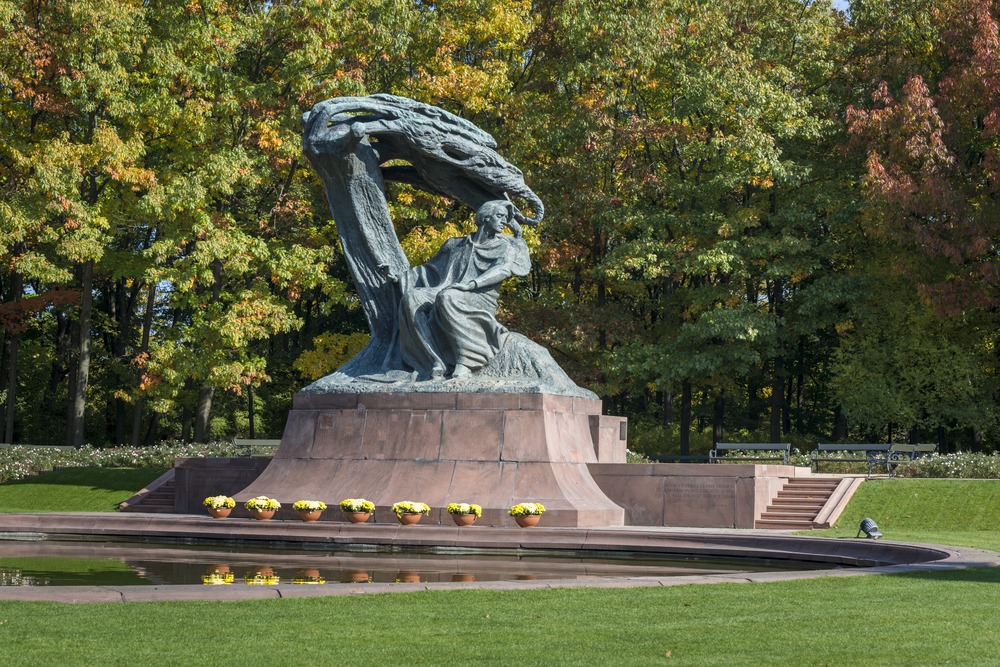
Polish pianist Frederic Chopin monument in Lazienki Park, Warszawa, Poland (Shutterstock)
WARSAW, Poland — As Frederic Chopin gasped for air on his deathbed in Paris in 1849, he whispered a request that became the stuff of musical legend: Remove my heart after I die and entomb it in Poland. He wanted the symbol of his soul to rest in the native land he pined for from self-imposed exile in France.
Ever since, the composer’s body has rested in peace at the famed Pere Lachaise cemetery in Paris — while his heart has endured a wild journey of intrigue and adulation.
First it was sealed in a jar of liquor believed to be cognac. Then it was smuggled into Warsaw past Russian border guards. Once in his hometown, Chopin’s heart passed through the hands of several relatives before being enshrined within a pillar in Holy Cross Church. During World War II, it briefly fell into the clutches of the Nazis. The organ has been exhumed several times, most recently in a secret operation to check whether the tissue remains well preserved.
Chopin’s heart inspires a deep fascination in Poland normally reserved for the relics of saints.
For Poles, Chopin’s nostalgic compositions capture the national spirit — and the heart’s fate is seen as intertwined with Poland’s greatest agonies and triumphs over nearly two centuries of foreign occupation, warfare and liberation.
“This is a very emotional object for Poles,” said Michal Witt, a geneticist involved in the inspection.
Chopin is “extremely special for the Polish soul.”
Chopin experts have wanted to carry out genetic testing to establish whether the sickly genius died at 39 of tuberculosis, as is generally believed, or of some other illness. But they remain frustrated. The Polish church and government, the custodians of the heart, have for years refused requests for any invasive tests, partly because of the opposition of a distant living relative of the composer.
This year, however, they finally consented to a superficial inspection after a forensic scientist raised alarm that after so many years the alcohol could have evaporated, leaving the heart to dry up and darken.
Close to midnight on April 14, after the last worshippers had left the Holy Cross Church, 13 people sworn to secrecy gathered in the dark sanctuary.
They included the archbishop of Warsaw, the culture minister, two scientists and other officials. With a feeling of mystery hanging in the air, they worked in total concentration, mostly whispering, as they removed the heart from its resting place and carried out the inspection — taking more than 1,000 photos and adding hot wax to the jar’s seal to prevent evaporation. Warsaw’s archbishop recited prayers over the heart and it was returned to its rightful place. By morning, visitors to the church saw no trace of the exhumation.
“The spirit of this night was very sublime,” said Tadeusz Dobosz, the forensic scientist on the team.
Polish officials kept all details of the inspection secret for five months before going public about it in September, giving no reason for the delay. They are also not releasing photographs of the heart, mindful of ethical considerations surrounding the display of human remains, said Artur Szklener, director of the Fryderyk Chopin Institute in Warsaw, a state body that helps preserve the composer’s legacy.
“We don’t want this to be a media sensation, with photos of the heart in the newspapers,” Szklener said. However, to prove that the heart is in good shape, he showed The Associated Press photographs of the organ, an enlarged white lump submerged in an amber-colored fluid in a crystal jar.
Some Chopin experts are critical of what they consider a lack of transparency.
Steven Lagerberg — the American author of “Chopin’s Heart: The Quest to Identify the Mysterious Illness of the World’s Most Beloved Composer” — believes international experts should have also been involved in the inspection. He said he wishes that the exhumation had involved genetic tests on a small sample of tissue to determine the cause of Chopin’s death.
Though Lagerberg and others believe that Chopin probably died of tuberculosis — the official cause of death — the matter isn’t fully settled.
Some scientists suspect cystic fibrosis, a disease still unknown in Chopin’s time, or even some other illnesses.
“The mystery of this man’s illness lingers on — how he could survive for so long with such a chronic illness and how he could write pieces of such extraordinary beauty,” Lagerberg said. “It’s an intellectual puzzle, it’s a medical mystery and it’s an issue of great scientific curiosity.”
Chopin was born near Warsaw in 1810 to a Polish mother and French emigre father. He lived in Warsaw until 1830, when he made his way to Paris — where he chose a life of exile because of the brutal repressions imposed by Imperial Russia after a failed uprising.
Fulfilling Chopin’s deathbed wish, which was also inspired by the composer’s fear of being buried alive, his sister Ludwika smuggled the heart to Warsaw, probably beneath her skirts. After being kept in the family home for several years it was eventually buried in the Baroque Holy Cross Church, in central Warsaw.
It remained there until World War II, when the Nazi occupiers removed it for safekeeping during the Warsaw Uprising of 1944. Even as they slaughtered Poles block-by-block, killing 200,000 people in retribution for the revolt, they took pains to preserve the relic of a composer that the Germans have sometimes claimed as their own, because of the influence great German composers had on him. After the fighting was over, they returned it to the Polish church in a ceremony meant to show their respect for culture.
Bogdan Zdrojewski, the culture minister who took part in the April inspection, defended his refusal to allow invasive testing of the heart.
“We in Poland often say that Chopin died longing for his homeland,” said Zdrojewski, who has since left the culture ministry to be a lawmaker at the European Parliament. “Additional information which could possibly be gained about his death would not be enough of a reason to disturb Chopin’s heart.”
Nonetheless officials have already announced plans for another inspection — 50 years from now.




















