Breaking
Harper says he’s optimistic about commodities, despite the ups and downs

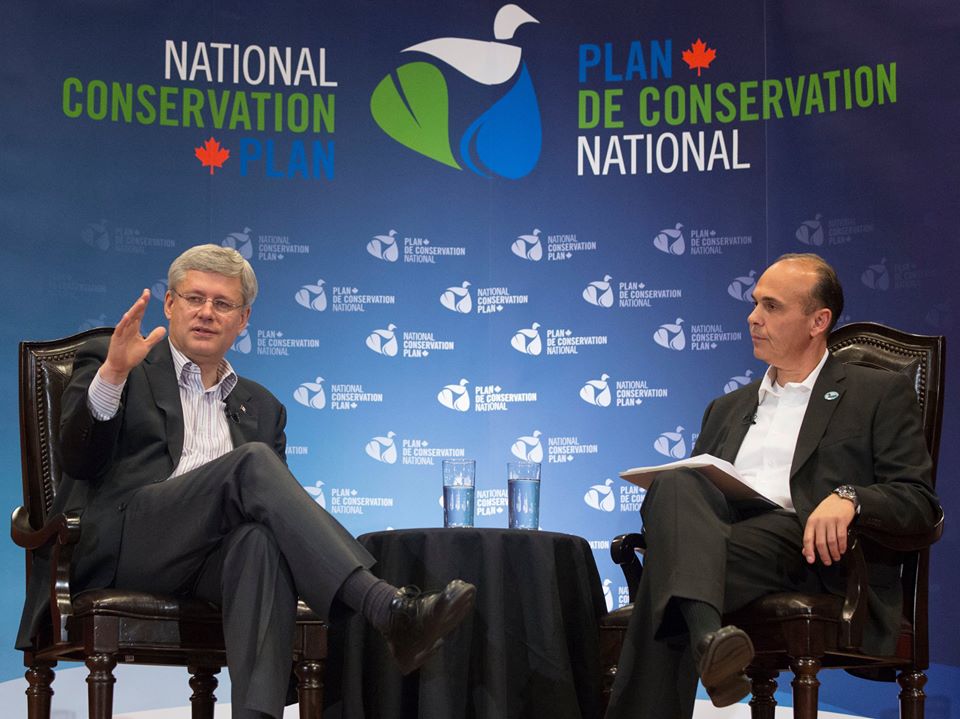
“Today I was in Sault Ste. Marie discussing our Government’s ongoing support for the hunting and angling community in Northern Ontario and across the country.” (Photo and caption courtesy of PM Harper’s official Facebook page)
OTTAWA — As Prime Minister Stephen Harper offered soothing words to those battered by the recent tumult in the Canadian commodity sector, there were already signs Friday that consumers are finding relief in the falling price of oil.
Speaking in Sault Ste. Marie, Ontario, Harper acknowledged the turmoil roiling commodity markets, but offered an optimistic long-term outlook, noting some Canadian mining and forestry companies have had success of late.
“Obviously, there are ups and downs in those industries, but I think many of them, of course, have been prospering in the last few years,” Harper said.
“As we have seen a growth in demand across the world, and I actually think notwithstanding the ups and downs, the long-term trajectory of increased demand for commodities is actually going to be there and going to help areas like this.”
But as motorists fill up on cheaper gas, economists warn lower crude prices are likely to damage the overall economic health of a country as dependent on oil production as Canada.
Tumbling oil prices, which have seen an even steeper slide this month, have already started to impact Canada’s inflation rate, said CIBC World Markets economist Nick Exarhos.
The annual rate edged down in September to two per cent, a dip of 0.1 percentage points from the previous month, according to the consumer price index released Friday by Statistics Canada. The inflationary impact of October’s oil-price plunge has yet to be seen.
Meanwhile, Canada’s core inflation rate, which is followed by the Bank of Canada and excludes volatile items such as energy-related goods, didn’t budge from its 2.1 per cent level.
“We saw some of the effects of weaker energy prices spilling over to the (standard) consumer price index,” Exarhos said.
“So we’re already seeing some of the impacts of the recent developments in the oil market, which has seen quite dramatic moves in energy prices.”
Exarhos said the Bank of Canada would likely stay neutral, since it follows the movements of the core rate, which is unaffected by energy prices. September’s 2.1 per cent core rate is not far off the central bank’s two per cent target.
Bank of Canada governor Stephen Poloz is widely expected next week to hold the key interest rate at one per cent, where it has been for more than four years. The central bank is scheduled to make its next rate announcement Wednesday, when it will also releases its latest monetary policy report.
BMO chief economist Douglas Porter wrote in a note Friday that he expects the central bank to shift the focus away from domestic issues like the consumer price index and sluggish labour markets. Instead, Porter said he expects the bank’s report to focus on weak global growth and rising uncertainty.
Porter also wrote that he expected core inflation to continue moving along at just over 2.0 per cent.
Looking at September, he said the 1.5 per cent monthly increase in meat prices — and an 11.5 per cent rise year-over-year — drove the annual core-inflation rate up by 0.3 percentage points alone.
Meat prices, he added, have experienced their fastest rise since the mid-1980s.
In other categories, the Statcan report said shelter costs climbed 2.7 per cent in September on a year-over-year basis, an increase led by a 16.2 per cent gain in natural gas prices. Food prices also rose 2.7 per cent in September, which followed an increase of 2.2 per cent the previous month.
Prices increased in all provinces, with Ontario and Alberta seeing the biggest increases of 2.6 per cent each.
On a seasonally adjusted basis, the consumer price index increased 0.2 per cent in September after rising 0.1 per cent in August.