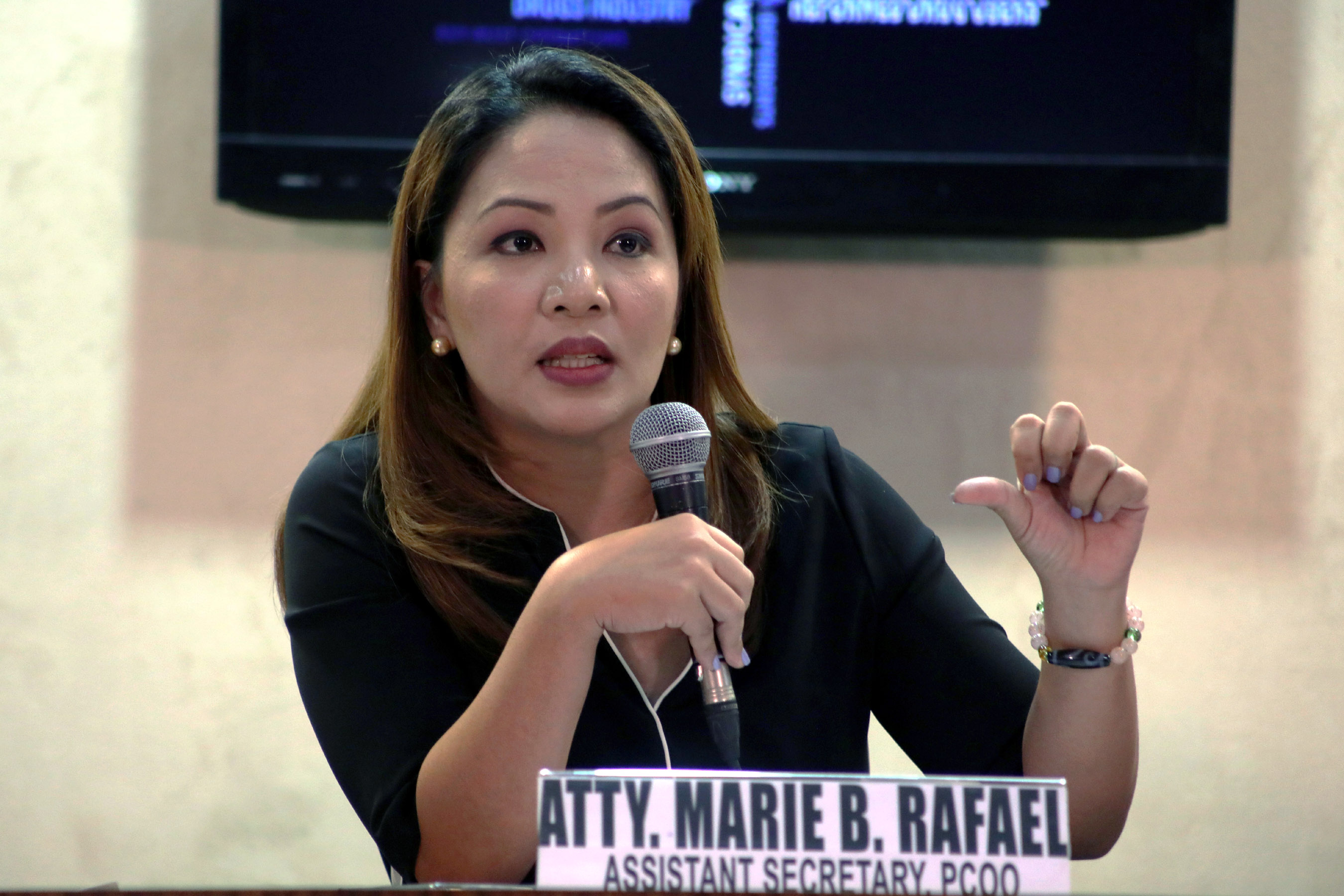
MANILA — The International Criminal Court (ICC) can “always” access the Philippine government’s documents related to President Rodrigo Duterte’s anti-narcotics campaign, the Presidential Communications Operations Office (PCOO) said on Thursday.
In a Palace press briefing, PCOO Assistant Secretary Ana Maria Rafael said the ICC can easily get copies of drug war records since these have already been made public.
“We can provide whatever data that we have because they can access it naman sa mga website natin (through our websites) and we always publish them,” Rafael said.
“So I don’t think there’s any problem with that because they can always access government records,” she added.
The ICC, in its “Report on Preliminary Examination Activities 2019,” announced its plan to finish its initial review of Duterte’s war on illegal drugs by 2020 to determine the possible necessity to carry out a full-blown investigation into the drug problem in the Philippines.
Rafael, however, said the executive branch has yet to receive any formal communication from ICC expressing its intent to collate data concerning Duterte’s anti-drug campaign.
“As of this time, at this point, I don’t think there is, especially that it’s still at a preliminary examination stage,” the Communications official said.
“We will wait if and when the government would accede to consent to reply,” she added.
The ICC in February 2018 conducted a preliminary examination of Duterte’s drug war, based on lawyer Jude Sabio’s communication which claims that the President has committed crimes against humanity for the deaths of thousands of drug personalities from July 1, 2016 to March 31, 2017.
The ICC’s alleged “brazen display of ignorance of the law” prompted Duterte to rescind its membership from the international body on March 17, 2018. However, the Philippines’ withdrawal formally took effect just on March 17, 2019, or exactly a year after the President’s notification.
The Court’s preliminary examination is still ongoing, as it maintained that it has jurisdiction over the possible crimes perpetrated by Duterte since the supposed killings happened when the Philippines was still a member-state of the international tribunal.
Presidential Spokesperson Salvador Panelo on Dec. 7 dismissed as “utter disrespect” the ICC’s insistence that it has jurisdiction to proceed with a preliminary examination of Duterte’s drug war, despite the Philippine withdrawal from the international tribunal.
Panelo also reiterated that the ICC has no jurisdiction over the Philippines, which is an “independent country” that has a working justice system.
Last Dec. 8, the Commission on Human Rights expressed willingness to assist the ICC, in case the international court asks for assistance with regard to Duterte’s anti-narcotics drive.
From July 1, 2016 to November 30, 2019, around 5,552 drug personalities have been killed during the conduct of a total of 151,601 anti-drug operations by the Philippine Drug Enforcement Agency, the Philippine National Police, and other law enforcement agencies nationwide, based on the figures released at a Palace press briefing on Thursday.
The anti-drug operations also led to the arrest of 220,728 drug offenders.