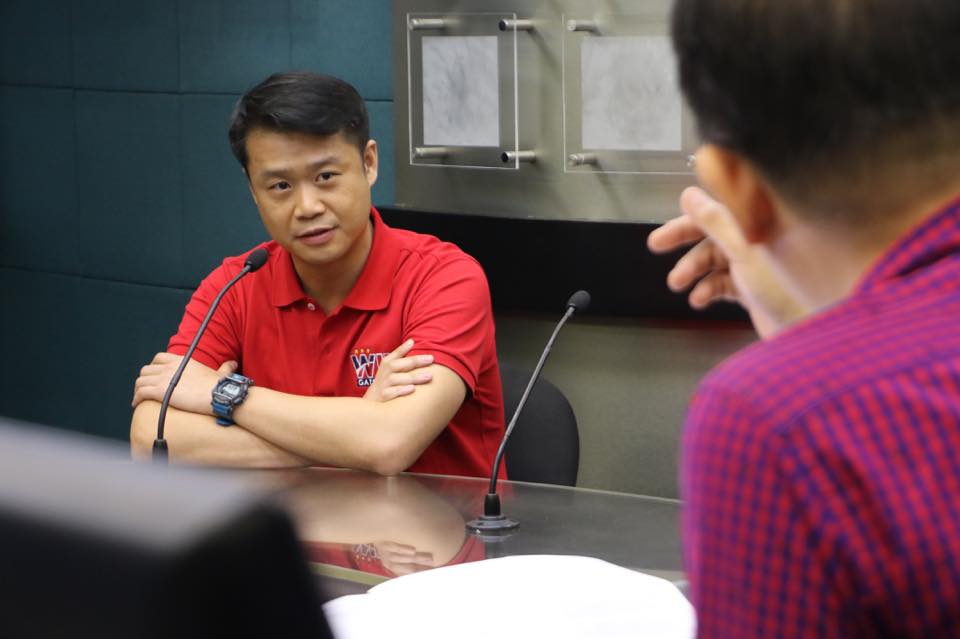
(Photo courtesy of the official Facebook page of Rep. Gatchalian)
The Senate Committee on Energy on Monday has approved on its third and final reading a bill seeking to trim down the costs of electricity in the country and to build a robust energy sector.
Voting 13-1, the Senate committee has affirmed Senate Bill No.
1439 otherwise known as the “Energy Virtual One Stop Shop (EVOSS) Act of 2017.
Senator Sherwin Gatchalian, the author of the bill and also the chair of the Senate Committee on Energy, said the measure is primarily focused to remove “red-tape” or bureaucratic inefficiencies, redundancies and overlaps in the energy sector.
“This legislation seeks to streamline the permitting process of new energy generation projects, thus cutting the length of the permitting process in half,” Gatchalian said.
Gatchalian added the bill directs the establishment of EVOSS under the supervision of the Department of Energy (DOE).
The EVOSS is an online system that “allows single submission and synchronous processing of required data and information and provides a single decision-making portal for the evaluation of new power generation projects.”
“Greater efficiency under the EVOSS system will result in a welcome bump in disposable income for the average Filipino family. We will be putting a lot of money back where it belongs – in the pockets of Filipino families struggling to pay their basic day to day expenses,” Gatchalian said.
Under the measure, the EVOSS would ensure the “secure, accessible and paperless” processing of documentary requirements, assessment, and payment of charges and fees, status updates and progress monitoring, not only for applicants, but also for national and local government offices and entities involved in the permitting process of energy generation projects.
“The platform effectively eliminates (1) repetitive form submission, (2) the need to physically transport documents from one agency to another, and (3) existing constraints that prevent multiple agencies from simultaneously processing applications,” Gatchalian added.
To ensure the timely processing of applications, Gatchalian said that anyone involved in the process would “be required to resolve all papers pending before them within a prescribed period of time.
”
Under the bill, specified government agencies are given timeframes to release actions on applications. For example, the DOE and all its attached agencies and offices would be given 60 days to release actions on applications. On the other hand, the Department of Agrarian Reform (DAR) and its attached agencies would be given 90 days while the Department of Environment and Natural Resources (DENR) would have 75 days to act on the applications. Failure of agencies to act within the specified timeframes would render applications to be deemed approved.
Government officers or employees who fail to comply with the set timeframes would be subjected to administrative penalties ranging from a 30-day suspension without pay to dismissal and perpetual disqualification from public service.
At present, Gatchalian explained, developers of run-of-river hydro plants in the country have to secure 359 signatures from 74 regulatory agencies and attached bureaus in a permitting process that takes around 1,340 days – or three and a half years- to complete.
The senator said the bill aims to rejuvenate and infuse greater competition into the local energy sector, which would result in a larger energy supply and cheaper generation costs in the country.
“Based on my conversations with industry analysts and our own internal research, cutting down red tape could reduce consumer electricity prices by as much as P1 per kWh,” Gatchalian said.
He added that this would translate to a total consumer savings of P55.2 billion a year, or annual savings of P2,400 for ordinary families in the metropolis.
“An extra P2,400 can do a lot for a family. That is enough to buy a sack of rice with some extra cash to spend on tuition and school supplies for the children, healthcare, and other essentials,” Gatchalian said.