MANILA — Marred by trash and illegal fishing, the reefs of Kalayaan Island Group (KIG) were diagnosed “relatively unhealthy” by Filipino scientists, who recently concluded a joint marine science research in the West Philippine Sea (WPS).
“If you are a diver, relatively, it’s not in its healthiest state,” Dr. Deo Florence Onda, PROTECT WPS chief scientist, told the Philippine News Agency (PNA).
Onda was referring to the Sabina Shoal or Escoda Shoal, the first site surveyed by the University of the Philippines-Marine Science Institute (UP-MSI), during its two-week expedition with the Department of Environment and Natural Resources Biodiversity Management Bureau (DENR-BMB) and the Department of Agriculture Bureau of Fisheries and Aquatic Resources (DA-BFAR).
PROTECT WPS or Predicting Responses between Ocean Transport and Ecological Connectivity of Threatened ecosystems in the West Philippine Sea is the first joint undertaking by the three institutions, which seeks to establish a connection with the far-flung features of WPS to the mainland.
“It’s not as colorful compared to other reefs that we’ve seen before. At Sabina, when we dived, patay eh, most of the corals are dead, you would see large pits and you would know that it’s dynamite,” Onda said.
The same was observed in Thitu Island or Pagasa Island. “Most of the corals are dead,” he said, suspecting that the harmed reef environment extends beyond the areas they had covered.
“If this is happening in the KIG, this might also be happening in the other parts of Spratlys, and if we can all work together, we could sustain the ecosystem there,” he said.
Sabina Shoal and Pagasa Island, two of the numerous features in the KIG, are a cluster of islets in the Spratlys also claimed by China, Brunei, Malaysia and Vietnam. These two were among the eight sites visited by the PROTECT WPS team from April 22 to May 5.
The PROTECT WPS is trying to prove that every reef in the KIG are connected and each has a role to play and is vital to mainland Philippines’ food security, and possibly to other littoral states in the region.
Crates of plastics
During the expedition, the UP-MSI team collected about six crates of trash ranging from bottles to plastic labels that bear foreign and Filipino brands, indicating human impact in the area.
“It’s because of the currents, but the fact that it’s accumulating in the area, through time it happens, you would have to ask yourself, after ten years, what happens to these places?” Onda said.
“What if there are invasive species or pathogenic microorganism, those that cause disease, what will happen if those clung to the plastic and the plastic drifted to the island? The species and the whole ecosystem in that island become threatened,” he added.
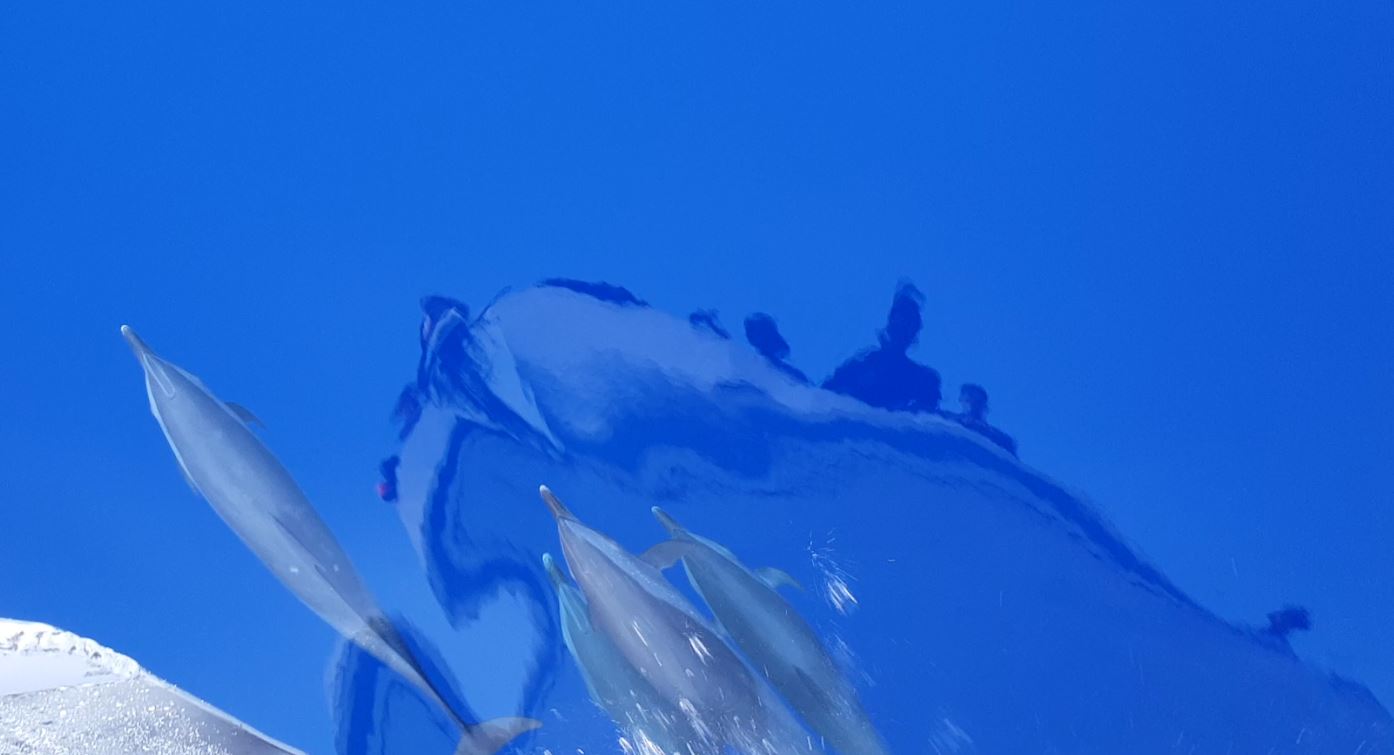
Entering the KIG, the PROTECT WPS team were joined by a school of dolphins racing the R/V Kasarinlan and leaping out of the water as if welcoming the scientists in the open seas.
Seeing this, Onda said the mere presence of micro and macro plastics alone is alarming, citing the reported death of marine animals due to ingestion of trash.
“There have been a lot of reports that the dolphins are dying because they ingest plastics and there are a lot of dolphins in the area. The garbage don’t decrease, if in ten years that’s the environment there, then there’s a lot of implication. We don’t directly know it yet but it’s one thing that we should find out,” he said.
In terms of discovery, the UP-MSI professor said the team has to analyze more, but based on visual inspections, two new species of seaweeds were identified by PROTECT WPS crew Dr. Michael Roleda and Dr. Wilfred Santianez, who are handling the team’s phycology laboratory.
“They were already saying that it’s interesting because there are reported new species of seaweeds that were only seen in this expedition. They have two species they are sure are new,” Onda bared, adding that these discoveries could be “economically significant” to the country.
“What if these new species have other usage? Biologically, they are serving a certain function in the environment, it keeps it in balance, economically, it means new potential sources of products for the Philippines,” he said.
Onda said the PROTECT WPS program is allotting at least one year to analyze the entire data gathered during the trip, but one possible recommendation it could come up with is the science-backed establishment of marine protected areas (MPA) in the KIG.
“Ultimately, our goal is to help with the management. This project and the past expeditions would be very helpful because the National Security Adviser said they have the intention of proclaiming some parts of the KIG as MPAs,” he told the PNA.
“But the thing with MPA is that ‘what are you protecting?’ If you don’t know, how will you protect?” he asked. “So this scientific data it will help with that — legislation, policy, management, and approaches.”
The government is planning to declare Pagasa Island and Eastern Kalayaan as MPAs. Earlier, National Security Adviser Hermogenes Esperon Jr. said the Philippines also considers inviting other nations in the designation of marine protected zones.
“A marine protected area gives you choices whether there should be no fishing at all or no exploitation of resources or it could be managed. That way we protect the environment, we sustain the environment so it’s a good activity that where we can join all other, we can invite nations to join us,” he said during his visit in Beijing.
Network of MPAs
Onda said that sustaining the region is “a collaborative effort” and not a one country success.
According to the UP professor, scientific research could also be used in crafting documents and agreements concerning the protection of the South China Sea.
“The best decision is based on facts. Science is science, whether you accept it or not it remains a fact,” he pointed out. “All of us benefit from this region, if it dies, Southeast Asia will suffer. Most of the fisheries come from that area. For the Philippines, WPS is the second most important fishing ground,” he said.
Dr. Jay Batongbacal, director of the UP-Institute of Maritime Affairs and Law of the Sea, agreed that it would be “useful” to have the study as a reference – both to existing documents and ones that are still being crafted, such as the Code of Conduct on the South China Sea.
“The scientific study that they have done and the result of that study would always be useful because it contributes to a science-based decision making which is what you really need in order to establish an effective marine protected area,” he told the PNA in an interview.
“In the Code of Conduct, if they are considering provisions to further encourage cooperation, then they could include it in the COC a part which deals with the joint establishment of marine protected areas without prejudice to their respective claims. Outside the COC process, they could do a separate agreement to do the same thing as an implementation to the China-ASEAN declaration for a decade of coastal and marine environmental protection in the South China Sea,” he said.