
Sports
100 years later, jersey numbers part of players’ identities

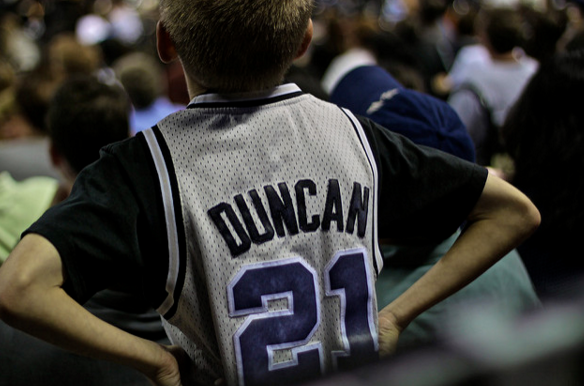
(Photo from Flickr/aaronisnotcool)
When Marcus Stroman takes the mound for the Toronto Blue Jays, he stands out in a way that might not be obvious to the untrained eye.
Here’s a hint: Look at the back of his jersey.
Stroman is a rarity in baseball – a pitcher who wears a single-digit number. The 6 on his back is in honour of his late grandmother – and another way for the 24-year-old right-hander to connect to the city where he plays.
The 2016 season will mark 100 years since the first uniform numbers were used in a major league game.
Back then, the digits showed up on players’ sleeves, and although it took over a decade for the idea to catch on for good, jersey numbers soon became an indelible part of the sport’s history. Nowadays, many players take pride in the numbers they wear, especially if they have specific reasons for choosing them.
“Grandma’s birthday,” Stroman said. “She’s my biggest fan. Her birthday’s March 6… Toronto’s also referred to as ‘The 6’ so it’s just kind of something that played into perfectly.”
When someone with a single-digit number takes the mound, that often means a position player is pitching. Stroman was one of only three full-time pitchers to wear a single digit last season, according to data from Baseball-Reference.com. Carl Edwards of the Chicago Cubs was also No. 6, and Adam Ottavino of Colorado wore No. 0.
It looks like the club will have another member this year. Right-hander Mike Leake, who signed with St. Louis this past off-season, is now No. 8 – the same number he wore at Arizona State.
The most common numbers across the majors last season were No. 30 and No. 50. According to Baseball-Reference.com, those numbers were worn by 30 players each. No. 30 has a lot of versatility – it appears on the backs of both pitchers and position players – while No. 50 is mostly worn by pitchers. The sheer number of relievers on big league rosters means numbers in the 50s are more frequent than many fans may realize.
The first uniform numbers in a major league game were worn by the Cleveland Indians on their left sleeves in 1916, but that ended up being just a temporary experiment. It wasn’t until 1929 that teams started wearing numbers permanently.
“The ‘29 Yankees and the ‘29 Cleveland Indians both started wearing uniform numbers on their players’ jerseys on opening day,” said Mark Stang, whose book on uniform numbers – “Baseball By The Numbers” – was published in 1996.
Stang says there’s no real evidence that players made a point of picking out specific jersey numbers early on.
“There’s very little reporting on that prior to about the end of World War II,” he said. “If there were players that chose a number for a particular reason, you find almost no anecdotal evidence of that in the press accounts of the day.”
But jersey numbers inevitably became part of players’ identities, a phenomenon that exists to this day.
When Prince Fielder was traded from Detroit to Texas a couple years ago, he started wearing No. 84, which is the year he was born. Yankees manager Joe Girardi wore No. 27 when he took over the job, since the franchise was chasing its 27th World Series title.
The Yanks got that championship in 2009, and now Girardi wears No. 28.
When 3-foot-7 Eddie Gaedel went up to bat for Bill Veeck’s St. Louis Browns in 1951, he wore No. 1/8. And later that year, when Ralph Branca gave up Bobby Thomson’s pennant-winning home run, the Brooklyn pitcher’s No. 13 seemed painfully appropriate.
Not everyone can come in making jersey demands, of course. In spring training, non-roster invitees often end up with some of the more exotic numbers, and a lot of those players won’t make the team.
Phillies prospect J.P. Crawford didn’t seem to mind his No. 77 this year. He was one of a handful of Philadelphia players in the 70s.
“They just assigned it to us,” he said last month. “We call ourselves the offensive linemen.”
Even some established veterans can find their options limited. The Yankees, for example, have retired every number from 1-10 – with the exception of No. 2, and that will probably be retired soon enough thanks to Derek Jeter.
When Chase Headley was traded to New York in 2014, he took No. 12.
“I just assumed that was part of the gig. Obviously, there’s been a lot of great players here. The single numbers are gone now,” Headley said. “When I got traded over, they said, ‘Hey, we have 12, 24…’ They just gave me a handful of numbers.”
Sometimes, being assigned a random number works out for the long run. Toronto catcher Russell Martin still wears No. 55.
“I went to spring training one year, I had 55 in my locker and it stuck. And I was like, ‘I’m going to keep it. I like it,’” he said. “And I ended up getting called (up) on May 5, so 5/5, that was my call-up date. I’m like, ‘You know what? That’s pretty cool.’”
Stroman had a number in the 50s when he first pitched in the majors in 2014, but after making 20 starts and winning 11 games in his debut season for the Blue Jays, he wasn’t an untested rookie anymore. So Stroman requested No. 6.
It was an unusual choice for a player at his position, but one that is very significant to him.
“I got 54 when I got here, and it’s kind of just, shut your mouth and just wear that,” Stroman said. “A decent year, and I wanted to wear a number that had sentimental meaning to me. So that’s why I changed it.”
___
AP Sports Writer Stephen Whyno contributed to this report.




















