Headline
Men can also be victims of sexual violence, Supreme Court stresses in landmark ruling

ASM, Philippine Canadian Inquirer
October 30, 2026

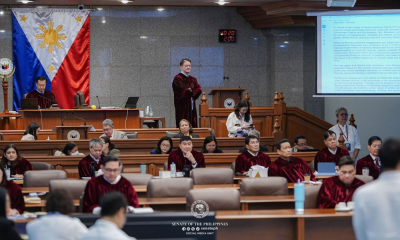
Photo courtesy: Human Rights Watch
MANILA, Philippines — The Supreme Court has stressed that sexual violence can affect anyone, regardless of gender, as it upheld the conviction of a woman who sexually abused her 11-year-old nephew and highlighted gaps in Philippine laws protecting male victims.
In a unanimous decision dated February 4, 2026, the Court emphasized that legal protections must recognize male survivors without relying on assumptions that women are always victims and men are always perpetrators.
The ruling, written by Senior Associate Justice Marvic Leonen, involved a woman who sexually abused her nephew in 2018 while the boy was visiting relatives.
The child later underwent psychological evaluation and therapy and was diagnosed with post-traumatic stress disorder.
The woman challenged her conviction, arguing, among other things, that the boy had consented.
The Supreme Court rejected that defense, explaining that the child was only 11 years old at the time and legally incapable of consenting to the sexual act.
The justices also emphasized that a child’s response to abuse must not be mistaken for genuine consent.
Why the Court modified the conviction
The case exposed a legal distinction between rape and other sexual offenses under Philippine law.
The lower courts had convicted the woman under Republic Act No. 7610, the law protecting children against abuse, exploitation and discrimination.
The Supreme Court upheld her criminal liability but modified the conviction to statutory acts of lasciviousness under Article 336 of the Revised Penal Code, applying the penalty prescribed for the offense involving a child below 12 years old.
The change did not mean the Court dismissed the abuse or found the woman’s conduct less serious.
Rather, the justices determined which criminal provision legally applied to the incident.
At the time of the offense in 2018, the Revised Penal Code defined rape through sexual intercourse in terms of a man having carnal knowledge of a woman.
That wording prevented the Court from treating the woman’s conduct as rape under that particular provision, even though the justices recognized the absence of consent and the serious harm suffered by the boy.
The decision highlighted how the wording of criminal laws can create different legal consequences depending on the sex of the offender and victim.
Court challenges gender stereotypes
Beyond resolving the criminal case, the Supreme Court called attention to the harmful effects of traditional assumptions about sexual violence.
The justices criticized the belief that sexual abuse is necessarily committed by men against women, noting that such stereotypes can leave male survivors overlooked or inadequately protected.
The Court also examined how historical rape laws reflected patriarchal views of women and sexual autonomy.
It stressed that recognizing the discrimination historically experienced by women should not prevent the legal system from protecting male survivors.
The decision explained that gender-based assumptions can make it more difficult for male victims to identify abuse, report their experiences and obtain appropriate legal remedies.
The Court’s discussion reinforces the principle that sexual violence must be assessed according to the abusive conduct and the applicable law, rather than stereotypes about who can be a victim.
How the law has changed
The ruling also discussed Republic Act No. 11648, which was enacted in March 2022.
The law raised the age threshold for statutory rape from 12 to 16 and amended the wording of the Revised Penal Code to refer to sexual intercourse committed by a person against another person under circumstances specified by law.
Unlike the previous wording, the amended provision no longer expressly limits the offender to a man and the victim to a woman.
However, the Supreme Court noted that judicial interpretations of the legal term carnal knowledge have continued to reflect traditional understandings of sexual intercourse.
Although the amended wording theoretically allows women to be held liable under the provision, the ruling did not conclusively resolve how courts should apply that language to every form of sexual intercourse.
The 2022 amendment also could not be applied retroactively to the woman’s 2018 offense to impose a different criminal liability.
Under the current law, a limited close-in-age exception applies in certain cases involving minors below 16, but it does not apply when the child is younger than 13.
Prison sentence and damages upheld
The Supreme Court sentenced the woman to imprisonment ranging from nine years, four months and one day to 16 years, five months and nine days.
She was also ordered to pay the child ₱150,000 in civil indemnity, ₱50,000 in moral damages and ₱50,000 in exemplary damages, for a total of ₱250,000.
The ruling comes amid continuing efforts to clarify how Philippine laws address sexual abuse involving children.
In separate guidance issued in April 2026, the Supreme Court also explained the distinction between acts of lasciviousness under the Revised Penal Code and lascivious conduct under Republic Act No. 7610.
While the latest decision does not itself rewrite the country’s rape laws, it places renewed attention on how those laws are interpreted and whether they provide equal protection to survivors.