Headline
Chinese Embassy dares PH lawmakers to declare envoy persona non grata as diplomatic tensions escalate

ASM, Philippine Canadian Inquirer
October 18, 2026

Photo courtesy: ph.china-embassy
MANILA, Philippines — The diplomatic dispute between the Philippines and China has intensified, with the Chinese Embassy in Manila openly challenging Filipino lawmakers seeking the removal of Ambassador Jing Quan following his controversial remarks about China’s military strength.
In a series of social media posts on Saturday, October 17, the embassy criticized senators and representatives who condemned Jing’s statements, accusing them of fueling anti-China sentiment and misrepresenting Beijing’s position.
The embassy went further by challenging lawmakers to act on their proposals to declare the ambassador persona non grata, a diplomatic designation indicating that a foreign representative is no longer welcome in the host country.
“Some senators and house representatives are talking about declaring the Chinese ambassador persona non grata. Is this threat or coercion?” the embassy wrote.
“But anyway, just do it. Otherwise, STOP BLUFFING,” it added.
The public exchange marks another escalation in the increasingly strained relationship between Manila and Beijing, with disagreements over the West Philippine Sea now extending into a direct confrontation involving foreign diplomats, Philippine legislators, and government officials.
Lawmakers push back against Chinese envoy
The controversy began after Jing suggested that China could easily prevail if it resorted to military force, while maintaining that Beijing preferred a peaceful approach.
His statement came in response to Defense Secretary Gilberto Teodoro Jr., who had described China as a source of regional instability.
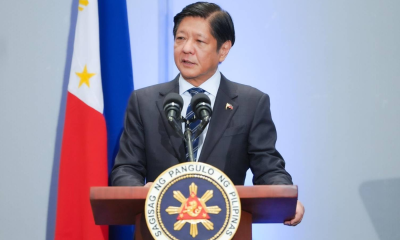
Philippine officials interpreted the ambassador’s language as threatening. President Ferdinand Marcos Jr. said the remarks sounded like a threat and were inappropriate for a diplomat, while the Department of Foreign Affairs formally protested the statement.
Several legislators subsequently called for stronger diplomatic action.
Senator Risa Hontiveros urged the government to consider declaring Jing persona non grata unless his remarks were formally withdrawn and Beijing issued an apology.
Senators Francis Pangilinan and JV Ejercito separately called on the ambassador to return to China, with Ejercito delivering his message in Mandarin.
Meanwhile, Akbayan party-list Representative Perci Cendaña renewed his demand for Jing’s expulsion following the embassy’s challenge, questioning how long the Philippines should tolerate such remarks from a foreign diplomat.
The embassy also circulated a compilation of statements from Senate President Sherwin Gatchalian, Senators Pangilinan, Hontiveros, Ejercito and Erwin Tulfo, Representatives Leila de Lima and Cendaña, and Akbayan president Rafaela David.
It accused the officials of maintaining consistently critical positions toward China, rejecting their interpretation of Jing’s comments.
Embassy rejects accusations of intimidation
Beijing’s diplomatic mission has maintained that Jing’s statements were taken out of context, arguing that his reference to military strength was accompanied by an explicit commitment to peace.
The embassy also criticized Philippine Coast Guard spokesperson for the West Philippine Sea Commodore Jay Tarriela, accusing him of interpreting its statements selectively. Tarriela disputed the embassy’s characterization.
In a separate statement, the embassy argued that some Philippine politicians were attempting to pressure China through public accusations rather than addressing differences through diplomatic engagement.
The dispute highlights conflicting interpretations of the ambassador’s remarks. Philippine officials have emphasized the implications of discussing military force amid existing maritime tensions, while the Chinese side insists that the statement was intended to underscore its preference for avoiding confrontation.
What declaring an ambassador persona non grata means
Under the Vienna Convention on Diplomatic Relations, a receiving state may declare a foreign diplomat persona non grata without being required to explain its decision.
Such a declaration would require the sending country to recall the diplomat or terminate the individual’s diplomatic functions. If that does not happen within a reasonable period, the receiving state may refuse to recognize the person as a member of the diplomatic mission.
However, statements by individual lawmakers do not, by themselves, constitute a formal persona non grata declaration by the Philippine government.
The distinction is important as the dispute moves from public criticism toward discussions of possible diplomatic measures.
A formal decision affecting China’s ambassador could have broader consequences for bilateral communication at a time when both governments continue to manage disagreements over maritime security, sovereignty and regional stability.
Diplomatic relations face another test
The latest exchange comes amid continuing disagreements over maritime activities in the West Philippine Sea, where Manila asserts its sovereign rights under international law and Beijing maintains expansive claims rejected by the 2016 arbitral ruling.
Despite these tensions, the Philippine government has emphasized that maintaining economic and diplomatic engagement with China remains important.
On October 13, Malacañang reaffirmed that the Philippines would continue pursuing trade and investment cooperation with Beijing without compromising its territorial and maritime interests.
The unfolding controversy therefore presents a broader diplomatic challenge: how the Philippines can respond to statements it considers unacceptable while preserving channels for resolving disputes with one of its largest trading partners.
For now, President Marcos has expressed interest in discussing Jing’s remarks directly with the ambassador, while the Department of Foreign Affairs has urged greater restraint in diplomatic statements.
As of October 18, no formal Philippine government decision declaring Jing persona non grata was confirmed in the reports reviewed. The immediate question is whether the controversy will be addressed through direct diplomatic discussions or lead to further government action.