Canada News
Record number of Filipino-Canadian candidates run in B.C.’s 2026 local elections

ASM, Philippine Canadian Inquirer
October 3, 2026
Record number of Filipino-Canadian candidates run in B.C.’s 2026 local elections
VANCOUVER, British Columbia — As Canada’s Filipino population continues to grow, Filipino Canadians are also becoming increasingly visible in local politics.
More than 957,000 people in Canada identified as Filipino in the 2021 Census, nearly four times the number recorded in 1996. By 2026, Prime Minister Mark Carney described Canada as home to more than one million Filipino Canadians, including nearly 200,000 in British Columbia.
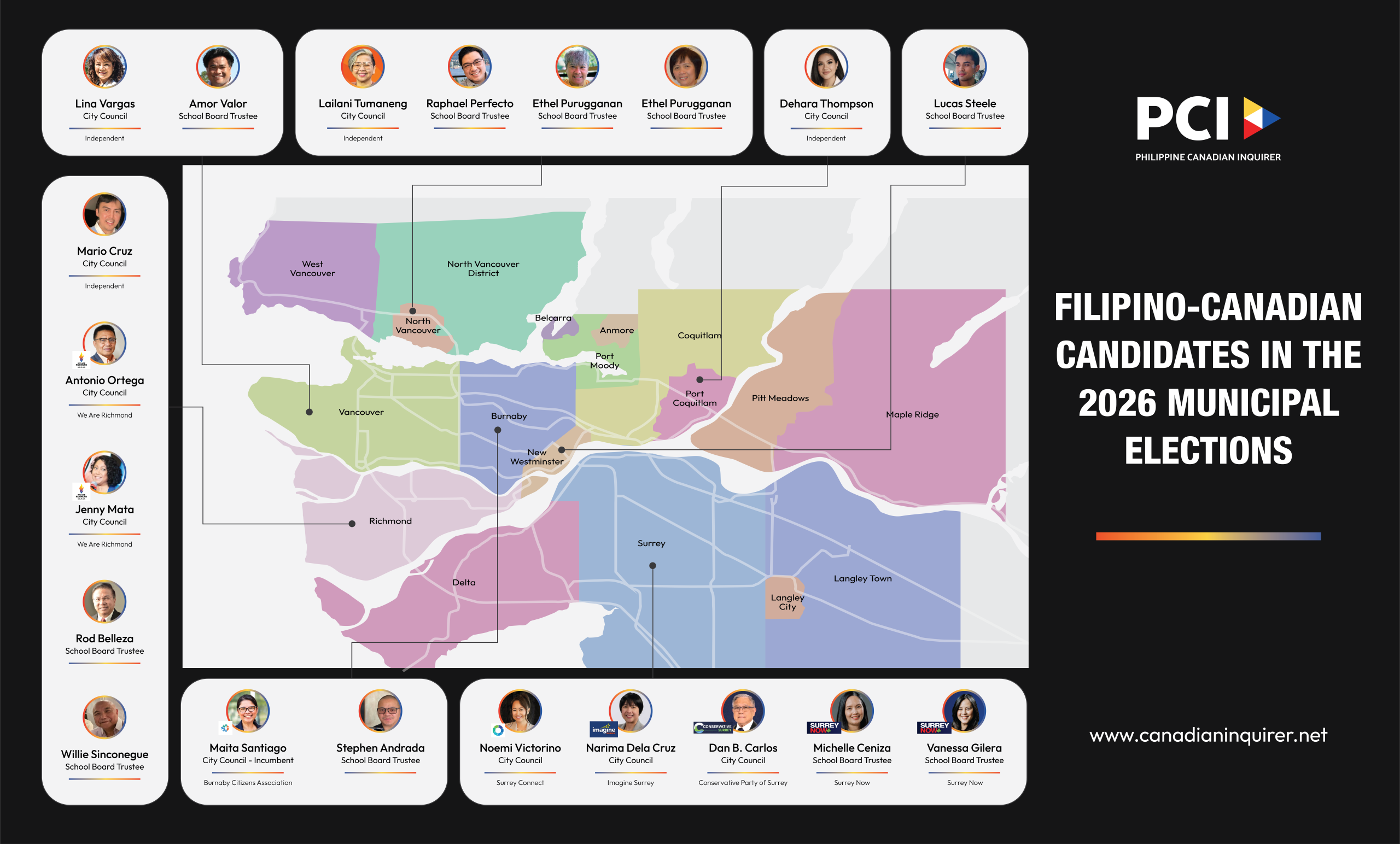
That growing community presence is being reflected in B.C.’s 2026 local elections, where a record 23 Filipino-Canadian candidates have been identified as running on October 17 – 13 for municipal council seats and 10 for school-board trustee positions. The field stretches from Metro Vancouver to northern communities including Fort St. John, Kitimat and Dawson Creek.
The candidates are:
VANCOUVER
- Armor Valor Corales
Vancouver Liberals, Vancouver City Council - Selena “Lina” Vargas
ABC Vancouver, Vancouver School Board
BURNABY
RICHMOND
SURREY
NORTH VANCOUVER
- Lailani Tumaneng
Independent, City of North Vancouver Council
- Raphael “Ralph” Perfecto
Independent, North Vancouver School Board
- Ethel Purugganan
Independent, North Vancouver School Board
- Senora Navales
Independent, North Vancouver School Board
WEST VANCOUVER
- Annasabelle Pronych
Independent / no confirmed electoral organization, West Vancouver City Council
OTHER CITIES
- Dehara Thompson
Independent, Port Coquitlam City Council
- Lucas Steele
New Westminster Progressives (NWP), New Westminster School Board New Westminster Progressives
- Ovvian Castrillo-Hill
Independent / no confirmed electoral organization, Fort St. John City Council
- Gregg Apolonio
Independent / no confirmed electoral organization, Dawson Creek City Council
- Edwin Empinado
Independent / no confirmed electoral organization, Kitimat City Council
Council candidates are dealing with issues such as housing, transportation, public safety, municipal services, local businesses and development. School-board candidates, meanwhile, are campaigning on concerns involving classroom resources, student well-being, school capacity, mental health, and parent engagement.
The growing number of Filipino-Canadian candidates broadens representation, while their platforms address issues that affect residents across communities, regardless of background. Each candidate will ultimately be judged on experience, platform, credibility and ability to represent the entire municipality or school district.
What the 2026 field does demonstrate is a broader shift in civic participation.
Filipino Canadians have long contributed to workplaces, businesses, churches, cultural groups and community organizations. Their growing participation in public office brings new perspectives to local government, with platforms and programs designed to benefit not only Filipino communities, but Canadians and residents across the wider community.
That matters because local government is often where public policy becomes most immediate. Municipal councils make decisions affecting neighborhoods, transportation, development and city services. School trustees help oversee public education systems serving children and families.
For Filipino Canadians, having more candidates on the ballot can also broaden the range of experiences represented in those discussions – including immigration, frontline work, small business, education and raising families in multicultural communities.
At the same time, winning office carries a wider responsibility. A Filipino-Canadian councillor or trustee would not represent Filipinos alone, but everyone within the city or school district they serve.
The October 17 election will determine how many of the 23 candidates earn seats. Regardless of the outcome, the size of this year’s field marks a notable expansion of Filipino-Canadian participation in British Columbia’s local political landscape.