Headline
DMW ramps up OFWs repatriation; 75 more set to arrive Tuesday

By Marita Moaje, Philippine News Agency
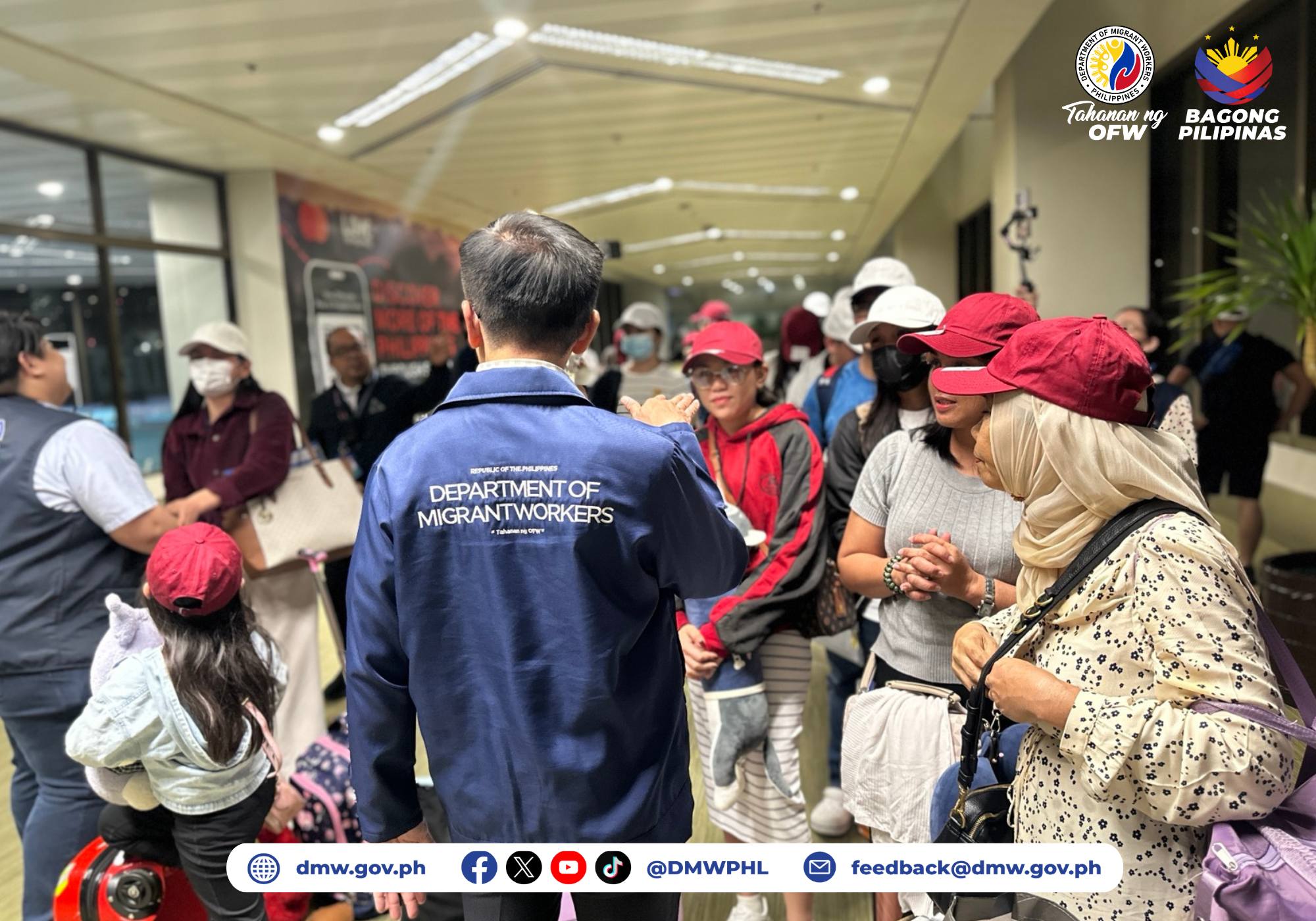
REPATRIATION EFFORTS. Thirty-two overseas Filipino workers from the United Arab Emirates and Oman arrive at the Ninoy Aquino International Airport Terminal 1 on March 10, 2026 amid the Middle East tensions. Migrant Workers Secretary Hans Leo Cacdac and Overseas Workers Welfare Administration (OWWA) chief Patricia Yvonne Caunan said, in a press briefing on Tuesday (March 17), that 75 more OFWs are scheduled to arrive within the day. (Photo: Department of Migrant Workers/Facebook)
MANILA – The Philippine government has stepped up its repatriation efforts for overseas Filipino workers (OFWs) affected by the Middle East crisis, with six scheduled flights arriving Tuesday.
At a media briefing in Mandaluyong City, Overseas Workers Welfare Administration (OWWA) chief Patricia Yvonne Caunan said these six flights carry 75 government-assisted OFWs.
“Today, we have six commercial flights coming in; some have already landed on different government-purchased repatriation tickets for our workers,” Caunan said.
“And so, we are expecting arrivals from yung ating mga kababayan na tulong-tulong natin tinawid mula Bahrain papuntang Saudi Arabia. Meron din po tayo na ini-expect na dumating na first batch mula sa Kuwait (our fellow countrymen whom we helped cross from Bahrain to Saudi Arabia. We also expect the first batch from Kuwait),” she added.
She said the flights are part of an ongoing large-scale evacuation program expected to bring home nearly 2,000 OFWs by the end of the week or early next week.
The Department of Migrant Workers (DMW), in coordination with the OWWA and the Department of Foreign Affairs (DFA), said close to 1,200 repatriation cases have already been funded, covering pre-departure processing, airfare and post-arrival assistance.
“These include complete services, from documentation and exit clearances to flights and reintegration support upon arrival,” Caunan said.
She said repatriation operations follow a multi-stage process, with OFWs transported via land border crossings from conflict-affected areas to designated exit points in neighboring countries such as Saudi Arabia, Egypt and Oman.
From there, they are flown back to the Philippines via chartered or commercial flights.
DMW Secretary Hans Leo Cacdac assured that OFWs crossing borders by land are safe and are assisted by various Philippine government teams deployed on both sides of the border crossings, through immigration and security checks, and onward to the country.
He said that in some Middle Eastern areas, limited commercial flights are also operating, particularly from the United Arab Emirates (UAE), with additional routes gradually opening in Qatar, Jordan and Lebanon.
From the time an OFW expresses intent to be repatriated and gets listed, Caunan said repatriation typically takes over a week to complete, depending on visa processing, security conditions and flight availability.
As of the latest data, she said at least 657 OFWs are now in the pipeline for return, with many currently housed in temporary accommodations while awaiting flights.
Cadac also assured that post-repatriation assistance, including psychosocial intervention, skills training and financial aid, is provided to these OFWs upon arrival, along with transportation back to their home provinces.
Continuing assistance
At a Bagong Pilipinas Ngayon interview on Tuesday, Philippine Ambassador to Qatar Mardomel Celo Melicor said the complex evacuation effort for OFWs and stranded Filipinos requesting assistance to exit Qatar — including through crossing borders toward Saudi Arabia — carries on as the government awaits regular flights to return in the Gulf state.
As of this posting, the Philippine Embassy in Qatar has facilitated the exit of some 100 Filipinos, with another group of more than 30 on their way via the government’s third repatriation flight.
The embassy, Melicor said, had also assisted 27 Filipino pilots and crew members who had been stranded due to the conflict in securing proper travel documents to cross Saudi Arabia.
“Safe at saka very secure naman po ang ating kalagayan. Pero kahit ba ganyan mayroong mga ibang OFWs na gustong umuwi at saka marami din iyong mga na-stranded na hindi naman sila OFWs kung hindi mga visitors, so ang embassy kasama ang MWO ginagawa po lahat para maiuwi sila (Our situation is safe and very secure. But even so, other OFWs want to go home, and many stranded people are not OFWs but visitors, so the embassy and the MWO (Migrant Workers Office) are doing everything to bring them home),” he said.