Headline
PH’s ‘strong’ partnership with UN an advantage in UNSC seat bid: PBBM

By Ruth Abbey Gita-Carlos, Philippine News Agency
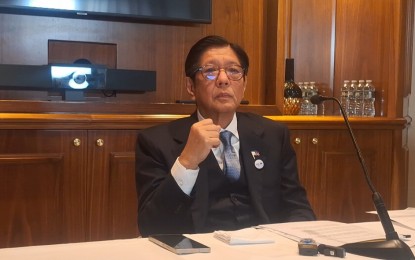
‘STRONG PARTNERSHIP’. President Ferdinand R. Marcos Jr. on Tuesday (March 10, 2026, New York time) holds a press conference at The Pierre, A Taj Hotel in New York City at the end of his two-day working visit to the United States. Marcos said the Philippines’ “strong” partnership with the United Nations (UN) is an advantage, as the country campaigns for a non-permanent seat in the UN Security Council (UNSC). (Photo: PNA)
NEW YORK CITY – President Ferdinand R. Marcos Jr. on Tuesday (New York time) said the Philippines’ longstanding and “strong” partnership with the United Nations (UN) could work to the country’s advantage in its bid for a non-permanent seat in the UN Security Council (UNSC).
Speaking to reporters at The Pierre A Taj Hotel on the final day of his working visit here, Marcos said the Philippines has built a strong record of cooperation with the UN since its founding in 1945.
“The advantage that the Philippines has is that we have a very strong record of partnership with the UN over the years. At hindi lamang (And it is not just about), it is not about the Philippines,” Marcos said.
“We have been working together with the UN since 1945 on many of the most important issues. And so it is really to strengthen that partnership and it is not just about the Philippines,” he added.
Marcos noted that the Philippines has actively supported UN initiatives, including peacekeeping missions and the promotion of key global issues such as women’s rights, climate change and social development.
“And because of that, we see now an opportunity to contribute even more. And that, I think, will serve to the advantage of the Philippines in this candidature,” he said.
Marcos said the Philippines’ potential election to the UNSC for the term 2027 to 2028 would allow the country to represent not only its own interests but also those of developing and middle-income nations, particularly in the Indo-Pacific region.
He added that the Philippines aims to serve as a “representative voice” for developing countries, middle-income nations, and climate-vulnerable states.
He said the country remains optimistic about its chances despite the challenge posed by rival candidate Kyrgyzstan, noting that several UN member states have already expressed support.
“It’s very hard to assess what the chances are. We have some solid expressions of support but it is a silent ballot, so secret ballot rather. So, you know, we just have to keep talking to our friends and hope that they provide us their support,” Marcos said.
Marcos expressed hope that the Philippines would secure the non-permanent seat, saying it would strengthen the country’s role in shaping global discussions on peace, security, and development.
“At ito’y magbibigay ng boses sa Pilipinas na kasing-halaga ng mga boses ng mga malalaking bansa (And it will give the Philippines a voice as important as those of the) rich and powerful nations that already sit as permanent members of the Security Council,” he said.