

By Peter Draper, University of Adelaide and Nathan Howard Gray, University of Adelaide; The Conversation
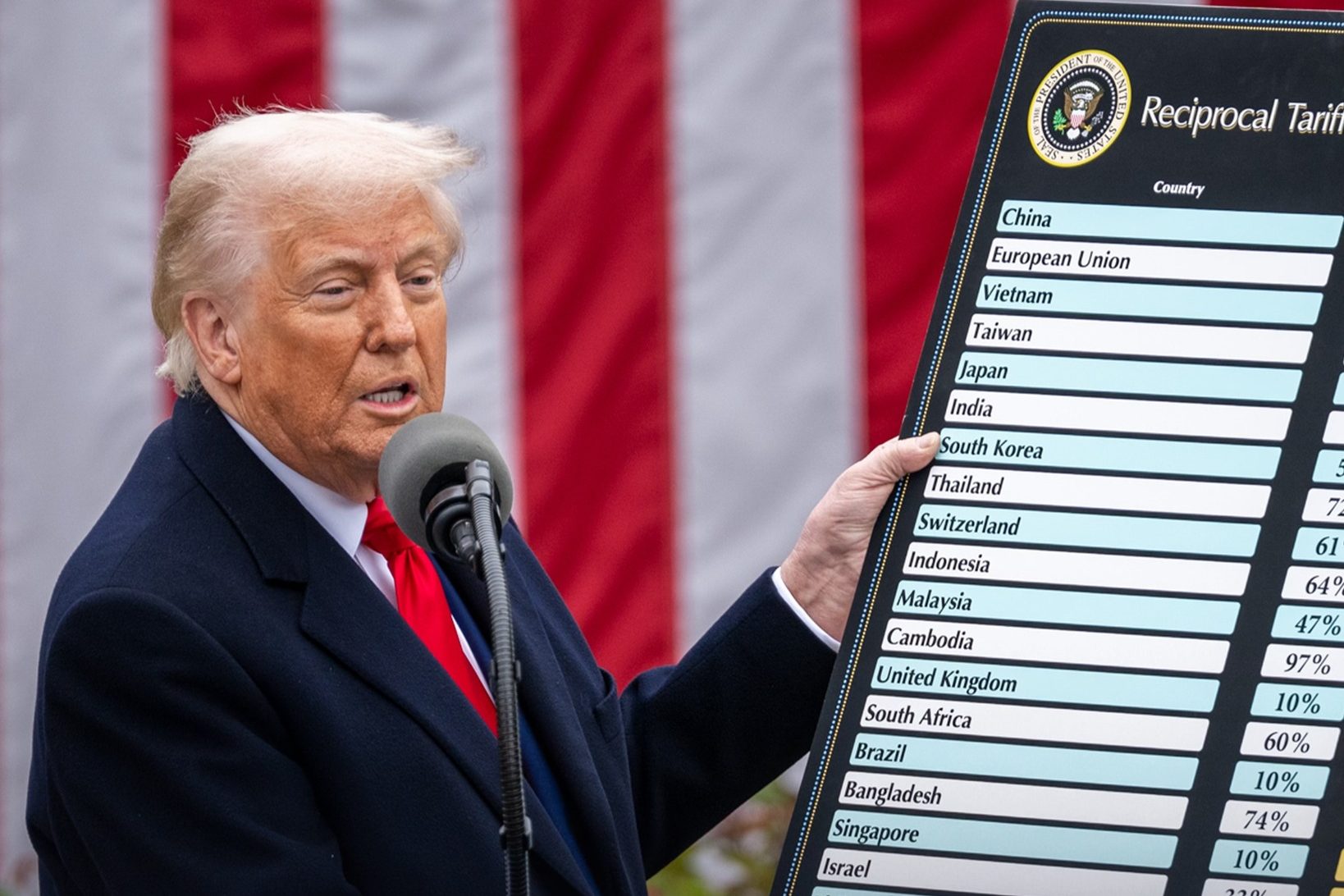
Trump has cast himself as a figure resetting a system he says is rigged against the US. (File Photo: The White House/Facebook)
The global trading system that promoted free trade and underpinned global prosperity for 80 years now stands at a crossroads.
Recent trade policy developments have introduced unprecedented levels of uncertainty – not least, the upheaval caused by United States President Donald Trump’s sweeping tariff regime.
This is presenting some fundamental changes to the way nations interact economically and politically.
The free trade ideal
Free trade envisions movement of goods and services across borders with minimal restrictions. That’s in contrast to protectionist policies such as tariffs or import quotas.
However, free trade has never existed in pure form. The rules-based global trading system emerged from the ashes of the second world war. It was designed to progressively reduce trade barriers while letting countries maintain national sovereignty.
This system began with the 1947 General Agreement on Tariffs and Trade, which was signed by 23 countries in Geneva, Switzerland.
Through successive rounds of negotiation, this treaty achieved substantial reductions in tariffs on merchandise goods. It ultimately laid the groundwork for the establishment of the World Trade Organization in 1995.
‘Plumbing of the trading system’
The World Trade Organization introduced binding mechanisms to settle trade disputes between countries. It also expanded coverage of rules-based trade to services, intellectual property and investment measures.
Colloquially known as “the plumbing of the trading system”, this framework enabled global trade to expand dramatically.
Merchandise exports grew from US$10.2 trillion (A$15.6 trillion) in 2005 to more than US$25 trillion (A$38.3 trillion) in 2022.
Yet despite decades of liberalisation, truly free trade remains elusive. Protectionism has persisted, not only through traditional tariffs but also non-tariff measures such as technical standards. Increasingly, national security restrictions have also played a role.
Trump’s new trade doctrine
Economist Richard Baldwin has argued the current trade disruption stems from the Trump administration’s “grievance doctrine”.
This doctrine doesn’t view trade as an exchange between countries with mutual benefits. Rather, it sees it as as a zero-sum competition, what Trump describes as other nations “ripping off” the United States.
Trade deficits – where the total value of a country’s imports exceeds the value of its exports – aren’t regarded as economic outcomes of the trade system. Instead, they’re seen as theft.
Likewise, the doctrine sees international agreements as instruments of disadvantage rather than mutual benefit.
The US retreats from leadership
Trump has cast himself as a figure resetting a system he says is rigged against the US.
Once, the US provided defence, economic and political security, stable currency arrangements, and predictable market access. Now, it increasingly acts as an economic bully seeking absolute advantage.
This shift – from “global insurer to extractor of profit” – has created uncertainty that extends far beyond its relationships with individual countries.
Trump’s policies have explicitly challenged core principles of the World Trade Organization.
Examples include his ignoring the principle of “most-favoured nation”, where countries can’t make different rules for different trading partners, and “tariff bindings” – which limit global tariff rates.
Some trade policy analysts have even suggested the US might withdraw from the World Trade Organization. Doing so would complete its formal rejection of the global trading rules-based order.
China’s challenge and the US response
China’s emergence as the world’s manufacturing superpower has fundamentally altered global trade dynamics. China is on track to produce 45% of global industrial output by 2030.
China’s manufacturing surpluses are approaching US$1 trillion annually (A$1.5 trillion), aided by big subsidies and market protections.
For the Trump administration, this represents a fundamental clash between US market-capitalism and China’s state-capitalism.
How ‘middle powers’ are responding
Many countries maintain significant relationships with both China and the US. This creates pressure to choose sides in an increasingly polarised environment.
Australia exemplifies these tensions. It maintains defence and security ties with the US, notably through the AUKUS agreement. But Australia has also built significant economic relationships with China, despite recent disputes. China remains Australia’s largest two-way trading partner.
This fragmentation, however, creates opportunities for cooperation between “middle powers”. European and Asian countries are increasingly exploring partnerships, bypassing traditional US-led frameworks.
However, these alternatives cannot fully replicate the scale and advantages of the US-led system.
Alternatives won’t fix the system
At a summit this week, China, Russia, India and other non-Western members of the Shanghai Cooperation Organization voiced their support for the multilateral trading system. A joint statement reaffirmed World Trade Organization principles while criticising unilateral trade measures.
This represents an attempt to claim global leadership while the US pursues its own policies with individual countries.
The larger “BRICS+” bloc is a grouping of countries that includes Brazil, Russia, India, China, South Africa and Indonesia. This group has frequently voiced its opposition to Western-dominated institutions and called for alternative governance structures.
However, BRICS+ lacks the institutional depth to function as a genuine alternative to the World Trade Organization-centred trading system. It lacks enforceable trade rules, systematic monitoring mechanisms, or conflict resolution procedures.
Where is the trading system headed?
The global trading system has been instrumental in lifting more than a billion people out of extreme poverty since 1990. But the old system of US-led multilateralism has ended. What replaces it remains unclear.
One possible outcome is that we see a gradual weakening of global institutions like the World Trade Organization, while regional arrangements become more important. This would preserve elements of rules-based trade while accommodating competition between great powers.
“Coalitions of like-minded nations” could set high policy standards in specific areas, while remaining open to other countries willing to meet those standards.
These coalitions could focus on freer trade, regulatory harmonisation, or security restrictions depending on their interests. That could help maintain the plumbing in a global trade system.
Peter Draper, Professor, and Executive Director: Institute for International Trade, and Director of the Jean Monnet Centre of Trade and Environment, University of Adelaide and Nathan Howard Gray, Senior Research Fellow, Institute for International Trade, University of Adelaide
This article is republished from The Conversation under a Creative Commons license. Read the original article.




















