
Canada News
’I did not expect to be a slave’: Amnesty International report exposes abuse of migrant workers

By Aloysius Wong, CBC News, RCI

Now a permanent resident, Bénédicte Carole Zé paid $10,000 in illegal recruitment fees for a job in Canada, only to work for an employer who physically, psychologically and sexually abused her. She is one of 44 migrant workers who shared their stories with Amnesty International for the non-profit’s report on the Temporary Foreign Worker Program. Photo: Radio-Canada / Ivanoh Demers
Human rights group says Canada’s system sets up foreign workers for multiple forms of ‘labour exploitation’
This story is part of Welcome to Canada (new window), a CBC News series about immigration told through the eyes of the people who have experienced it.
I did not expect to be a slave here.
Bénédicte Carole Zé came to Canada in 2016 to work on a poultry farm after paying $10,000 in illegal recruitment fees for a job here. But once she arrived, she says she was forced to work 70- to 80-hour weeks for an employer who she alleges sexually abused her, controlled her banking and did not let her leave the house or have a cellphone, while threatening her with deportation if she complained.
The Cameroonian woman’s testimony is just one of many accounts of exploitation and abuse in a new Amnesty International report (new window) into the experiences of labourers in the temporary foreign worker program (TFWP).
I did not come here injured,
Gabrielle, a worker from Jamaica, told Amnesty. She was identified under a pseudonym.
She says she suffered a severe injury after falling off a ladder while working on apple trees on a B.C. farm.
Canada has destroyed me,
said Gabrielle, who alleged that her supervisors would utter racial slurs and threaten to send her back to the tree you came from
to make her and others work faster.
Amnesty’s report, published Thursday morning, integrates research and interviews with 44 migrant workers from 14 countries living or working in Quebec and Ontario.
It documents what the human rights organization calls the labour exploitation
of migrant workers, which it says ranges from wage theft and unsafe working conditions to abuse and race- and gender-based violence.
Julia Sande, Amnesty International Canada’s human rights law and policy campaigner, says the stories she heard from migrant workers were harrowing.
They got here, and were shocked and horrified at what they found,
Sande, who was also a researcher for the report, told CBC News.
She stressed that pretty much every worker
that Amnesty interviewed had recounted multiple human rights abuses.
I remember someone talking about passing out and saying, ‘All I needed was a glass of water and they treated me like not a human being who was deserving of that.’
Employment and Social Development Canada (ESDC), the department that oversees the TFWP, wrote in a statement to CBC that ensuring the health and safety of temporary foreign workers remains our key priority.
ESDC says it has “recently strengthened” rules on penalties (new window) for non-compliant employers (new window). In the first six months of the 2024-25 fiscal year, it said the department issued $2.1 million in penalties, more than double the amount issued for the same period the year before.
‘Inherently exploitative’
Amnesty calls the TFWP inherently exploitative
and discriminatory
because it gives employers too much power over foreign employees, the organization says, while also predominantly targeting racialized workers from the Global South.
The organization argues in its report that the widespread abuse of foreign workers violates Canada’s commitments to international law, including a UN covenant to maintain safe and fair working conditions (new window).
It recommended the program be overhauled to address what it called systemic discrimination, while also calling to grant migrants permits to work for any employer, as opposed to the current model, which ties each foreign worker to a specific employer in a single sector.
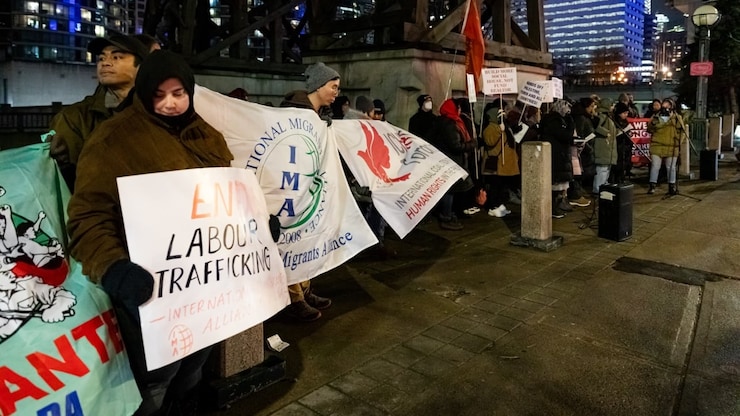
A migrant rights advocate holds a sign to ‘end labour trafficking’ at a rally in Toronto for International Migrants Day on Wednesday, Dec. 18, 2024. (Aloysius Wong/CBC) Photo: (Aloysius Wong/CBC)
The 71-page report is only the latest in a series of inquiries critical of the TFWP.
A July 2024 UN report (new window) called the program a breeding ground for contemporary forms of slavery,
following UN special rapporteur Tomoya Obokata’s visit the year before (new window). At the time, Obokata also recommended ending the use of closed work permits.
Last year, Senate (new window) and House (new window) committees also issued similar recommendations to phase out employer-specific permits.
WATCH | Amnesty report details ‘unsafe conditions’ and ‘horrific housing’:
Migrant workers face conditions that mirror slavery movies, Amnesty says
Amnesty International Canada researcher Julia Sande says temporary foreign workers in Canada are subjected to ‘horrific housing,’ as well as poor access to drinking water and sanitation.
In a statement to CBC, Immigration, Refugees and Citizenship Canada (IRCC) said it is continuously taking steps to strengthen its temporary foreign worker programs,
including requiring employers to provide (new window) private health insurance and prohibiting charging recruitment fees to foreign workers.
IRCC also pointed to a 24/7 tip line (new window) where people can report abuse of temporary foreign workers.
It did not answer whether the government is considering discontinuing the use of closed work permits.
As the issues raised in the report are part of current litigation, we are unable to comment at this time,
it said.
Sande is disappointed in the lack of action from authorities, despite the repeated warnings.
This just simply cannot go on any longer,
she said. [The government] cannot know about this and … continue violating their international human rights obligations.
Increase in vulnerable foreign workers
According to IRCC, more than 2,700 open work permits were granted to vulnerable foreign workers (new window) in the first eight months of 2024 — the most in any year so far.
The federal government has made some changes to the TFWP amid heightened scrutiny around immigration. In August, ESDC announced that it would cease to process applications from employers in metropolitan areas with high unemployment. And six weeks ago, in an effort to reduce fraud, IRCC removed the permanent residence incentive for foreign workers (new window) in the program.
This article is republished from RCI.




















