
Business and Economy
Before we “axe the tax,” a quick lesson in history and physics

By Thomas F. Pedersen, Policy Options
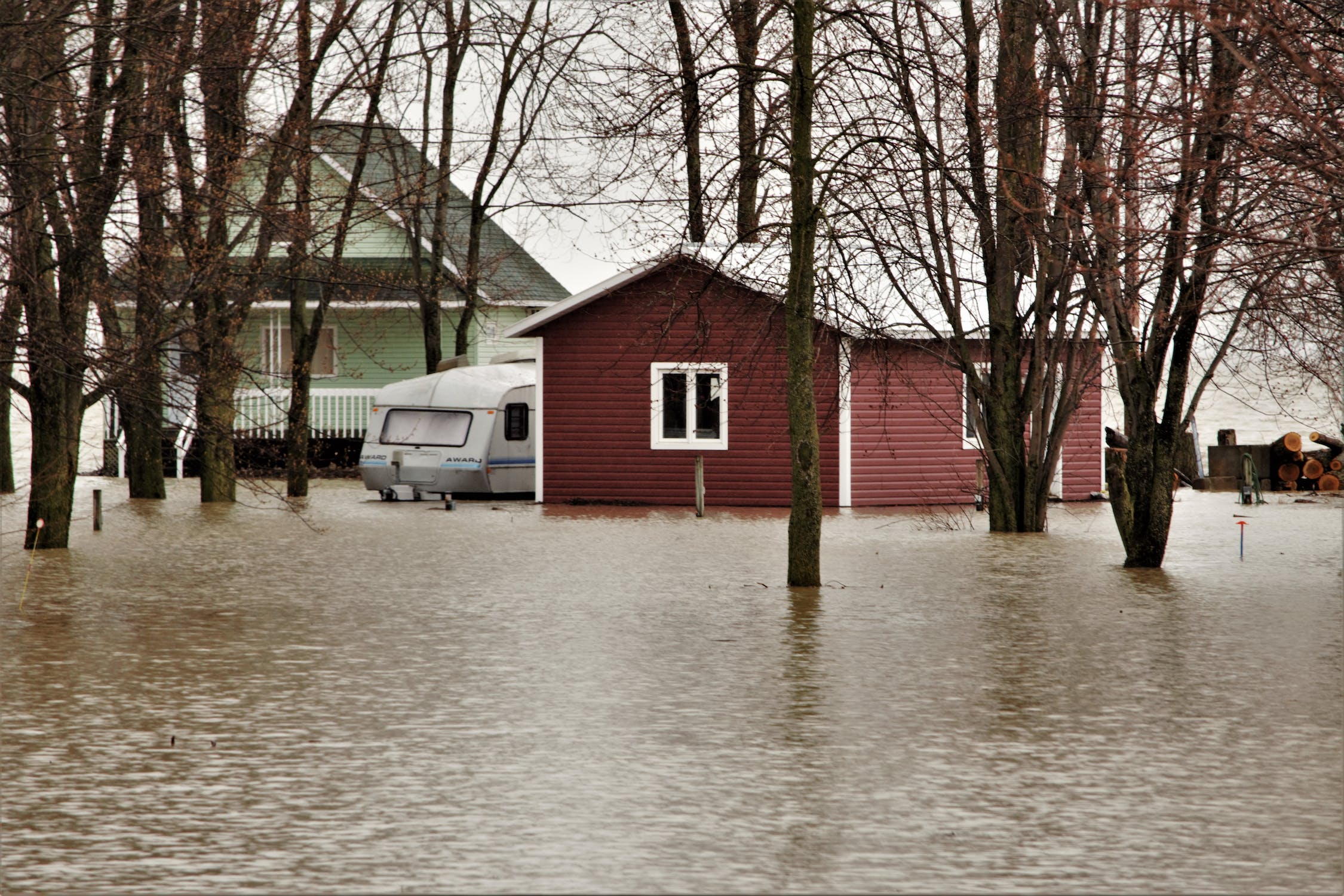
Here in Canada insurance claims resulting from extreme weather events — largely floods and wildfires — this year alone already exceed $9 billion. (Pexels photo)
Pierre Poilievre, please take note.
An aspiring prime minister whose centrepiece mantra is to axe Canada’s carbon tax would be advised to pause for a couple of basic lessons in history and atmospheric physics.
In the mid-19th century, two eminent European physicists, Rudolf Clausius and Benoît Clapeyron, derived one of the most important relationships in climate science: the Clausius-Clapeyron relation. It states that the water-holding capacity of the atmosphere increases by about seven per cent for every degree Celsius that the temperature rises.
Across the English Channel at about the same time, John Tyndall, eminent professor of natural philosophy at the Royal Institution in London, was making the first measurements of the heat-absorbing capacity of carbon dioxide and other gases. In a seminal evening lecture in 1859, he said that an atmosphere containing carbon dioxide “admits of the entrance of the solar heat but checks its exit; and the result is a tendency to accumulate heat at the surface of the planet.”
Checks its exit. Those three words capture the first experimentally verified explanation of the greenhouse effect.
So, in the modern — and warmer — world in which we live, what links the Clausius-Clapeyron relation, Tyndall’s greenhouse-gas experiments, carbon taxation, our wallets and Pierre Poilievre’s fondness for his call to “axe the tax”?
One word: floods.
That word is inconvenient for Poilievre because there is pretty close to a direct line between the increasing intensity of extreme rainfall events and smart, revenue-neutral carbon pricing to limit the carbon emissions that John Tyndall long ago warned us about. Thus far, the result has been an atmosphere that has warmed up on average by nearly 1.5 degrees C, making it moister, just as Clausius and Clapeyron determined it would.
And, along the line of contact between cold fronts and warm, now-moister air masses — contact that fosters condensation — the likelihood of historically unprecedented deluges is now twice what it was in Tyndall’s era.
Such deluges are now happening with astonishing frequency, and they bring with them enormous costs. Last August, 158 mm of rain fell on Montreal in a matter of hours, swamping low-lying areas and generating an estimated $2.5 billion in insurance claims.
A month earlier, about 100 mm of rain fell on Toronto in just three hours, overwhelming drainage infrastructure. The price tag: $1 billion.
Overseas in September, several days of torrential rains broke records in Poland, Czechia, Austria, Hungary, Romania, Germany and Slovakia, accounting for at least $4 billion in insured losses.
And on Oct. 29, Valencia, Spain, was hit with a year’s worth of rain in just eight hours — nearly 500 mm. Flash floods turned streets into rivers. They swept vehicles into massive piles, destroyed homes and killed over 200 people. The costs — labelled “incalculable” by Le Monde in early November — are still being tallied and will be many billions of dollars.
Those examples have much company: in September alone, extraordinary rainfall events and catastrophic flooding hit Turkey, the Philippines, Saudi Arabia, Mexico, France, Italy, India, Wales, Morocco, Algeria, Vietnam, Guatemala, Croatia, Nigeria, Thailand, Greece, Japan, South Korea, Tunisia, China, Indonesia, Panama, Nepal and Sri Lanka!
Billions in damages will grow into trillions later this century, according to current projections. Here in Canada insurance claims resulting from extreme weather events — largely floods and wildfires — this year alone already exceed $9 billion.
If you happen to live on higher ground somewhere in Canada and believe global warming is not affecting you, I’d ask that you check that opinion against the direction your home-insurance premiums have been headed lately. Homeowner insurance premiums have risen on average eight per cent since last year, Statistics Canada reports.
When Poilievre claims that the consumer-based carbon tax that he is vowing to remove is driving up the cost of living — a claim the Bank of Canada has shown is demonstrably false — he would do well to connect the dots between rising global carbon emissions, floods and household-insurance costs.
Smartly designed carbon taxation constrains emissions. But don’t take my word for it — look at the data.
In 2008, B.C.’s conservative government, led by Gordon Campbell, legislated the world’s first broad-spectrum, fully revenue-neutral, gently accelerating carbon tax. By 2013 (when Campbell’s successor, Christy Clark, froze the tax) it had yielded a per-capita decline in carbon emissions of 19 per cent relative to the rest of Canada.
Revenues generated were used to reduce personal, corporate and small-business tax rates, and to provide direct cash support to low-income individuals.
Mark Carney has given us a sensible next step after the carbon tax. We need to take it
Five public-opinion trends to watch in 2025
Why the carbon tax often costs more in Atlantic Canada
Ottawa’s climate strategy must be led by a coalition of the most trusted
And the kickers: B.C.’s economy grew at least as fast as the rest of the country, and if you made wise decisions and reduced your emissions (thereby paying less tax), you had extra cash in your pocket as income-tax rates came down.
This revenue-neutral tax structure earned international acclaim and was applauded in 2010 as “a template for the world” by Paul Ekins, eminent professor of economics and director of the U.K.’s Green Fiscal Commission.
Given B.C.’s success and the consequences of climate change, Poilievre needs to rethink his promise to axe the tax. He could begin by heeding the guidance of politically allied economists — like many at the Fraser Institute — who agree that taxing carbon emissions and offering rebates to taxpayers is wise policy.
Wise leadership requires learning from history and adapting to ensure Canada is part of the solution to a planetary crisis that affects us all. Taxing carbon with full revenue neutrality is a proven way to achieve both.
This article first appeared on Policy Options and is republished here under a Creative Commons license.




















