By Andrea Freeman, Southwestern Law School, The Conversation
Join us for a live podcast recording at the Canadian launch of RUIN THEIR CROPS ON THE GROUND — on Thursday, Nov. 14 from 7-9 p.m. at Another Story Bookshop in Toronto. Free to attend. RSVP here. In conversation with Vinita Srivastava, host of the Don’t Call Me Resilient podcast.
Editor’s note: This article is adapted from RUIN THEIR CROPS ON THE GROUND: America’s Politics of Food, from the Trail of Tears to School Lunch by Andrea Freeman. Published by Metropolitan Books/Raincoast. Copyright © 2024 by Andrea Freeman. All rights reserved.
Frybread, sometimes called “die bread” or a “weapon of health destruction,” has multiple origin stories, and they all involve oppression and perseverance.
In one rendition, the United States federal government’s Indian agents in charge of providing rations stored flour carelessly, allowing weevil larvae to infest it. No other food was available, so Indigenous cooks fried the flour in hot lard to kill the larvae. With this stroke of genius, they salvaged the flour and created the first frybread.
Another tale locates frybread’s birthplace on Fort Sumner’s Pecos River, where U.S. soldiers incarcerated Navajos and Apaches after a military campaign. Army officers gave the captives sparse supplies of flour and salt and iron pots. Charged with creating something edible, Navajo women kneaded the flour into dough balls, flattened them, then deep-fried them in animal fat. The prisoners enjoyed the dish so much that even after leaving Fort Sumner and returning home, they continued to cook and eat it.
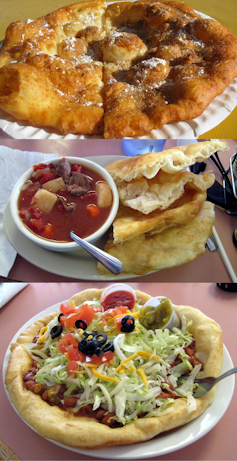
Modern frybread is still made from simple ingredients: flour, baking powder, salt, and sometimes sugar, fried in shortening, lard or oil.
jshyun/Flickr, theotter/Flickr, CC BY-NC-ND
It is a versatile food that can be sweet or savory, perfect as the base of a taco, a filling breakfast, or a snack. When served sweet, it often has cinnamon and sugar sprinkled on top and comes with jam. A savory version might have pizza toppings.
T-shirts celebrating frybread abound: “Frybread Feels,” “Got Frybread?,” “Frybread Power,” “Frybread Is My Soulmate,” “I Was Told There Would Be Frybread,” “It’s All About the Frybread.” In “Commod Bods and Frybread Power” scholar Dana Vantrease explains that these popular T-shirts help Indigenous people find each other in environments where wearing traditional regalia is no longer common.
A’aninin anthropologist George P. Horse Capture called frybread “a divine gift in exchange for hardships such as racism and disease that native people have endured.”
In 2005, South Dakota declared frybread its official state bread.
A 2012 mockumentary, More Than Frybread, comically portrays the cutthroat competition among Indigenous nations in an Arizona frybread championship.
Ojibwe rock artist Keith Secola’s song “Frybread” is a musical tribute to the beloved food. In one version of the song, he associates frybread with Indian resistance. At the same time, Secola contends that “frybread has killed more Indians than the federal government.”
On the hit television show Reservation Dogs, the only series ever to feature all Indigenous writers, directors and main cast members, the Indian Health Center invites rapper Punkin’ Lusty, played by real-life Mvskoke rapper Sten Joddi, to perform his hit song “Greasy Fry-bread.” The occasion is Diabetes Awareness Month. Lusty raps:
“Baby girl looking deadly (Yeah!)/Why she acting all Rezzy (Yeah!)/Hotter than a pan of frybread grease!/Have a Native hittin’ Powwow Beats!/Gotcha Auntie in the kitchen/Like no he didn’t/Got her Gramama’s
skillet/Like she ’bout to kill it!”
The song solidly locates frybread within Indigenous culture.
Foregrounding this song in the Health Center’s battle against diabetes underscores the other side of frybread’s legacy, also emblazoned on a T-shirt that announces “Frybread: Creating Obesity Since 1860.”
Cheyenne and Hudulgee Muscogee Indigenous rights activist Suzan Shown Harjo, who vowed to give up frybread as a New Year’s resolution, explains, “Frybread is emblematic of the long trails from home and freedom to confinement and rations. It’s the connecting dot between healthy children and obesity, hypertension, diabetes, dialysis, blindness, amputations and slow death.”
In The Heartbeat of Wounded Knee, writer and English professor David Treuer introduces health educator Chelsey Luger, who is Ojibwe and Lakota. Chelsey talks to Indigenous communities about the perils of frybread as part of her efforts to steer their diets in new directions, even in the face of limited food options. “Sometimes people get defensive, but we are able to make the conversation positive. We say we grew up with it and like it and we say frybread is not power. We say frybread kills our people. It’s that serious. It causes diabetes and heart disease. We have to look at those colonial foods as a kind of enemy.”
Frybread arouses passionate feelings in its fans and detractors. Some people celebrate it as culinary artistry, some consume it as a comfort food, some curse it as a colonial byproduct, and some hold it up as a sign of ignorance or self-destruction. But everyone agrees that it is a far cry from the pre-colonial foods that nourished Indigenous people for centuries.
Library of Congress
In a nutshell, frybread embodies the contradictions of trying to hold onto familiar foods while staying healthy. Terrol Dew Johnson, co-director of Tohono O’odham Community Action, does not consider frybread a traditional food. “Is there traditional songs about fry bread? You know, is there a ceremony you should perform when you do fry bread? So you’re looking back into your culture in your own tribes and see, ‘What kind of prayers do I pray to our creator about fry bread?’”
But an Indigenous woman who moved away from her reservation feels the opposite. She describes how frybread connects her to her family: “Fry bread is important for me… . The smell of it keeps us happy… . It makes me think about my moms and how she’d cook that up every morning. [My boyfriend] used to dance in the powwow circuit, so it also reminds us of being young and kicking our heels up.”
Outsiders often blame Indigenous people’s love of frybread and other low-nutrition foods for their health problems, ignoring the history of colonialism and attempts at genocide and assimilation that created structural barriers to good health.
A 2000 National Institutes of Health study of obesity in Indigenous elementary school students concluded that their caregivers and communities were responsible. Narrowly examining only the nutritional content of their food, researchers neglected to question if these were the only foods available and why. Understanding Indigenous diets requires a close reading of the past that acknowledges displacement, broken treaties, and destruction of traditional food sources. It demands a deeper analysis of the effects of poverty, racism, and government actions that led to inadequate medical services on and off reservations and lack of access to nutritious food.
The reality is that frybread does less damage than the food provided under the guise of nutrition assistance. The boxes of commodity food that the USDA distributes to reservations are at least as bad, without providing frybread’s redeeming cultural comforts. Ultimately, the demonization of frybread only serves to distract from government policies that have dictated Indigenous food and health since colonization.
Andrea Freeman, Second Century Chair Professor of Law, Author of Ruin Their Crops on the Ground and Skimmed: Breastfeeding, Race, and Injustice, Southwestern Law School
This article is republished from The Conversation under a Creative Commons license. Read the original article.