

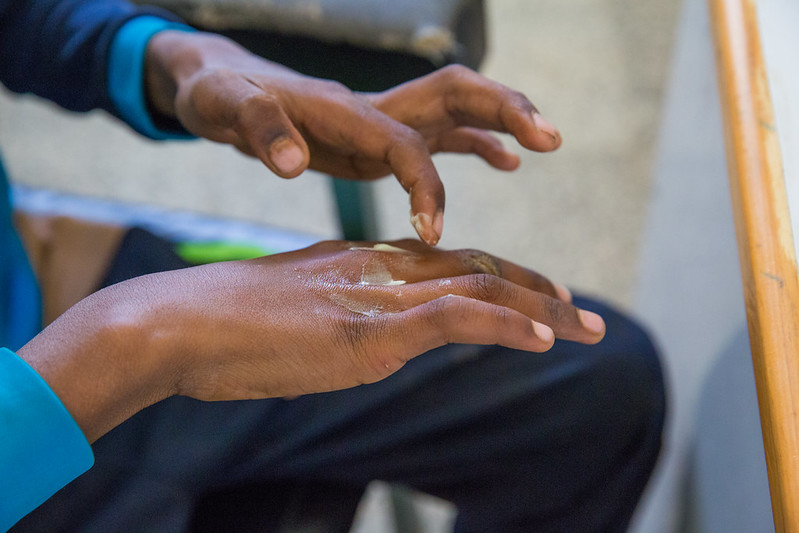
FILE: Scabies response in drought-affected areas. (Photo: UNICEF Ethiopia/Flickr, CC BY-NC-ND 2.0)
By Michael Head, University of Southampton, The Conversation
Scabies is an itchy skin infection that sees outbreaks across the world.
It is caused by mites, similar to but much smaller than head lice. These mites burrow under the skin, lay eggs and reproduce, causing an immune response which generates the unpleasant itching associated with the disease.
Outbreaks often occur in institutional settings, such as residential care homes for the elderly. In October 2024, outbreaks around UK university settings were reported in the media.
The incubation period for scabies is typically four to six weeks. This is the time between being infected – a mite getting onto and then under the skin – and a patient showing symptoms such as the classic unpleasant itch.
So, the cases reported in October 2024 would have been infected mid to late September, around the time of student arrival at their universities around the country.
Given this long incubation period, it can be difficult to prevent and control outbreaks. The condition can also be difficult to diagnose because the clinical presentation on the skin can be tricky to spot – for example, between the fingers.
Transmission is typically by prolonged skin-to-skin contact and sharing contiminated bedding, towels, clothes and soft furnishings where the mites can wait and crawl onto the next person who uses them. Guidance recommends washing bedding, clothes and towels at high temperatures to kill the mites, or if that is not possible then to seal the items inside plastic bags for three to four days.
Stigma and under-reporting
Data from The Royal College of General Practitioners’ report on communicable and respiratory disease in England for October 2024 indicates that the reported case numbers of scabies are higher than the seasonal average.
These official figures are also likely to be conservative. Like many skin infections, scabies is a stigmatised disease and so under-reporting or late reporting are common.
There is a perception that scabies is a disease “of the unwashed”. This is likely to be incorrect, with the burrowing of the scabies mites meaning they simply cannot be washed away by bathing. Also, scabies can appear in areas covered by clothes, including in the groin or on the buttocks – another reason for stigma and under-reporting. This means the data we have is likely to be much lower than the true number of cases.
Treatment and prevention
Treatment is usually a skin lotion called permethrin or sometimes another cream called malathion. In order to be effective, these creams have to be rubbed all over the body, not just at the site of infection.
Ivermectin, taken orally, is also extremely effective at curing scabies and can be prescribed to control outbreaks. Public information campaigns can help with alerting the general public and describing the possible symptoms.
The World Health Organization defines a range of diseases as Neglected Tropical Diseases (NTDs). As the name indicates, the majority of these are mostly found in tropical countries. These include skin infections such as leprosy and mosquito-transmitted diseases such as dengue. However, scabies is unique among NTDs in being common in more temperate environments such as the UK. The mites thrive in almost all climates, and an infection does not go away unless correctly diagnosed and treated.
In September 2023, there were scabies outbreaks and treatment shortages in the UK. It is uncertain whether there are shortages in the October 2024 outbreak. Regardless, anyone with a persistent itch or known contact with a scabies case should report this to a healthcare worker for follow up.
While scabies does not kill many people, it is a thoroughly unpleasant infection that causes significant impact on quality of life. Awareness and early reporting can help to bring outbreaks to a rapid conclusion.
Michael Head, Senior Research Fellow in Global Health, University of Southampton
This article is republished from The Conversation under a Creative Commons license. Read the original article.




















