

By Sorin Rizeanu, University of Victoria; The Conversation
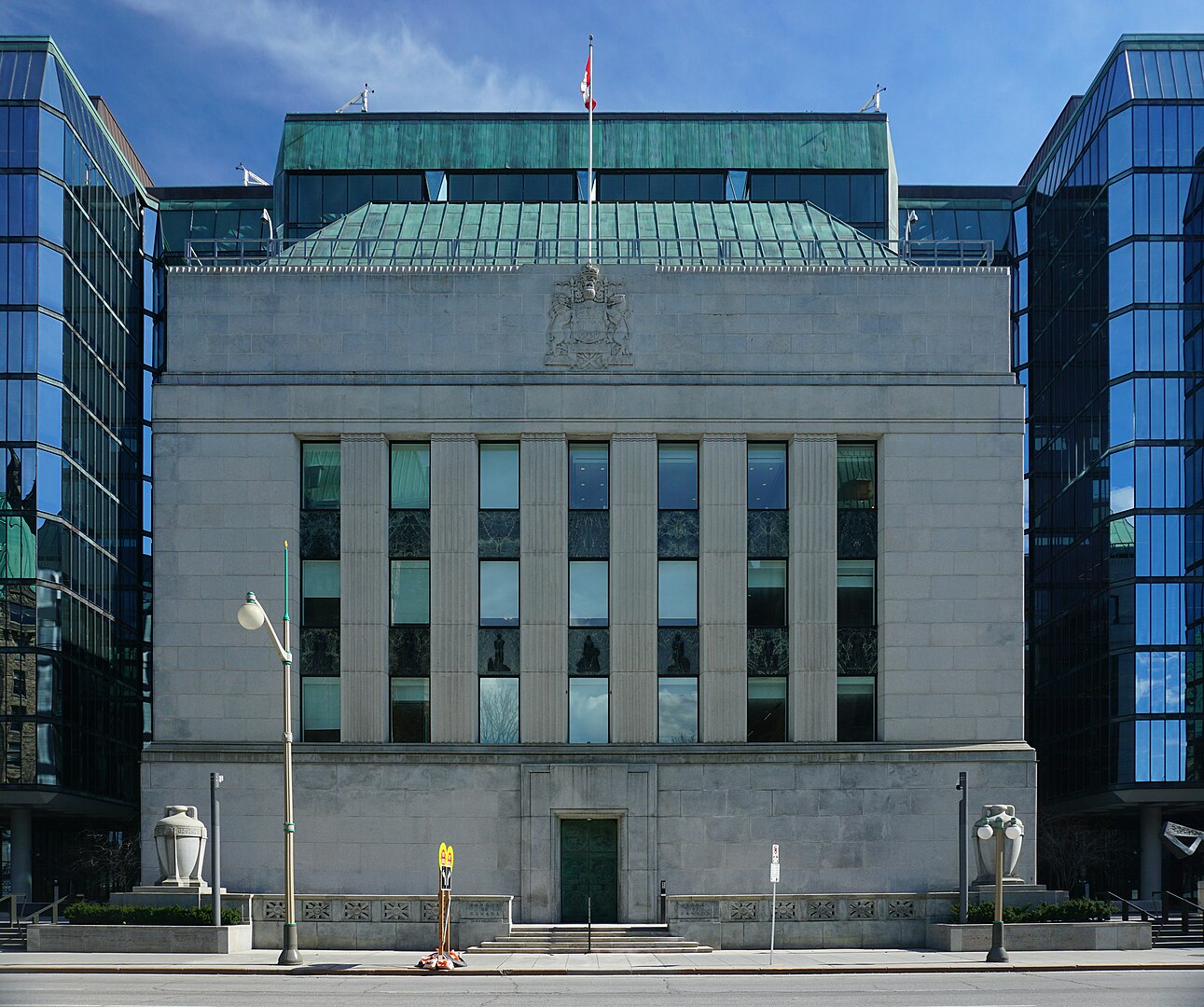
The Bank of Canada has good reasons to cut the interest rate back to 2.5 to 3.5 per cent, but this could have a significant impact on the loonie. (File Photo By 方畢可/Wikimedia Commons, CC0)
The Canadian and American economies are deeply intertwined. With the United States Federal Reserve cautious amid mixed signals from the labour market and rising inflation worries, the Bank of Canada has just lowered its key interest rate to 3.75 per cent — cutting it by half a percentage point.
Strong U.S. job growth and cooling inflation could result in a smaller Fed rate cut compared to its previous cut and to Canada’s recent cut. It could also pause the rate entirely, which may change economic conditions in the U.S. and Canada in the months to come. Upcoming U.S. elections complicate the problem further.
In Canada, cooling inflation, slowing manufacturing sales and more cautious consumer spending opens the door to another half percentage point rate cut by the end of the year.
But does the Bank of Canada have the ability to offset shifts in U.S. monetary policies through its own monetary instruments? In fact, how much room does it have to diverge from U.S. policy at all?
Monetary conditions are transmitted from the world’s biggest financial centres to the rest of the world through gross credit flows and leverage. Any policy differences between Canada and the U.S. immediately impact Canada, including spillover effects on the loonie exchange rates and other widespread economical and social effects.
Canada’s double trilemmas
Canada’s key challenges include economic growth as a potential recession looms, taming inflation, housing, managing interest rates while private and public debt is sky-high and stabilizing Canada’s commodity-linked currency in an increasingly volatile geopolitical environment. Failing to address these challenges could lead to severe systemic imbalances.
The Bank of Canada has good reasons to cut the interest rate back to 2.5 to 3.5 per cent, but this could have a significant impact on the loonie.
Canada is facing two sets of trilemmas: a monetary one for the central bank and a fiscal one for the government. On the monetary side, stable exchange rates, independent monetary policy and financial market openness are three objectives that cannot all be achieved simultaneously. European countries have sacrificed monetary independence in exchange for a strong euro and financial openness.
Canada, in contrast, has opted for free capital mobility and independent monetary policy at the expense of exchange rate stability. This allows the loonie to be determined by market forces, giving the central bank the ability to adjust interest rates while capital moves freely across the border.
On the fiscal side, the government is grappling with climate change, immigration and wealth inequality. However, there is also strong public resistance to higher taxes, and public debt and deficits are currently at alarming levels.
If the central banks are at odds
If the Bank of Canada were to cut interest rates while the Fed doesn’t, the loonie would likely depreciate sharply, forcing a response. Such a divergence happened in June 2024, with the Fed following with a 0.5 per cent cut only in September.
On such short-term deviations, sterilization is typically implemented to dampen the depreciation of the loonie by acquiring Canadian dollars and selling reserves.
If the central banks were to remain at odds in the longer term, a decrease in money supply as investors flee would likely cause a decrease in domestic bank lending, which is already under pressure from public and private debt and increased default rates.
This could decrease longer term interest rates and put additional pressure on the economy through the capital account. If investors believe the central bank is merely delaying the inevitable depreciation of its currency, it could also reinforce carry trade dynamics — an investment strategy where money is borrowed at a low cost in one currency to earn higher returns from investments in another currency.
The bond market would also react, with notable effects in key economic sectors and asset valuation. Long-term interest rates tend to align more across countries than short-term rates, especially if global factors are influencing real rates or if investors are seeking safer assets.
While the Bank of Canada can set its policy rate independently of the Fed’s rate, it has less control over the long-term. Long-term rates are tied to exchange rates and reflect expectations for future short-term rates and risk factors. Mortgage rates and corporate borrowing rates would be affected as well.
Monetary policy can’t be the only answer
The Bank of Canada’s mandate is to “keep inflation low, stable and predictable.” While this can be fulfilled through rate cuts, diverging from U.S. policy will have widespread effects on the Canadian economy. These impacts will be uneven, with indebted investors and banks likely benefiting while the working class may bear the brunt.
The Bank of Canada focuses on providing liquidity to the financial sector, often with little regulation or oversight. However, this approach tends to overlook challenges faced by the working class. In 2022, for instance, Bank of Canada Governor Tiff Macklem advised against employers increasing wages to match inflation over concern that a wage-price spiral would occur.
Even if the central bank wanted to address these issues, it’s limited by the ability to manage multiple outputs with just one instrument. As a result, the central bank should report not only on inflation, but also on the overall trade-offs of rate cuts.
The Bank of Canada has a vested interest in tampering the effects of a new rate cut, especially since it could trigger a “capital famine” in the long-term and weaken the Canadian dollar. In the short-term, divergences from the U.S. will likely be manageable, but in the longer term, currency depreciation may be unavoidable to keep the economy afloat.
Monetary policy is vital, but it’s merely the first line of defence against inflation. To truly address Canada’s economic issues, both monetary and fiscal policies need to work together in harmony, with a broader public discussion that goes beyond inflation.
Sorin Rizeanu, Assistant Professor, Gustavson School of Business, University of Victoria
This article is republished from The Conversation under a Creative Commons license. Read the original article.




















