
Breaking
Study: Tetanus shot may aid treatment of deadly brain cancer

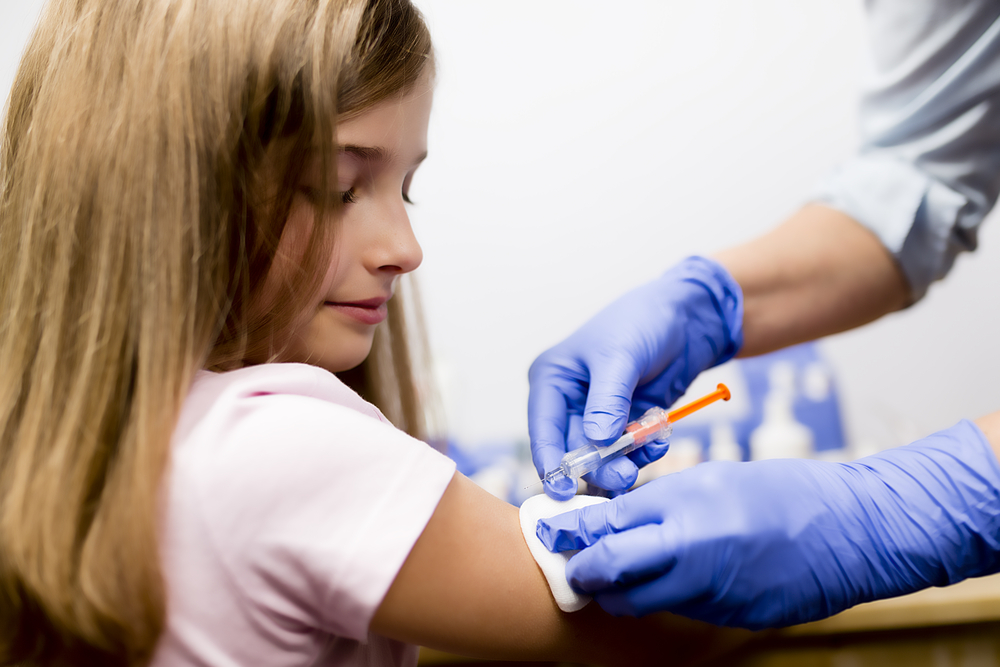
shutterstock
NEW YORK — Can a tetanus shot help treat brain cancer? A small study hints that it might.
A dose of tetanus vaccine let patients live longer when added to an experimental treatment for the most common and deadly kind of brain tumor, researchers report.
It “put the immune system on high alert,” paving the way for the experimental treatment to work better in attacking the disease, said researcher Kristen Batich of the Duke University Medical Center.
In a paper released Wednesday by the journal Nature, she and others describe a study of 12 patients. Some who got the tetanus shot lived years longer than those who didn’t.
Dr. John Sampson of Duke, senior author of the report, called the results promising but noted the study was small, and said bigger studies are needed to confirm the results. A follow-up study has already been planned but isn’t recruiting patients yet, Batich said.
Brain cancer experts unconnected with the work were impressed.
The results are “very exciting,” said Dr.
Nader Sanai of the Barrow Neurological Institute in Phoenix. While he agreed more work is required, “what you have so far, it’s a very positive story.”
Tetanus is otherwise known as lockjaw. Vaccines for it are routinely recommended for children and adults.
The new study focused on glioblastoma, which killed Massachusetts Sen. Edward M. Kennedy in 2009. Even after surgery to remove the tumor, it usually grows back and kills. The few drugs to treat these tumors have little effect. Half of patients die within about 15 months.
The new work is an example of a long-standing effort to harness the immune system to fight cancer, an approach called immunotherapy.
The specific strategy it used is called a dendritic-cell vaccine. Doctors remove particular blood cells from a patient and equip them with a chemical target found in the tumor.
Then they return the cells to the patient’s body, where they train the immune system to go after the cancer.
The 12 patients in the new study were treated with surgery, radiation and chemotherapy. All patients got an ordinary tetanus-diphtheria shot and then three injections of their own cells, spaced two weeks apart.
Then they were randomly divided into two groups. One group got a second, tiny dose of the tetanus-diphtheria vaccine at the place in the skin where the cells would be injected the next day. The other group got a dummy dose.
The idea behind the tetanus mini-shot was that the immune system “gets revved up in this particular area” so that “the body will be more excited about what’s to come,” Sampson said.
Cell injections continued monthly until brain scans showed tumor growing.
For the six patients who got the dummy shot, only one was still alive two years after diagnosis, surviving for about 3 1/2 years. Still, overall results for this group indicated a small benefit from the cell injections alone, Batich said.
The results were far better for patients who got the mini-shot of tetanus. Four surpassed two years. One of them lived almost five years and another nearly six years.
Still another is approaching nine years and counting. She is Sandy Hillburn, 68, of Fort Lee, New Jersey.
When diagnosed in New York in April 2006, “I was told I had two to three months to live,” she recalled in a telephone interview.
But her family flew her to Duke in North Carolina because of its reputation for glioblastoma care, and she was offered a slot in the experimental study.
“I was very positive it would help,” Hillburn said. “I said, `Sure, thank you.’ I’m still saying thank you.”
In the years since then, she has attended her son’s wedding and gained five more grandchildren. Now she plays soccer with six grandsons in Ohio and Boston.
“I look forward to seeing the wonderful people they’re becoming,” she said.
She continues to visit Duke once a month for more cell injections. Sampson said it’s not clear why she has lived so long.
Hillburn credits the treatment and her medical care at Duke. She also cited the example of her father, who is a 97-year-old survivor of two kinds of cancer.
“He just went about his life, and so I did the same thing,” Hillburn said.
The study was funded in part by a government grant to a business venture that is licensing the technology. Some of the authors have filed patents related to the tetanus strategy.




















