

By Carol E. Harrison, University of South Carolina, The Conversation
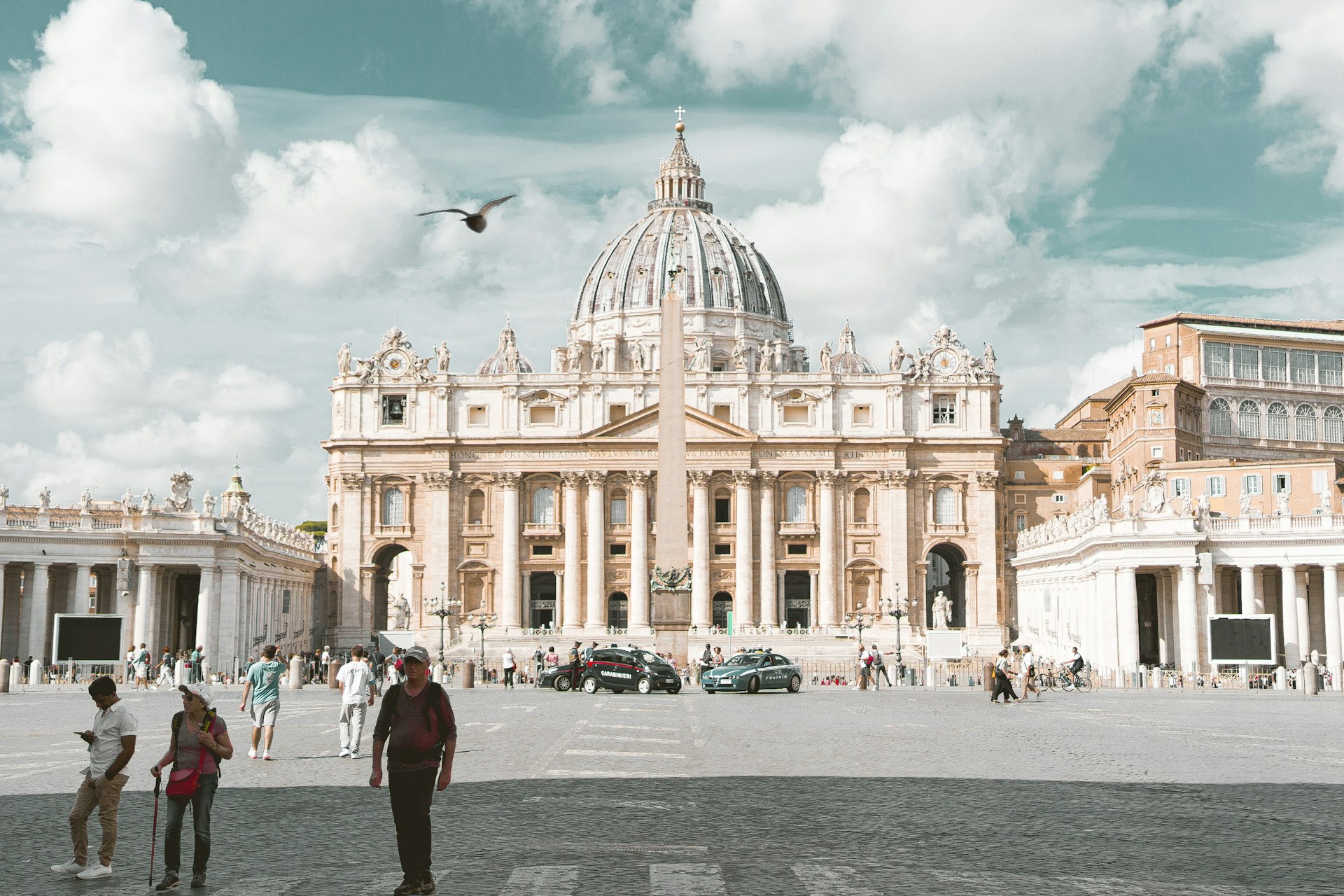
Responding to women’s request to participate formally, however, one dismissive cardinal reportedly suggested that they should “try again at Vatican III or IV.” (File Photo: Maëva Vigier/Unsplash)
In 2021, Sister Nathalie Becquart became the first woman to vote at any Vatican meeting when Pope Francis appointed her undersecretary to the synod, a gathering of bishops whose second session opened on Oct. 2, 2024.
Becquart is, in the words of Catholic media, “the synod’s face and voice,” even “a synodal icon.” She describes “synodality” as “like having a coffee together” – encouraging many Catholics to hope that their church will reimagine itself in less hierarchical ways. With her appointment, Cardinal Mario Grech, the synod’s secretary-general, remarked, “A door has been opened.”
Grech did not mention it, but Catholic women have been knocking on this door for over a century. Becquart and the synod’s 53 other female participants, both lay and religious, follow a long line of Catholic women who have cogently, and often critically, analyzed church governance.
At the current synod, whose purpose is to address “communion, participation, and mission” in the church, women’s role is on the agenda. But Catholic women have historically found ways to speak to and about their church leadership, even when they have been excluded from its proceedings.
Uninvited guests
In 1869, when Pope Pius IX convened the First Vatican Council, no one dreamed of inviting women, but they were nonetheless there.
Vatican I was the first churchwide meeting of bishops since the Reformation. Its most momentous – and controversial – result was the proclamation of papal infallibility, sealing the church’s view of itself as an absolute monarchy. Critics both within and outside the church condemned the assertion that the pope alone, without the counsel of bishops, could determine doctrine. Women who witnessed the council, especially those who published accounts of the event, were eloquent critics of this top-down church.
Many well-educated and well-connected laywomen traveled to Rome in 1869 to witness their church set its future direction. They hosted salons where bishops exchanged news in the evenings after council sessions. They corresponded with absent friends and were nodes in a network of Catholics who opposed infallibility.
When the German priest Ignaz von Döllinger wrote a devastating critique of infallibility from his study in Munich, he relied in part on information forwarded from Rome by his friend and protegée, 27-year-old Charlotte von Leyden. Outliving the council fathers of Vatican I, she got the last word in 1907, when she published the chapter on papal Rome for the landmark “Cambridge Modern History.”
The conservative Catholic press relentlessly mocked these women as misguided busybodies. Vatican I sidelined the laity of both sexes, but women who claimed a voice in church affairs seemed especially impertinent to the bishops who endorsed infallibility. Violating St. Paul’s injunction that women be silent in church, they defied clerical authority and the logic of a church that spoke with only one voice.
Change comes slowly to Vatican II
Vatican II began in 1962 much like Vatican I: an all-clerical, all-male assembly.
Women initially sought influence in similar ways as well. Every night the Belgian journalist Betsie Hollants made a pot of soup and held open house for the council fathers. Soup broth and red wine were cheap, she recalled, but they made for convivial gatherings that kept her informed about the council. Responding to women’s request to participate formally, however, one dismissive cardinal reportedly suggested that they should “try again at Vatican III or IV.”
As the council proceeded, the absence of women seemed increasingly incongruous. Douglas Horton, an American Protestant pastor invited as an observer, noted the “air of artificiality” of an assembly without women. By the second session in 1963, Mildred Horton and other non-Catholic observers’ wives could attend some events, but no Catholic women were present. When the Catholic press corps received Communion, a Swiss Guard physically prevented the only female journalist from approaching the altar.
Pope John XXIII had declared “aggiornamento” – bringing the church up to date – the order of the day, but these incidents made many wonder if aggiornamento was possible without women.
Signs of change arrived at the fourth session in September 1964, when the new pope, Paul VI, appointed 23 women auditors: 10 religious and 13 lay women. They participated in preparatory sessions, especially those concerning the laity, where they were, in Paul’s words, “experts in life.”
No woman ever addressed the council fathers; their efforts to do so were rebuffed, but their presence in preliminary meetings was significant. In a discussion of marriage, for instance, Luz María Alvarez-Icaza – a Mexican woman who, with her husband, José, was an auditor – informed the assembled clerics that she was confident that their mothers had conceived them in acts of love, not animal lust. One of the most significant changes to emerge from Vatican II was the reassessment of marital sex. Whereas the church once viewed sex between husband and wife as a check on humanity’s essentially sinful nature, new teachings described it as a positive expression of love.
More than ‘flowers and light’
The documents produced by Vatican II say relatively little about women, which was, arguably, a victory for female auditors. Many of them mistrusted the council fathers’ view of women as a separate, even foreign, species.
The Australian theologian Rosemary Goldie, listening to the eminent French theologian Yves Congar’s extravagant descriptions of women’s role, told him, “You can cut the references to women as flowers and light. … We don’t need any of that grandiose stuff. … All we want is to be treated as full human beings.”
“Women are not ‘a category’ in the church,” Sister Mary Luke Tobin, an American, maintained: “Men and women are the church.”
Thanks to these 23 “mothers of the council,” Vatican II’s teachings on women are, for the most part, incorporated into its larger treatment of human dignity, not segregated into separate chapters on women’s nature.
Possibilities today
How much will it matter that 54 voting women have replaced the hostesses, writers and auditors of Vatican I and Vatican II? We probably won’t know for a long time – decades at least.
Revolution is unlikely. Many Catholics support allowing women to serve as deacons – ministers who can perform some, but not all, of the priest’s duties. That possibility, however, is off the synod table, handed to a commission for further study. The ordination of women as priests seems impossibly distant.
It could be, however, that 54 female voices teach their church how to speak of and to women as equals. Or it may be that those voices disappear amid the cacophony of nearly 400 participants. As Pope Francis reminds both conservatives and progressives, the synod is not a parliament. Votes are counted, but as a step toward discernment of truth, not a moment of decision.
Carol E. Harrison, Professor of History, University of South Carolina
This article is republished from The Conversation under a Creative Commons license. Read the original article.




















