
Canada News
The Netherlands generates way more solar power than Canada. Here’s how they do it

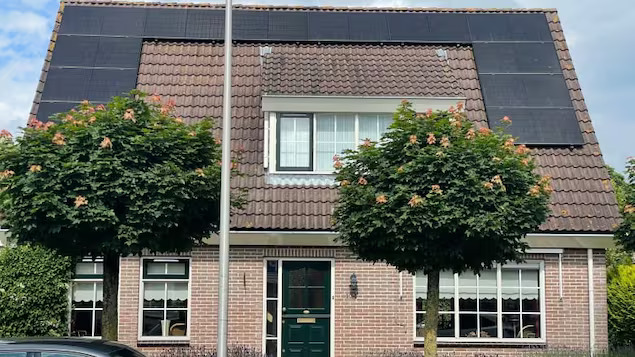
Solar adoption is high in the Netherlands, with one third of Dutch homes hosting rooftop panels. The country now has the highest per-capita solar generation in Europe. (Jill English/CBC) PHOTO: (JILL ENGLISH/CBC)
By Jill English, RCI, CBC News
Global investment in solar power now tops all other energy generation technologies combined, says IEA
Solar is now the cheapest option for new sources of electricity (new window) in much of the world, and the Dutch are all in.
The Netherlands is known for scattered showers, abundant waterways, and actively-used agricultural land, so it took ingenuity for the small country to soar to the top of the continent’s solar pyramid.
One in three homes (new window) has rooftop solar, commercial ventures are grabbing up space on waterways, and even old landfill sites (new window) are finding a second life as energy generators.
I want to be a myth buster,
says European solar strategist Kahya Engler when asked about the financial burden of transitioning to solar. The cost to invest in solar energy has come down a lot.
She’s been working to promote the renewable technology for nearly two decades. Her most recent venture is with the Netherlands’ commercial rooftop leader Sunrock, helping expand its business across Europe.
To her, the case is simple.
We all have daylight, and solar panels work on daylight,
she says from Sunrock’s Amsterdam office, where even the interior design pays homage to the sun.
We’re ready to go.
But key to continued growth, says Engler, is consistent government policies that encourage solar — something that’s faltered in Canada, and may be at risk in Europe too.
Solar revolution
Investment in the 70-year-old renewable technology is now greater than all other energy generation technologies combined, according to the International Energy Agency’s latest investment report (new window), published this month.
While Canada lags behind in solar (new window) adoption, many places including Germany, China, Japan and even the United States are moving quickly.
In fact, on certain days, some places are generating so much energy, the price to purchase it is dropping below zero, prompting concerns about storage capacity (new window) for the abundant power source.
The financial backing is putting the global commitment to triple renewable energy capacity (new window) by 2030 in reach, according to some analysts.
Even if the transition is propelled by economics alone, with no further policy drivers to help, renewables could still cross a 50 per cent share of electricity generation at the end of this decade,
BloombergNEF’s 2024 New Energy Outlook states.
Over the last decade, global solar generation has risen twelvefold (new window), but some countries are buying in more than others.
While Germany (new window)has the most capacity for solar power generation in Europe, the Netherlands is the continent’s current leader in solar energy per capita.
The Netherlands embraces solar
Solar now accounts for more than 16.6 per cent (new window)of electricity generation in the country, putting it well above Canada’s 1.1 per cent, and the global average of 5.5 per cent.
Renewable energy obviously has been a big topic since 2000 in Europe, but the Netherlands was a relatively slow starter,
says Engler. It really grew very, very fast.
Sunrock specializes in commercial rooftop solar, and has quickly expanded across Europe since it was founded as a small startup in 2012. The market leader now has upwards of 160 employees and more than five million square metres of operational solar photovoltaic systems (solar panels).
Project manager Bart Meij says using otherwise empty rooftops offers an untapped revenue stream for building owners is an easy sell.
[The property owner] can rent his roof and we can place solar on it. Win, win,
says Meij. Storage on the inside, green energy on the roof. Double use, which is better than single use.
Each project takes several months of preparation, and a few weeks of installation before it starts feeding energy to the grid.
Solar can be built very fast compared to many other power resources,
says Sara Hastings-Simon, an energy systems researcher at University of Calgary.
That was of particular value when the war in Ukraine broke out, she says, and exposed Europe’s reliance on Russian gas as a vulnerability.
Canada lags in solar generation
In Canada, where traditional energy streams haven’t been threatened by conflict, solar hasn’t had the same pick-up, sitting at just more than one per cent of electricity generation.
Hastings-Simon also points out that much of Canada’s overall electricity mix comes from hydropower, which is a low-carbon source.
But when compared to investment in fossil fuels — the demand for which the International Energy Agency says will peak at the end of the decade (new window) — investments in solar remain low.
And changing provincial policies in Ontario (new window) and Alberta in particular have driven away both domestic and international investment over the last decade, according to solar industry experts.
It’s undeniable that [renewables] have become more politicized here in Canada, in recent times,
Hastings-Simon says.
Alberta hosted three quarters of Canada’s investment in wind and solar in 2022, according to the Government of Canada, but the province put a six-month moratorium (new window) on new renewables projects last summer, followed by new regulations (new window) when the moratorium lifted in February.
Critics say the rules still stifle growth.
I think it’s fair to say that the policies that are being put into place are going to have an impact and slow investment into solar,
says Hastings-Simon.
Changing politics create instability for business
Engler fears changing politics in Europe could slow the transition there as well.
National elections and the European Union vote last month have given power to more populist voices (new window) on the continent, calling the future of Europe’s guiding climate policy — known as the European Green Deal — into question.
There is obviously a risk that this progress … might slow down, which obviously then has consequences for us as a business, but also for climate change,
said Engler. It’s very important that there’s a continuation of the vision.
She says consistency and certainty allow for ambition.
The more positive the regulations, the faster we can really make this a reality.
WATCH | Populist shift in Europe may slow climate progress:
EU PARLIAMENT COULD SHIFT TO THE RIGHT AS ELECTIONS KICK OFF
The European Union’s next parliament and policies could be shaped by far-right parties that are expected to make gains in elections over the next four days. Climate change and immigration are among the defining issues, including in the Netherlands, where voting is already underway.
Jill English (new window), Susan Ormiston (new window) · CBC News
This article is republished from RCI.




















