

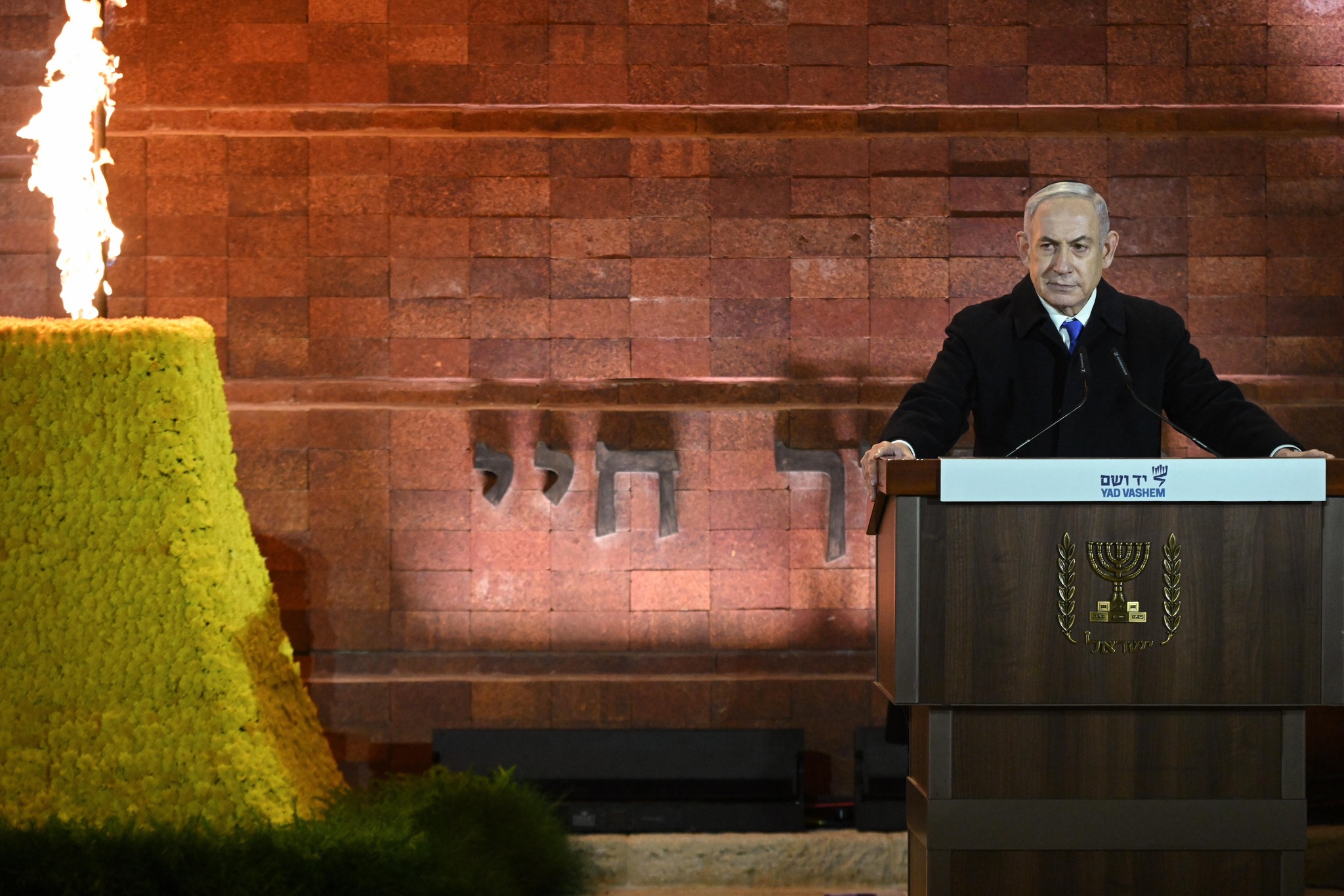
On May 20, Karim Khan, prosecutor of the International Criminal Court (ICC), announced that he has applied for arrest warrants for five Israeli and Hamas leaders. These include Israel’s Prime Minister Benjamin Netanyahu and Minister of Defence Yoav Gallant. This dramatic development marks the first time leaders of a western allied state have been accused of war crimes and crimes against humanity at the ICC.
Along with an expert panel that independently reviewed the evidence supporting the application, Khan concluded there are reasonable grounds to believe Netanyahu and Gallant are criminally responsible for starvation, murder, intentional attacks against civilians, extermination and persecution, among other crimes.
Khan alleges these acts are part of a common plan “to use starvation as a method of war and other acts of violence,” both to achieve Israel’s war aims and to collectively punish the civilian population of Gaza. Under international law, the crime of starvation includes not only the deliberate deprivation of food, but also other objects indispensable to human survival including water, medicine and fuel.
The crimes alleged against Hamas leaders Yahya Sinwar, Mohammed Deif and Ismail Haniyeh include hostage taking, murder, torture, extermination and sexual violence committed while in the context of captivity, among others.
Canada does not recognize Palestine as a state, while the majority of United Nations members do. Because the State of Palestine is a member of the ICC, it has jurisdiction over crimes committed by Palestinians on any territory, as well as those committed on Palestinian territory, including by nationals of non-member states like Israel.
State responses
While many ICC member states, like France and Belgium, have reacted positively to the application, others have been more cryptic. Canada, the United Kingdom and Germany have all joined the United States and Israel — who are not members of the ICC — in some version of the argument that issuing the warrants creates a false moral “equivalence” between Hamas and Israel.
Canadian officials refused to say whether Canada would support the ICC’s work with respect to the case against Israeli leaders. Foreign Affairs Minister Mélanie Joly said whether Canada would agree to execute any eventual arrest warrants should Netanyahu or Gallant visit was a “hypothetical” question.
While Deputy Prime Minister Chrystia Freeland said that “Canada respects the independence” of the ICC, Prime Minister Justin Trudeau said the request indicates a “troubling… sense of equivalency between the democratically elected leaders of Israel and the bloodthirsty terrorists that lead up Hamas.”
Like all ICC member states, Canada is under a general legal obligation to co-operate fully with ICC investigations and prosecutions in accordance with the Rome Statute, which is the basis of the ICC’s authority.
This doesn’t mean all member states must agree with every decision taken by the prosecutor in the exercise of his discretion, but it does imply that they refrain from actions that would frustrate the proper functioning of the ICC or deliberately contest its legitimacy.
The ICC has made clear member states don’t have discretion to “choose to co-operate with the Court … on the ground of a disagreement with the Court’s interpretation and application of the Statute.”
Obligation of co-operation
While we are certain to see challenges to the ICC’s jurisdiction and admissibility brought by Israel, it is not for other members of the ICC to question the authority of its decisions. In the event that Canada were faced, for example, with a request to arrest Netanyahu, it would be obliged to co-operate.
Unlike in the case against Vladimir Putin, Khan has chosen to go public with his request for warrants before they were issued by the ICC. He has done so to encourage both Israeli and Hamas leaders to change course in this conflict, and to reinforce “that the lives of all human beings” — both Israeli and Palestinian — “have equal value.”
This was a risky decision because it opened the door for political criticism that will not be as readily available once the ICC has decided there are reasonable grounds to issue warrants. While the harsh responses of the U.S. and Israel were entirely predictable, that so many ICC member states have followed the same line of attack is worrisome.
If and when arrest warrants are eventually issued, it would be wholly inappropriate for leaders of member states like Trudeau and U.K. Prime Minister Rishi Sunak to continue to characterize the warrants as “unhelpful.” To do so would undermine the findings of the ICC, and would be inconsistent with states parties’ general obligation of co-operation.
Canadian response
Now — before the ICC decides on arrest warrants — is the time for the Canadian government to decide whether it will continue to support the work of the ICC as it promised to do in the motion that passed on March 18.
Trudeau and Joly’s statements are inflammatory insofar as they rely on the racist and dehumanizing trope that contrasts western liberal civilization with the barbarous other. Their statements also encourage the position that crimes committed by a democratically elected government are less severe or blameworthy than crimes committed by non-state actors.
From the Allied atrocities during the Second World War through Vietnam and the so-called “war on terror,” history shows us that this simply isn’t true.
Under Prime Minister Stephen Harper in 2015, Canada was the only member state to oppose Palestine joining the ICC because “‘Palestine’ is not recognized by Canada as a state.”
Notwithstanding Canada’s recent abstention at the General Assembly on the question of Palestinian membership in the UN, it is now an open question whether Canada will oppose the ICC’s jurisdiction over the alleged crimes on the same basis. Given that the Court has already found that it has jurisdiction over territory occupied by Israel since 1967 for the purposes of the prosecutor’s investigation, as international law expert Tom Dannenbaum notes, such a challenge is unlikely to be successful.
Crucially, were Canada to contest the ICC’s jurisdiction after it issues arrest warrants, it wouldn’t be on the basis that reasonable grounds to believe that Israeli or Hamas leaders have committed international crimes were lacking. Instead, such a policy decision would rely on the premise that Palestinian lives are less worthy of protection than the lives of the nationals of other ICC member states.
Heidi Matthews, Assistant Professor of Law, Osgoode Hall Law School, York University, Canada
This article is republished from The Conversation under a Creative Commons license. Read the original article.




















