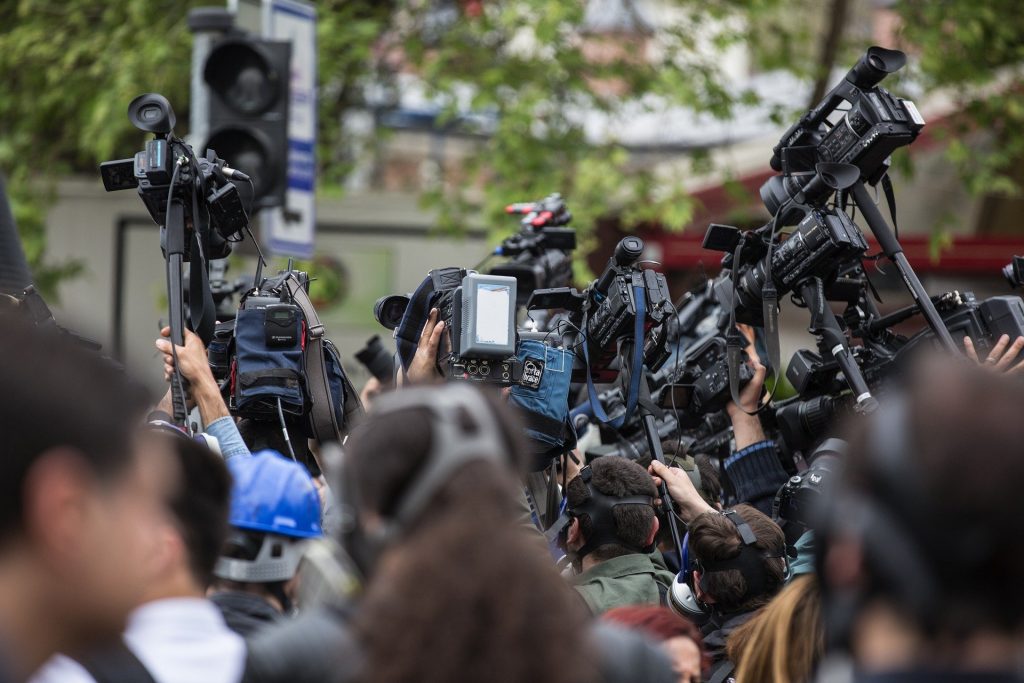
All of this has been made worse by open hostility towards journalists on social media, and the financial difficulties facing the industry as a whole. (Pixabay photo)
Just five years ago, the UK took the bold step of setting up a Media Freedom Coalition of 50 countries committed to protecting press freedom against its enemies in authoritarian states around the world.
But at home, journalists have been squeezed between new waves of restrictive legislation and a general decline in public trust in institutions, including traditional media. Barrister Geoffrey Robertson KC has written scathingly that UK law is “antipathetic to serious journalism” and must be reformed if the fourth estate is to effectively scrutinise the rich and powerful.
UK press freedom may soon face a crucial test over the possible extradition of Julian Assange. The WikiLeaks founder could face espionage charges in the US, dependent on ongoing legal battles and President Joe Biden’s recent suggestion that he may yet decide to drop the case.
All of this has been made worse by open hostility towards journalists on social media, and the financial difficulties facing the industry as a whole. On World Press Freedom Day, here are four key threats to press freedom in the UK.
1. Violence against journalists
Journalists continue to face violence around the world, and the UK is no exception. Five years ago, 29-year-old freelancer Lyra McKee was shot dead while witnessing a riot in Londonderry in 2019. Three men are due to face trial for her murder in a Belfast court. But the murder of investigative journalist Martin O’Hagan in Northern Ireland in 2001 remains unsolved.
The scale of violence against UK journalists was laid bare in a 2020 survey of over 300 members of the National Union of Journalists. More than half (51%) of respondents reported experiencing online abuse in the past year, while 22% had suffered physical assaults for their work. An overwhelming 78% agreed with the statement that “abuse and harassment has become normalised and seen as part of the job”.
2. Overly restrictive laws
Prominent media lawyer Gill Phillips says editors and journalists in the UK now face “a forest of legal traps and limitations”. This arises from laws on national security, libel, public order, privacy and data protection.
Government drafts of the 2023 National Security Act met howls of protest from newspapers. Opponents feared that investigative journalism and whistleblowers could be criminalised for legitimately handling information that could be deemed likely to “materially assist” a foreign power.
The government gave assurances on exemptions for journalists before the law came into effect, but not all are convinced. The lack of a public interest defence in national security legislation is criticised in a recent book by international lawyers Amal Clooney and Lord David Neuberger, who say it is an essential safeguard for states to comply with international law.
The instinct to prioritise government secrecy and discretionary powers over press freedom has a long history in UK law. For years the Investigatory Powers Act enabled MI5 and other agencies to access journalists’ communications without independent oversight, until the European Court of Human Rights and UK Investigative Powers Tribunal ruled it unlawful in 2020.
And in 2022 the arrests of four journalists at a Just Stop Oil protest on suspicion of conspiracy to commit a public nuisance were found to have been ordered by senior police officers.
3. Legal obstacles
Another particularly acute threat to public interest journalism in the UK is the stream of abusive legal actions, or Slapps (Strategic Litigation Against Public Participation).
Pre-publication letters and emails from law firms threatening to sue publishers or journalists for defamation often deter publication or water down the contents of reports, for fear of costly and drawn-out lawsuits brought by the super-rich.
In a notorious case in 2021 the government enabled the sanctioned head of the Wagner mercenary group, Yevgeny Prigozhin, to sue Bellingcat founder Eliot Higgins.
The news media have broadly welcomed the Anti-Slapp provisions related to corruption and financial crimes that were included in the Economic Crime and Corporate Transparency Act. As of yet there are no concrete plans for a standalone anti-Slapp law – broader and tougher legislation is needed to stop vexatious claims before they reach court.
4. Declining industry
These issues are playing out against the backdrop of a media industry being hollowed out. The latest Digital News Report by the Reuters Institute for the Study of Journalism found that hundreds of jobs were lost in national and local newspapers in 2022. Print circulation among national titles fell by up to 23% in a year, as news consumption on social media increases.
With fewer people willing to pay for skill-intensive journalism, publishers are demanding that artificial intelligence companies pay for copyrights on the materials they use to train their chatbots. AI newswriting tools already on the market are likely to hasten the slimming-down of newsrooms.
It’s not all bad news. The UK is still an exciting laboratory for digital newcomers in investigative and specialist journalism. The range of winners at the 2024 UK Press Awards shows newspapers’ enduring vigour and commitment to telling untold truths about scandals, from the dumping of human waste in our rivers to the errant behaviour of politicians.
And despite some of the recent legislation, the government has recognised the need to address the worsening environment for journalists by setting up a National Committee for the Safety of Journalists in 2020. The committee is proving to be a helpful forum for tackling some of the most serious challenges to press freedom in the UK.
William Horsley, International Director, Centre for Freedom of the Media (CFOM), University of Sheffield
This article is republished from The Conversation under a Creative Commons license. Read the original article.