
Lifestyle
From bridge to chess, why men outperform women at ‘mindsports’ – and what to do about it

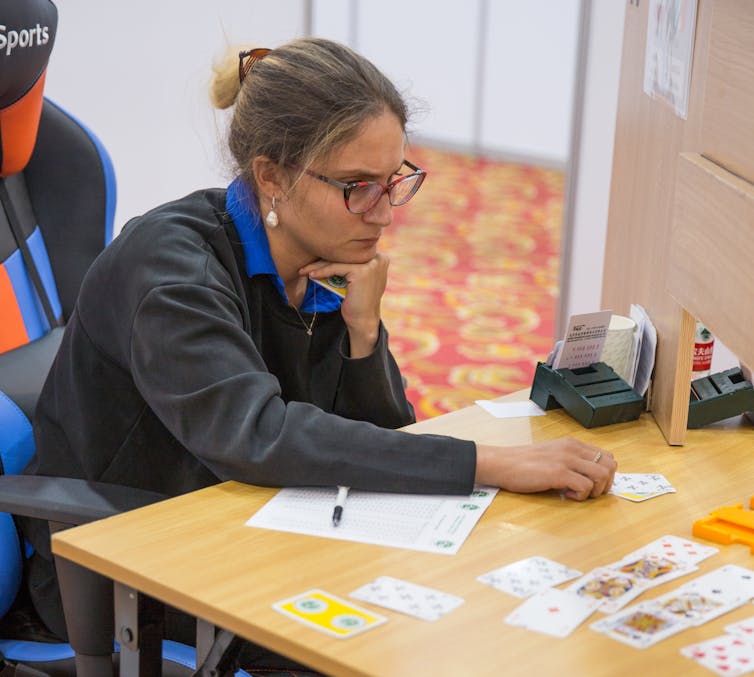
Francesca Canali from the World Bridge Federation, CC BY-SA
Why do men strongly outperform women at “mindsports” such as chess and bridge? Mindsports mainly use the brain and require skills such as memory, critical thinking, problem solving, strategic planning, mental discipline and judgment. Without physical differences in strength, how do we explain why the top level of such games tends to be dominated by men?
A defining characteristic of bridge, which I study, is that it is always played in partnership. Each game consists of four players divided into two pairs who compete against each other to win tricks. Major bridge events have open and women’s categories, often held concurrently, with very few women playing in the open.
While this allows women to compete at an international level, it feeds into perceptions about women’s inability to succeed at the highest level.
Women have limited visibility at the top levels of bridge. The chief tournament directors and those on international executive committees are most often men (although this is starting to change). The captains and coaches of the women-only teams are nearly always men. Female sponsors prefer to hire male professional players as partners and teammates.
Male domination at both the top levels of administration and of the game means there can be a lack of recognition of the structural barriers for women.
Research conducted by the academic project Bridge: A MindSport for All (Bamsa) found that gender stereotypes and “neurosexism” (claiming there are differences between female and male brains that can explain women’s inferiority), can partly explain differences in achievement.
That’s because sexist arguments that male brains are superiorly wired for logic and mathematics can be used to offer men more opportunities and training than women.
This is despite the fact that modern research shows there isn’t such a thing as a distinctly male or female brain. Most brains are a mosaic of what we think of as feminine and masculine features. And the more mixed our brains, the better our mental health.
The brain also changes a lot depending on our environment – if we are constantly encouraged or discouraged to do certain things, such as nurturing, this will affect our brain wiring – a process called neuroplasticity.
Research has also shown that when people are reminded of a negative gender stereotype, such as women not being good at maths or men not being good at emotions, they actually perform worse on tasks measuring such ability. Men also have higher levels of general confidence than women, which is a reflection of society and can be an advantage in mindsports.
In my research, I interviewed 52 top bridge players (20 women and 32 men) from Europe and the US. We discovered that some bridge players, both men and women, believed that female brains are simply better suited to emotion, nurturing and multi-tasking than to mental toughness and competitiveness.
I discovered that many used outdated neuroscientific arguments about the gendered brain as a purely biological organ, fixed in its processes and isolated from the external world. There seemed to be a general acceptance that male players are inevitably “better”.
The damage of such widespread beliefs is down to a general lack of knowledge of contemporary neuroscience. Neurosexist arguments and gendered stereotyping, whether intentional or not, create social barriers. These can have negative consequences on participation and inclusion in bridge and other mindsports.
Players themselves may also inadvertently engage in casual sexism and discriminatory language. In the competitive bridge environment, for example, “playing like a man” provides the most status for women. Such dialogue can become normalised “banter”, leading to less respect or recognition of the expertise of top female bridge players.
The Bamsa research suggests that men’s dominance in elite mindsport can ultimately be explained through historic and structural opportunities that privilege men rather than brain differences. For example, women may be constrained by factors such as childcare and other caring duties, which reduces time to practice, play and concentrate.
Research on chess has similarly shown that the underperformance of female chess players can be largely attributed to gender stereotypes and socialisation.
The paradox of women-only events
Given the everyday sexism that exists in the worlds of bridge, chess and beyond, women-only events are important spaces. These can help women develop and compete in a less pressured arena relatively free of discrimination and the male gaze.
The women-only game can be considered a valuable space given wider constraints and expectations of society. However, at the same time, the existence of the women-only game serves to reinforce deeply entrenched ideas about women’s abilities to play top-level tournaments. To get rid of women’s bridge or chess would be to remove a needed women-only space, but to keep it reinforces difference and skill-based inequality.
The paradox of the women’s game is that it both enables and constrains women, it is simultaneously both the problem and the solution. Given the complexity of the issue, there is no simple fix to the conundrum. What is clear is that stereotyping and sexism are unlikely to encourage younger women to dedicate the necessary time and effort to becoming an elite player.
Possible solutions include a gender policy at the world level, raising awareness and unconscious-bias training. The new Bamsa project is focusing on developing mindsport education in schools. The future continuity of bridge relies on it being inclusive and welcoming (as well as competitive and challenging).
As a result of the Bamsa research, the European Bridge League has recently also developed a gender policy that raises awareness of gender-based obstacles, suggests best practices and outlines what disciplinary action should be taken if the policy is breached. It is anticipated that this can be extended globally via the World Bridge Federation.
Samantha Punch, Professor of Sociology, University of Stirling
This article is republished from The Conversation under a Creative Commons license. Read the original article.




















