
News
Why Al-Aqsa remains a sensitive site in Palestine-Israel conflict

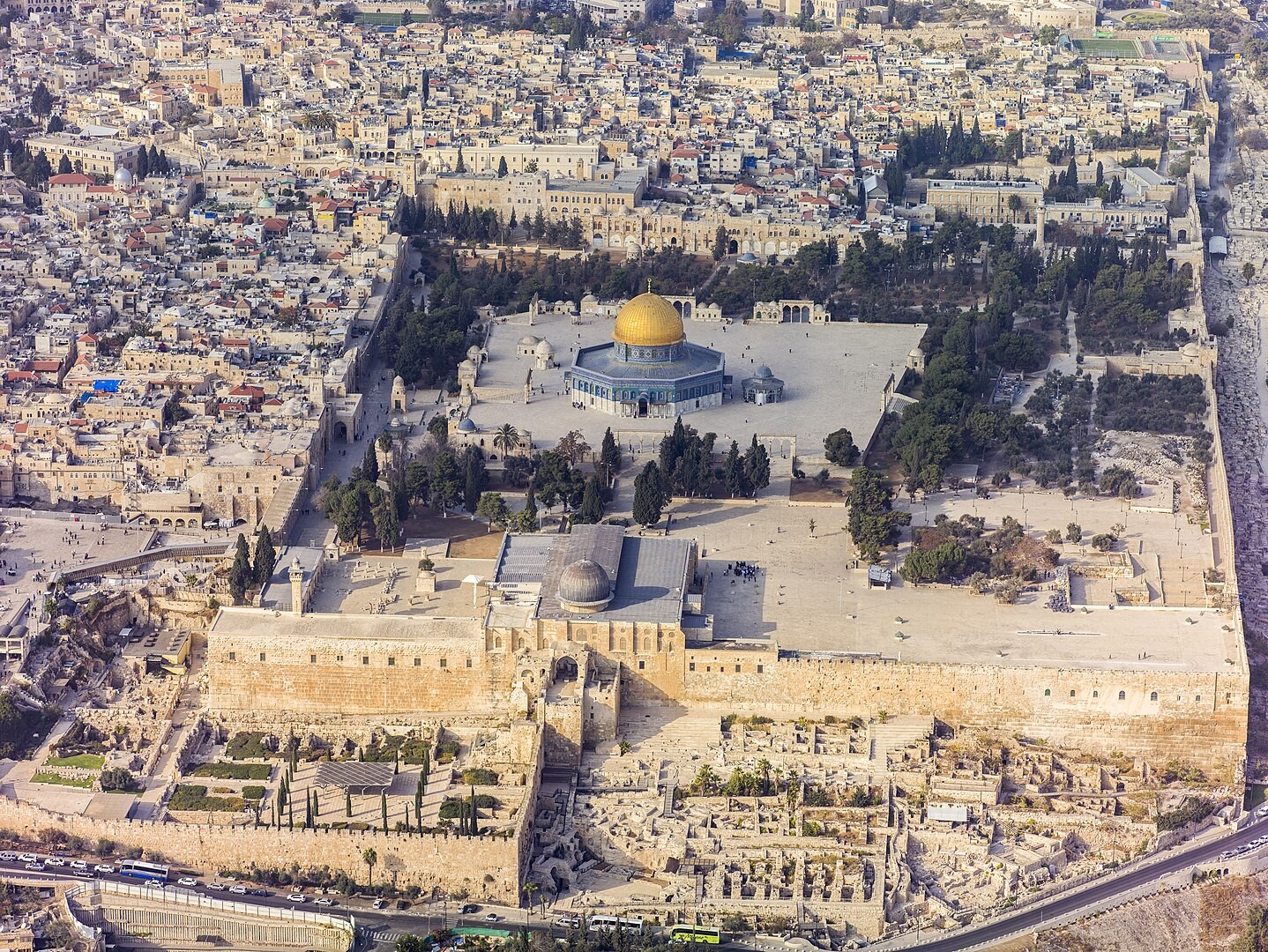
FILE: Southern aerial view of the Temple Mount, showing, Al-Aqsa Mosque. (Photo By Andrew Shiva/Wikimedia Commons, CC BY-SA 4.0)
As a scholar of global Islam, I teach an introduction to Islam course and include a discussion about Al-Aqsa as part of the syllabus. That’s because Al-Aqsa has deep religious significance for Muslims around the world.
But it is also important to highlight its remarkable political relevance for Palestinians.
These two facts make it a focal point for conflict.
The night journey of Muhammad
The Masjid al-Aqsa, or simply Al-Aqsa, means “the farthest mosque” or “the farthest sanctuary,” and refers to the lead-domed mosque within the sacred precinct of Haram al-Sharif – “the Noble Enclosure.” The precinct includes the Dome of the Rock, the four minarets, the compound’s historic gates and the mosque itself.
Mentioned in Sura 17, verse 1 of the Quran, the mosque is linked to the story of Muhammad’s “Isra” – the “night journey” from Mecca to Jerusalem – that in part confirms him as the last and most authoritative of the prophets for Muslims. The Quran says the prophet was “carried … by night from the Sacred Mosque [in Mecca] to the Farthest Mosque [al-Aqsa], whose precincts we have blessed.”
From there, it is believed that Muhammad ascended to heaven – called the Mir’aj. The Dome of the Rock – Qubbat as-Sakhra – is said to shelter the rock from where Muhammad physically ascended.
The mosque’s origins stretch back to the seventh century. It was first built in A.D. 637, just five years after the prophet’s death. It has been destroyed, rebuilt and renovated multiple times.
The current building largely dates to the 11th century and hosts daily prayers and Friday gatherings that draw large crowds. It lies adjacent to important Jewish and Christian religious locales, particularly the site of the First and Second Jewish Temples.
At times, the Dome of the Rock – a shrine – and Al-Aqsa – a mosque – have been confused as one and the same. While part of the same “Noble Sanctuary,” they are two distinct buildings with different histories and purposes.
However, the term Al-Aqsa is sometimes used to indicate the entire “Noble Sanctuary” complex. Originally, it is believed that the term “the farthest sanctuary” referred to Jerusalem as a whole.
Place in Islamic history
After Mecca and Medina, the vast majority of Muslims worldwide consider Jerusalem the third-holiest place on Earth.
Referenced frequently in Islamic tradition and hadith – records of something the Prophet Muhammad said, did or tacitly approved of – it is believed that while in Mecca, Muhammad originally oriented his community’s prayers toward Al-Aqsa.
In A.D. 622, the community fled Mecca because of persecution, seeking refuge in Medina to the north. After a little over a year there, Muslims believe God instructed Muhammad to face back toward Mecca for prayers. In Surah 2, verses 149-150, the Quran says, “turn thy face toward the Sacred Mosque [the Kaaba in Mecca] … wheresoever you may be, turn your faces toward it.”
Nonetheless, Jerusalem and its sacred locales – specifically Al-Aqsa and the Dome of the Rock – have remained sites of Islamic pilgrimage for 15 centuries.
The ‘most sensitive site’ in conflict
Given its sacred significance, there was great concern about the precinct’s fate after Israel’s victory in the 1967 Arab-Israeli War and its subsequent annexation of East Jerusalem.
Although Israel granted jurisdiction of the mosque and complex to an Islamic waqf – “endowment” – Israel still commands access to the grounds and security forces regularly perform patrols and conduct searches within the precinct. Under the Preservation of the Holy Places Law, the Israeli government has also allowed entry to different religious groups – such as Christian pilgrims.
Many Israelis respect the sanctity of the place as the holiest site in Judaism. In 2005, the chief rabbinate of Israel said it is forbidden for Jews to walk on the site to avoid accidentally entering the Holy of Holies – the inner sanctum of the Temple, believed to be God’s dwelling place on earth. Nonetheless, certain ultra-Orthodox Jewish groups controversially advocate for greater access and control of the site, seeking to reclaim the historic Temple Mount, in order to rebuild the Temple.
Described as “the most sensitive site in the Israel-Palestinian conflict,” it has frequently been host to political acts.
For example, in August 1969, an Australian Christian named Dennis Michael Rohan attempted to burn down Al-Aqsa, destroying the historically significant and intricately carved minbar – or “pulpit” – of Saladin, a treasured piece of Islamic art.
On Sept. 28, 2000, Israeli opposition leader Ariel Sharon and a delegation guarded by hundreds of Israeli riot police entered the precinct. This sparked protests and a violent crackdown by Israeli authorities, with multiple casualties. Many Muslims worldwide considered this a “desecration” of the sacred mosque, and the event helped ignite the Second Intifada, or Palestinian uprising.
Tensions peaked again after an attack on Yehuda Glick, a controversial right-wing rabbi, in autumn 2014. In response, Israeli authorities closed down access to Al-Aqsa for the first time since 1967. In March and April of that year, Israeli police used tear gas and stun grenades on Palestinians inside Al-Aqsa, prompting an international outcry.
Numerous other incidents between Israeli forces and worshipers have occurred at Al-Aqsa in recent years.
Controlled access to the site reminds Palestinians of their relative powerlessness in their ongoing land disputes with Israeli authorities. At the same time, attacks at Al-Aqsa resonate with Muslims across the world who react with horror to what they see as the desecration of one of their most sacred sites.
Defending Al-Aqsa and fighting for rights to access it, I argue, have become proxy conflicts for both Palestinian claims and the need to defend Islam as a whole.
This is an updated version of a piece originally published on May 12, 2021.
Ken Chitwood, Senior Research Fellow, Muslim Philanthropy Initiative at IUPUI and Journalist-fellow, USC Dornsife Center for Religion and Civic Culture, University of Southern California
This article is republished from The Conversation under a Creative Commons license. Read the original article.




















